

Opinion: Regulators aren’t the main reason for your spiking energy bills
The officials who oversee Pepco don’t have control over a majority of the increases in your bill, writes Public Service Commission Chairman Emile C. Thompson.
The officials who oversee Pepco don’t have control over a majority of the increases in your bill, writes Public Service Commission Chairman Emile C. Thompson.
Steep city budget reductions mean patients are going without medicine, losing teeth, and living with pain.

They collect memorabilia and create tributes to the iconic system.

Handing out water every day has made Alan a fixture at this Brightwood intersection.


Earlier this month, Alan stood at his usual post on a median on Missouri Avenue, surrounded by the chaotic rhythm of the busy intersection. He handed water bottles to drivers, receiving — but never asking for — a few crumpled dollars in return. But it was not a usual day, as the city-owned trucks that rolled into the nearby gas station parking lot reminded him. He had to move.
Alan, who goes only by his first name to protect his privacy, is the founder of Alan’s Oasis, a “hydration supplementation station location” that operates at the Brightwood intersection. For 12 hours a day, Alan “passive-aggressively panhandles,” as he calls it, pacing up and down the intersection, stopping to tell a repeat customer a joke or inform someone their headlight is out. Once or twice an hour, he’ll receive $20. Every now and then, he gives out a miracle bottle — $100 in exchange for one bottle of water.
His business model, giving away water to people driving by instead of selling it, has made him a local celebrity. Alan’s “a fixture” in the neighborhood, A’Lexa Hawkins, one resident, said. Reddit threads describe him as a “kind man” and a “great guy.” One post calls his oasis “one of my favorite sites in D.C.”
Though Alan no longer lives on the street, the city still classifies his makeshift water station as an encampment, which the Office of the Deputy Mayor for Health and Human Services (DMHHS) defines as the accumulation of personal belongings on public property.
DMHHS conducted the encampment clearing at his intersection on March 11. Alan said this was the first time the city had forced him to clear his set-up in almost four years, though DMHHS said Alan has previously complied with requests to move his wares, including during closures in 2022 and 2023. Although Alan quickly returned, the future of his oasis is uncertain.
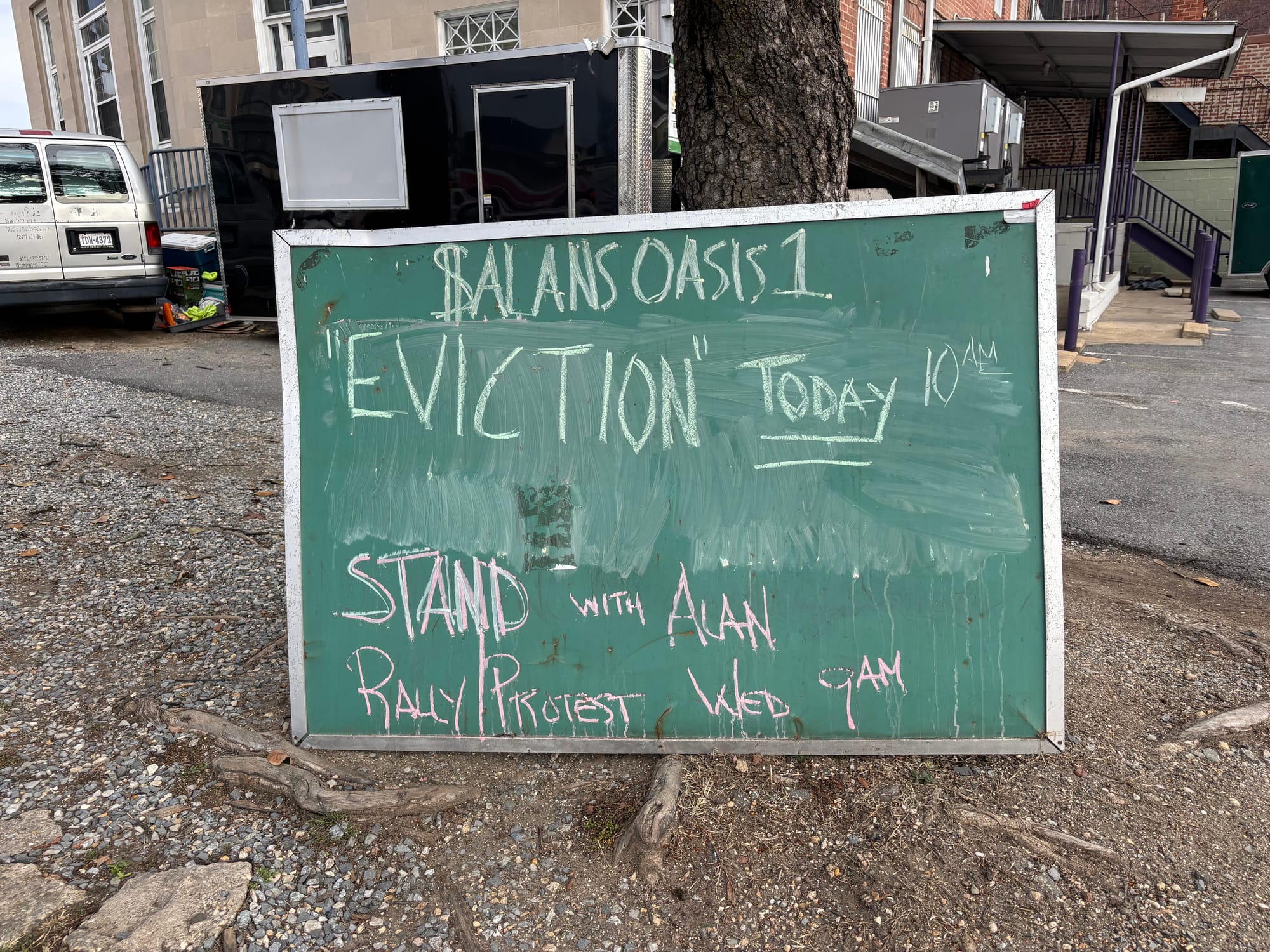
Alan originally thought he’d lose his oasis in early September, when he found a notice posted on his sign suggesting the area would be cleared later that month. For the next three weeks, he fought to get the clearing canceled. Every hand that stretched from a rolled-down window was met with a plea to call the city to complain, post on Reddit, or attend his self-planned protest the day of what he called his “eviction.”
On that day, though, the city never came. A DMHHS spokesperson later told Street Sense there had been a misunderstanding — the closure was not targeting Alan's hydration station, but a tent nearby. When Alan discovered the tent had been abandoned, he threw it away. The city canceled the closure.
According to the spokesperson, the notice was posted on Alan’s belongings for awareness, in case the person who lived in the tent also owned the things on the median.
But Alan said he was never told the closure was just for the tent. He spent three weeks thinking about the clearing constantly. He was relieved DMHHS didn’t show up, but also sad that no one showed up to his protest.
In the months since, Alan has continued to run the oasis while struggling to find housing. In the fall, he was living in a tent on a gas station's property — the owner let him live there because he acted as a security guard at night — but he said he had to leave when the company found out.
Eventually, he was able to save enough to move in with his friend. During one of D.C.’s most severe cold spells in recent history, he was able to sleep in a bed and have access to a kitchen. Still, he worries about his revenue from the oasis dipping and impacting his ability to pay rent in the crowded shared house.
(Alaena Hunt)
On Feb. 23, Alan found a notice posted on a pole near his hydration station, informing him of a cleanup on March 11. “Any property not stored or removed from within 200 feet of this notice by the scheduled clear time is subject to removal and immediate disposal,” it read. Again, there was an abandoned tent in the area, so Alan hoped that once he disposed of it, the city would cancel the closure.
In another attempt to stop the clearing, he shrank his oasis to just a sign and his cooler.
“All day I'm trying to fucking figure out how I'm gonna get through this, because I ain't got nobody to help me,” Alan said after the sign was posted.
But on the morning of March 11, the trucks rolled in, and the city’s encampment team appeared. The team told Alan’s case manager he was a safety hazard — he had to move.
“The safety of all residents and drivers who traverse this intersection daily is our highest priority. No resident is allowed to hoard bulk items on this [District Department of Transportation] space due to the extreme safety hazard that it presents to the traffic patterns of Georgia and Missouri Ave NW,” a spokesperson from DMHHS wrote in an email.
The city often references safety concerns when deciding to close an encampment, including when people are set up close to a road and at risk of being hit by vehicles. But Alan finds this argument frustrating, because he considers himself a guardian over the intersection. Alan said he stops traffic when police cars or ambulances drive by, and he yells at drivers who get confused by the chaotic intersection and drive into oncoming traffic.
“I'm actually a safety benefit for them,” he said.
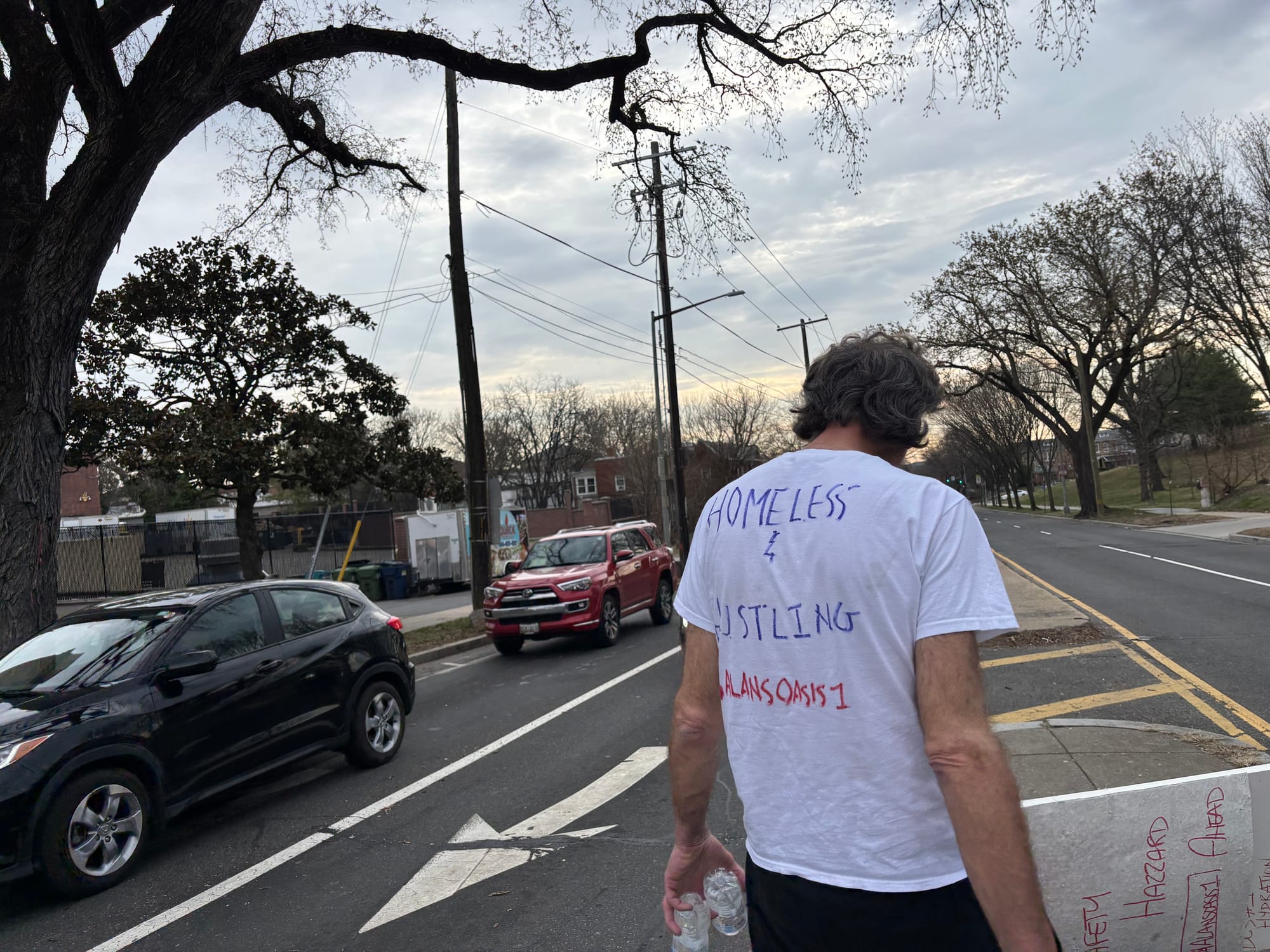
On the day of the closure, Alan took off his usual attire — a shirt that reads “Alan” on the front and “homeless and hustling” on the back. He wrote “Safety Hazard” in big lettering across the front of a new shirt and put it on.
A couple of minutes before 10 a.m., when the closure would begin, the intersection was bustling with members of DMHHS and outreach workers. Alan decided to move his things off the median, so he did not risk losing his signs. A friend helped him carry them to the side of the road.
Hawkins, a concerned neighbor who came to make sure that Alan was okay, told Street Sense that if Alan had to close his oasis, “I would feel like we really failed.”
“As a community, as a city, we didn't support people who were industrious and positive and doing something good for the community. And when he needed us most, we weren't there,” she said.
The city has told Alan he needs to keep the space clear. According to a DMHHS spokesperson, “Continued compliance by this resident will avoid the need for further Protocol enforcement actions on this space as it has been deemed unsuitable for the housing or hoarding of personal items.”
While Alan has continued to operate his oasis since, he’s been hesitant to put up too many signs. Business has been down as a result. Now that the city has cleared him once and told him he needs to keep the space clear, he worries about the future.
While Alan walks up and down the median for hours, his thoughts are sometimes consumed by how little money he’s making. Other times, he thinks about “the fact that this whole life is meaningless.”
For now, he tries to find meaning in his oasis. One of his signs reads, “be safe, be kind, be well, be loved, be LOVE.” He added the last one, “be love,” because you can’t make yourself “be loved,” but you can “be love,” he said. That’s what he tries to do.

The D.C. soccer team heads back to Audi Field with their star forward, new uniforms, and hopes for another championship run.


The Duke Ellington School of the Arts graduate was recently named artistic director of the country's fourth-largest Black dance company.


The history of D.C.'s official dance.


By creating content, merch, and experiences that are for and about Chocolate City

With your help, we pursue stories that hold leaders to account, demystify opaque city and civic processes, and celebrate the idiosyncrasies that make us proud to call D.C. home. Put simply, our mission is to make it easier — and more fun — to live in the District. Our members help keep local news free and independent for all: