

Dance & taxes: Your weekly Civics Roundup
Plus, a clothing swap, a cooperative movement meeting, and more ways to get involved.
Plus, a clothing swap, a cooperative movement meeting, and more ways to get involved.

From the schedule to Trump's role in the park's restoration.

Feds say the 15th Street protected bike lane will cause more traffic during cherry blossom season, but bike advocates say it makes everyone safer.

The debate over putting housing above a beloved public library continues.

Four years ago, Mayor Muriel Bowser stood outside an aging public library and community center in Chevy Chase and outlined ambitious plans to build more affordable housing in wealthy Ward 3 — including at sites like that one.
“It’s our challenge to make that happen across all eight wards of Washington, D.C.,” she said to a crowd of people. “I know you’re with me on that.”
And in theory, many of them were.
But Bowser’s recently released plans to build dozens of units of affordable housing for low-income residents at that very location — the Chevy Chase Civic Core on upper Connecticut Avenue NW — have sparked widespread criticism, some of it even coming from her erstwhile allies.
They say that too much of the housing Bowser wants to build there will be market-rate, amounting to a giveaway of public land to a developer. And they quietly worry that the proposal — which would have the developer also build a new library and community center, along with open space and retail — could again embolden the not-insignificant number of residents who fought against building any housing at all.
D.C. officials say the proposal is a realistic balancing act in a highly engaged neighborhood that has been divided over the fate of the Chevy Chase Civic Core for years. Some residents agree; any affordable housing is better than none, they argue. But others still marvel at how Bowser seems to have united once-competing factions against her proposal.
“Certainly those against any housing aren't happy,” said Advisory Neighborhood Commissioner Peter Gosselin, who represents a portion of Chevy Chase, at a somber public meeting on Wednesday evening. “But many who want affordable housing have to be disappointed too.”
Residents have been deeply divided about what should come of the Civic Core — located blocks from the Maryland line in one of D.C.’s toniest neighborhoods — but they all agree that something needs to be done.
The 1.7-acre site includes two uninspiring 1960s-era buildings — the public library and the community center — along with a playground, basketball court, outdoor space, and parking. For at least a decade, residents have been clamoring for the library and community center to be rebuilt. Despite their ages and modest sizes, both facilities are amongst the most heavily used in the city.
Discussions about possible renovations picked up amid a national reckoning around racial injustice in the wake of the killing of George Floyd, which raised uncomfortable questions about Chevy Chase, a leafy and liberally minded neighborhood with a history of racial covenants that kept Black residents out. (In 2023 Chevy Chase was 61% white; D.C. as a whole is 37% white.)
Those conversations dovetailed with Bowser’s push for the construction of 36,000 housing units across the city. (When the campaign successfully concluded last year, Ward 3 had contributed significantly less than any other part of the city — especially for affordable housing.)
The two issues were seen as intertwined: Chevy Chase had in the past worked to exclude Black residents, and now Bowser and some residents felt it was time to reverse course and build more affordable housing to help diversify the neighborhood. (The median home sale price in Chevy Chase has hovered around $1.5 million for years.)
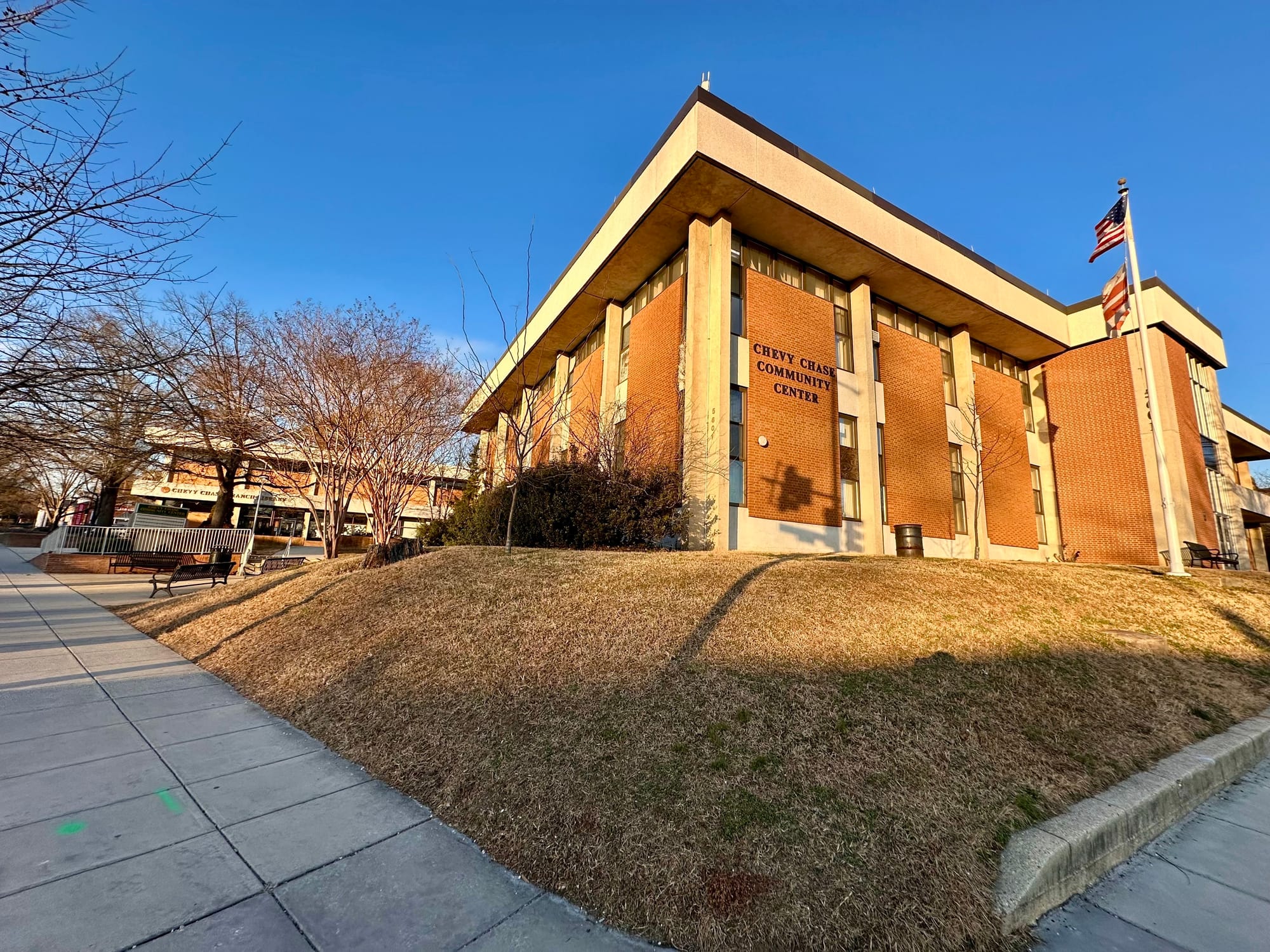
D.C. has a long history of selling or giving away public land to developers and negotiating requirements like affordable housing in the process. But in Chevy Chase, Bowser wanted to expand on that approach by requiring that they rebuild the public facilities in addition to adding housing on top.
The only other project of its type is in the West End, where an old police and fire station was given to a developer, who rebuilt the fire station, added a new public library, and put both affordable- and market-rate housing on top.
Proponents of such projects say they can minimize cost to the city, while residents get fully rebuilt public facilities and additional housing — often in desirable areas. Critics, though, say these arrangements amount to an unnecessary giveaway to private interests. Bowser’s similar plan to turn over an aging fire and police station on U Street for a redevelopment project has faced steady opposition.
In Chevy Chase, D.C. started laying the groundwork for the Civic Core project three years ago, and put out a call for development proposals in early 2024. Meanwhile, residents argued. Some fought the idea of any housing at all, saying a new building would overwhelm the neighborhood. Others insisted that if there was to be any housing, it should broadly target lower-income and working-class residents. There were concerns about parking, impacts on local businesses, and whether local schools could accommodate more kids.
The tenor of some of the debates was – well, the words “divisive,” “angry,” and “embittered” have been tossed around plenty. A local ANC endorsed putting housing on the site in 2023; last year, though, a new slate of commissioners went in the other direction, urging the city not to include any housing at all. Ironically enough, over that same time period public opinion in the neighborhood seemed to move more towards accepting housing – especially if it was affordable. (The ANC conducted two surveys, one in 2023, the second in 2025.)
Ultimately, eight development proposals were presented to Chevy Chase last March. They all included housing — between 100 and 200 units on top of the new library and community center — with many of them fully affordable for different income levels.
Last week, Bowser made the great reveal: Her administration chose a proposal from Rift Valley to build a new library and community center, and add 177 units of housing on top — 54 of which would be affordable for some of D.C.’s lowest-income residents. The project would also retain open space, put parking below ground, and add retail.
But while the debate to get to this point has been divisive, a strange type of unity seems to have followed Bowser’s announcement: Plenty of people are equally unhappy with what she unveiled. On one end, residents who don’t want housing on the site — and even some who do — say that 177 units is just too many. A separate group argues that, regardless of the overall size of the building, there’s just not enough affordable units.
“I’m surprised and disappointed,” says Anne Schwartz, a Ward 3 resident and member of the Washington Interfaith Network, which lobbied the neighborhood’s residents to accept affordable housing on the site. “A proposal that initially had over 100 units of affordable housing is now down to 54. We’re trying to understand what happened.”
In Rift Valley’s initial proposal, there were supposed to be 137 units of affordable housing and 69 of market-rate: two-thirds for the former to one-third of the latter. But in the proposal Bowser unveiled, that flipped. (And it's the bare minimum: Under D.C. law, 30% of any housing units built on public land have to be affordable.) That fact is driving criticism from proponents and opponents of housing alike.
“From the very beginning, many people were suspicious that this would be a developer giveaway,” says Bruce Sherman, an ANC commissioner who voted last year to urge the city not to build any housing at all. “That is to say, a bait-and-switch proposition. Promise a lot of affordable housing up front, but at the end of the day, tilt towards market-rate housing.”
For Sheryl Barnes, a member of Chevy Chase Voice, which has loudly opposed the project, the big fear is that by ceding the land to a developer the neighborhood risks losing what is now plainly public space. “It’s the only community commons we have where we meet and mingle on equal terms … and that’s the way it should stay,” she says.
Barnes also says there are other larger plots of public land in Ward 3 that could be used for affordable housing, including portions of the University of the District of Columbia campus in Van Ness.
In an interview with The 51st, Deputy Mayor for Planning and Economic Development Nina Albert says that the Rift Valley proposal was chosen in part because it best balanced what were divergent and passionate opinions on what should happen at the Civic Core.
“Some folks wanted this site to be 100% affordable housing, and other parts of the community wanted zero development. We believe that this proposal actually balances all of the community’s asks and needs very elegantly,” she says.
Albert points out that the housing units will be a range of sizes — from studios to three bedrooms — and targeted toward residents making 30 to 50% of the area median income ($46,400 to $77,500 for a family of four). And that's significant, at least symbolically. Historically, D.C. has spent less money on housing for those income ranges, prompting critiques that it has ignored some of the city’s most vulnerable residents.
It’s that specific targeting of the 54 units of housing that draws praise from Karrenthya Simmons, the ANC commissioner who represents the district where the Civic Core is located. “I think any affordable housing is a win,” she says. “We’re never going to be able to solve the affordability crisis through just this project site, but any little bit of affordability will help.”
Lisa Gore, another ANC commissioner who has been pushing for housing on the site, also takes the pragmatic approach, urging her neighbors not to make the perfect the enemy of what she sees as the good. “100% affordable is not realistic,” she says, especially as the city’s finances have soured in recent years. (Affordable units often require additional public subsidies.)
Still, Gore recognizes that Bowser’s proposal hasn’t won many people over — even those predisposed to supporting it. Even she has concerns; it's too many units all told, she says.
“The community — and this is typical with Chevy Chase — is highly engaged and you have camps that see this project very differently and each camp has very specific goals of what they’re looking for,” she says. "I don’t think that when they looked at the proposal and saw the number of units and the affordability mix that they felt like they were getting what they wanted."
Differences of opinion can also be seen at the D.C. Council, which will ultimately have to approve a critical part of the plan — giving the public land away to the developer. (It’s known as “surplussing” in government lingo.) Ward 3 Councilmember Matt Frumin says he wants housing at the Civic Core but "there are still details to be hashed out" about how much and what types. There's plenty of process to come, he adds: "Let’s get input and see how the curve can be bent on key issues people have raised."
Ward 4 Councilmember and mayoral candidate Janeese Lewis George — who represents part of Chevy Chase — argues that it’s too much market-rate housing. She says that the proposal buttresses her case for social housing, a model where the government pays for the entire project and then rents from mixed-income tenants helps sustain it. “At the end of the day, in order to build the truly affordable housing we need in the District, you have to take away profit as the goal,” she says.
So what happens next? Albert says a package will eventually be sent to the council for its consideration, but there’s no firm timeline yet. One it's sent over, that pacckage will give lawmakers a better sense of the dollars and cents of the proposal, including what it would cost to increase the number of affordable units.
For Schwartz and other affordable housing advocates, the goal now is not to let the current criticisms of Bowser's pick derail the project in its entirety. “People have been worrying from the start that the whole thing could fall apart,” she says. “We’ve invested a lot of time. We’re a long way from throwing in the towel.”
But Gosselin, one of the ANC commissioners who has supported housing at the Civic Core, seemed more pessimistic during a public meeting he hosted to hear feedback on Wednesday night. “The fact that neither side gets what we want says it might be a good time to open a new chapter,” he said. “One that’s a little less rancorous and with a little more listening on both sides.”

Feds say the 15th Street protected bike lane will cause more traffic during cherry blossom season, but bike advocates say it makes everyone safer.

The three-month sprint to the June 16 primary election is on.

It never became the network D.C. promised, but it did shape life along the corridor.


The GOP's latest attempt to interfere with local affairs would also stop the city from banning right turns on red.
With your help, we pursue stories that hold leaders to account, demystify opaque city and civic processes, and celebrate the idiosyncrasies that make us proud to call D.C. home. Put simply, our mission is to make it easier — and more fun — to live in the District. Our members help keep local news free and independent for all: