


A new map is fueling a debate on housing and displacement in D.C.
Critics of the proposed Future Land Use Map say it isn't thinking big enough.

I often played SimCity when I was a teenager, a once-popular computer game that allowed you to design, build, and run a fictional city.
The first step was deciding where things would go, and you’d do that by designating large blocks of land for specific uses — placing parks next to the residential area, for example, office buildings somewhere downtown, and industrial land on the outskirts.
It turns out that wasn’t actually far from how these things work in real life, and right now D.C. is going through its own SimCity-like process to determine what gets built where for the next quarter-century. It’s called the Future Land Use Map, and the city is asking for the public’s input on a new version.
Sound nerdy and technical? Absolutely. But it’s also consequential: If you’re the type of person who thinks that D.C. needs way more apartment buildings, for example, this will guide whether and where that can happen. The new draft map is also political, rekindling long-running debates over how D.C. uses its land — and whether it could be using it to build more housing.
Below is what you need to know about the FLUM.
What exactly is the FLUM?
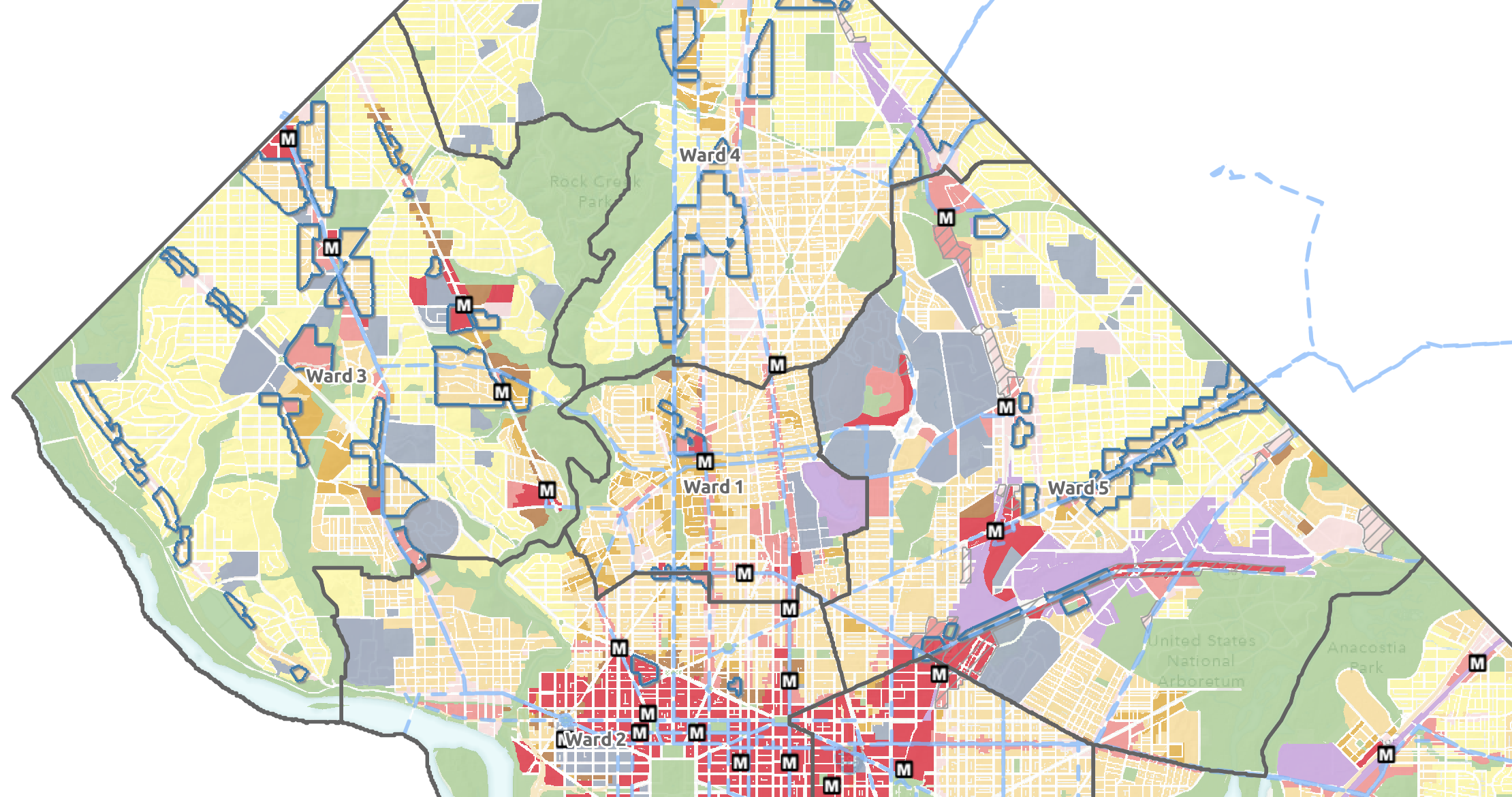
The Future Land Use Map is exactly what it sounds like: a map designating which parts of D.C. can be used for what purposes, whether it’s high-density housing, office buildings, industrial land, or park space. And it’s forward-looking, setting those development expectations for decades. In this case, the newest draft of the FLUM — which was unveiled by the D.C. Office of Planning last month — would carry D.C. through 2050.
“The FLUM is a guide to where we as a city see changes, the vision for the future uses of the city,” says Cheryl Cort, the policy director for the Coalition for Smarter Growth.
The FLUM is also a critical component of the city’s Comprehensive Plan, the policies, priorities, and regulations that guide development and growth throughout D.C.
Why is a new FLUM being debated now?
Last year, D.C. kicked off the first wholesale rewrite of the Comprehensive Plan since 2006, an initiative city officials are calling D.C. 2050. (There were targeted changes made to the Comprehensive Plan in 2021, though.)
The goal of the D.C. 2050 initiative, according to the D.C. Office of Planning, is to plan for expected growth. That could include up to 165,000 new residents and 116,000 more households over the next quarter century. (D.C. currently has roughly 693,000 residents and 325,000 households.)
Part of the full rewrite includes adopting a new FLUM, which will then help guide further decisions and policies on what gets built where.
What changes have been proposed?
For large swaths of D.C., the proposed FLUM doesn’t make any real changes. Residential neighborhoods from upper Northwest to the far reaches of Southeast would remain the same.
But it does include some increases in density along large corridors in Ward 3, where the city’s most expensive neighborhoods are, as well as similar changes in portions of Wards 4, 5, 7, and 8. And in many of those places, the Office of Planning says the changes would allow for more “middle” housing like rowhouses, duplexes, and small apartment buildings where single-family homes may now be the norm.
The Office of Planning says that its proposed changes were aimed at increasing housing along transit networks, distributing affordable housing equitably across D.C., and allowing more types of housing across the city. It says the goal was to increase the city’s capacity by 25,000 households.
In an interview with The 51st, Anita Cozart, the director of the Office of Planning, said the proposed changes to the FLUM are “modest but targeted.”
How have people reacted to the new FLUM?
For many urbanists, modesty is a missed opportunity to swing for the fences — especially when compared to places like Portland and Minneapolis, which have made more dramatic changes to allow for more housing construction.
While some give the Office of Planning credit for pushing to increase density in portions of Ward 3 — where housing prices have been highest and overall housing construction lowest — they also say that the draft FLUM doesn’t do enough to chip away at the single-family residential zoning that dominates large parts of D.C..
“I appreciate its focus on opening up Ward 3 to find new ways to accommodate different kinds of housing opportunities. That’s something we’ve been working on for a long time because it’s very hard to build housing in Ward 3,” says Cort. “But it’s not expressing a big enough vision for ensuring more people can live in neighborhoods they’d like to live in.”
There’s also concerns that the proposed FLUM’s modesty will ultimately do little to achieve one of its stated goals: bringing down housing prices.
“The Office of Planning has stated its goal plainly: keep housing prices from rising faster than inflation. That is not an ambitious enough target. When housing costs already consume a third or more of income for nearly half of D.C. renters — and more than half of Black renters — holding the line on price growth still leaves the crisis intact. The goal must be to reduce housing costs — and that requires building significantly more homes than D.C. 2050 currently envisions,” says Ward 1 ANC Commissioner Josh Jacobson, who created a website outlining his criticisms of the proposed map.
The fate of the proposed FLUM is also running head first into the current election cycle. Within days of the Office of Planning unveiling the map, candidates for mayor, D.C. Council, and D.C. delegate to Congress alike were lambasting it as a missed opportunity to increase density across the board.
Mayoral candidate Janeese Lewis George said the proposed FLUM was “codifying exclusion,” while fellow contender Kenyan McDuffie argued that it “simply does not allow dense development in the places where the city needs it most.” Gary Goodweather and Rini Sampath, who are also in the mayoral race, spoke at a rally hosted by the pro-growth D.C. YIMBYs, similarly arguing that the proposed FLUM wouldn’t allow enough housing construction across the city.
But what about displacement?
There are other groups who similarly dislike the proposed FLUM, but for a different reason: They say the proposed new density would actually lead to displacement of low-income residents.
“Density is a tool, not a comprehensive solution or a vision for our communities,” said the Committee of 100 for the Federal City, a longtime civic advocacy group, in a statement on the proposed map. “Just increasing density enriches real estate speculators and developers and furthers displacement, all at the expense of our communities.”
That view is shared by Empower D.C., which organizes tenants. “Changing the land use maps gives developers an upper hand,” says the group, “thereby eliminating their need to consult with and make concessions with communities seeking greater affordability.”
Interestingly, Cozart told me that the Office of Planning has been sensitive to these arguments. “When you increase housing capacity, that does put market pressure on certain neighborhoods, and particularly it puts market pressure on renters, right?” she said. “If we do a mass upzoning across the board without really thinking of those impacts, that signals to some people that there’s a desire for those individuals to move. That’s not the objective.”
She says her staff looked at where the potential for displacement could be highest if density were suddenly increased, and opted against increasing it there in order to protect existing residents. And that partially explains why some of the map’s bigger changes focus on Ward 3; many of the residents there are already middle- or high-income, and are thus less likely to be priced out if density is increased.
What’s next?
This proposed FLUM is just a draft. With input from the public, the Office of Planning will head back and make changes. Have thoughts of your own? There’s an online survey here.
This fall, the Office of Planning will unveil a proposed new Comprehensive Plan, which will kick off a roughly nine-month process of public comment before a draft is formally submitted to the D.C. Council in June 2027.

Read next

Does your tap water smell like chlorine? There’s a reason why.
You're not imagining things — but the water is perfectly safe.

Everything to know about Malcolm X Park’s closure
From the schedule to Trump's role in the park's restoration.

Wilson Building Bulletin: Moves toward transparency for federal agents
Also: A proposed ballot initiative on a foie gras ban advances, and a new tax may come for disposable wipes.

Poopy Potomac no more? D.C. lifts advisory for river after sewage spill
But environmentalists say more has to be done to convince people the waters are safe