


D.C. residents saw Pepco bills skyrocket this winter
The cold weather is only part of the story.

When cold weather arrives, most people expect to see a bump in their utilities. But many D.C. residents were shocked to see their electricity bills had doubled and even tripled this winter — in some cases, climbing over $1,000 in a single month.
“Your first thought is that it's something you're doing wrong,” said Rawan Abhari, whose February Pepco bill topped out at $303 and whose next bill is projected to be at least $400. But after reading stories about other residents going through the same thing, she realized the problem was bigger than just her household.
Dozens of 51st readers reached out with similar experiences: a $600 bill for a two bedroom apartment; over $400 for a one bedroom.
It’s hitting home for D.C. lawmakers, too. Ward 4 Councilmember Janeese Lewis George said she received a Pepco bill for $899. For At-Large Councilmember Robert White, it was $1,100.
Pepco customers say that these bill increases are unsustainable, and that they’re at a loss about what to do about them.
“My bill quadrupled the past two months and I don’t know what to do to fix it,” emailed Alexander, a D.C. resident who asked to go by his first name to maintain his privacy. He lives in a 750 square foot one-bedroom apartment, and says his Pepco bill climbed to $400.
The 51st dug deep into why your electricity bills are rising, and what’s being done about it.
What does Pepco have to say?
The utility has pointed to the region’s historically cold winter as a cause of rising heating demand and costs. “December 2025 was the coldest December in ten years, followed by a January that also ranked the coldest January of the past decade,” read a February press release.
But in an email to The 51st, Pepco’s own data show that their D.C. customers actually used more energy in January 2025 than January 2026.
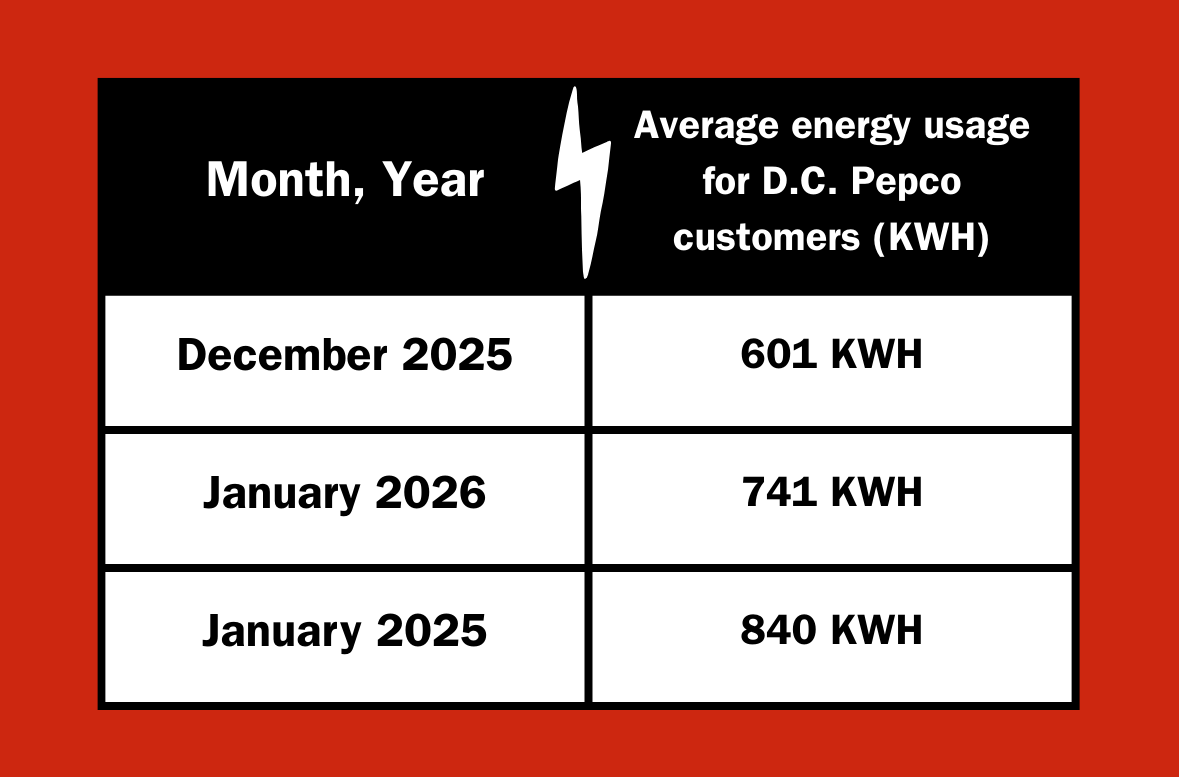
A Pepco spokesperson said that because of the way the company’s billing cycle works, it still doesn’t have the full picture for January 2026 energy usage and numbers may shift.
Some D.C. residents are unconvinced that the cold weather explains the extent of their rising bills, however, and have noted to The 51st that their energy usage isn’t drastically different from months or years past.
Harrison Pyros, communications coordinator for the public utility advocacy group We Power DC, said that newer buildings, which should be more energy efficient than older homes, were also facing high electricity bills. “They shouldn't be seeing these types of doubling,” Pyros said.
Extreme cold and excessive heat can have an influence on electricity bills — but weather alone doesn’t tell the full story of why residents are seeing drastic changes.
Pepco hikes rates while data centers surge
For about five years, Pepco has been using a new method to raise their rates. Instead of using historic data to propose updated rates — as it has previously done — the utility has used forecasted budgets and projected expenditures to set rates. In other words, Pepco had estimated how much it will spend on new projects and infrastructure in future years, and sought to raise rates to pay for it ahead of time.
Using this “multiyear rate plan” framework, Pepco has gotten permission to raise rates twice in the last five years: once in 2021 and again in 2024. Each plan calls for rate hikes to take place over the course of multiple years. Both of these plans — the first for $108 million and the second for $123 million — were approved by the D.C. Public Service Commission (DCPSC), which oversees the city’s utility companies.
Thanks to these plans, Pepco’s rates have gone up almost every year since 2021. In turn, so have electricity bills for D.C. customers.
The rate hikes aren’t the only part of the electricity bill equation, however. Another variable is the cost of electricity, which Pepco does not control.
Due to the recent rapid proliferation of data centers — particularly in Northern Virginia, which houses 35% of the world’s data centers — there has been around an $8 to $10 billion cost increase in the regional energy supply since 2024, said Mike Jacobs, who leads the Union of Concerned Scientists’ work on electricity markets and regulatory reform.
Tough questions for the utility
When Pepco proposed the multiyear rate hikes to the DCPSC, the company said the projected funds were necessary to cover the costs of grid maintenance and infrastructure upgrades.
But consumer advocates have questioned the accuracy of Pepco’s budget forecasting. They’ve also said there is too little transparency and accountability around how Pepco actually ends up using the money, as Washington City Paper reported last year. One piece of testimony to the DCPSC found that the utility did not spend the $94 million it collected after its first rate hike.
Last spring, the D.C. Office of the People’s Counsel (which advocates on behalf of utility customers) filed an appeal over the 2024 hike, arguing that the DCPSC ignored required due process for evaluating the initial rate hike.
“We don't know really where the money [from multiyear rate plans] gets shifted oftentimes,” said OPC’s Assistant People's Counsel Ankush Nayar.
In an email to The 51st, Pepco spokesperson Addie Kauzlarich says the $94 million number is “misunderstood.”
“This was not unused money or funding that went somewhere else. It simply reflects the difference between the projects Pepco planned to complete and put into service during those years and what was actually completed,” Kauzlarich said, citing COVID-related challenges and supply chain issues as reasons for the delay. The utility also earned less than its approved return during this time, she said.
Pyros is skeptical of this justification. “We as ratepayers are fronting the money and then hoping that a for-profit utility is going to act in good faith and spend that money responsibly,” Pyros said.
As a condition of the second approved rate hike, Pepco agreed to undergo a management audit. The audit was meant to evaluate the accuracy of the company’s forecasted spending — a critical part for understanding how effective Pepco’s multiyear rate plan actually is. Two versions of that audit, a public version and confidential version, were filed to the DCPSC in December.
In public comments from the U.S. General Services Administration (GSA), which represents federal facilities serviced by Pepco, the agency wrote that the audit affirmed “serious concerns” about the multiyear rate hikes, and that there was a “fundamental disconnect” between Pepco’s planning, actual costs, and customer benefits.
“Pepco has done a poor job at accurately forecasting costs and billing determinants under the [Multiyear Rate Plan] framework,” reads one line in the 13-page file by the GSA.
Is the D.C. government doing anything about rising Pepco bills?
There are a handful of bills that D.C. councilmembers are working on to address D.C.’s growing utility affordability crisis. Ward 1 Councilmember Brianne Nadeau introduced a bill last February that would prohibit electric and gas utility companies from disconnecting services in the winter and summer months for households with vulnerable individuals, including children under 18, seniors aged 65 and older, individuals with disabilities, those who are pregnant or 12 weeks postpartum, and recipients of public assistance programs such as TANF and SNAP.
Another bill introduced last year, by Ward 6 Councilmember Charles Allen, would require the Department of Energy and Environment to automatically enroll income-qualifying households into utility assistance programs. “Because the programs make you jump through hoop after hoop after hoop, a lot of people who need it can't even navigate their way through all the different application processes,” said Allen about D.C.’s utility assistance programs.
Last week, Councilmember Robert White introduced a bill titled “Utility Rates and Ratemaking Amendment Act of 2026,” which aims to add guardrails for multiyear rate plans that would “shift the financial burden off of customers.” One major change includes mandating that future rate hikes are proposed on the basis of historic costs, not forecasted budgets.
Allen’s office also just introduced a bill this week that would make it quicker and less costly for residents to get their rooftop solar panels connected into the grid. In a press release, the councilmember’s office said that plug-in technology could save residents 10% to 30% on their electricity bills.“I think that can make a meaningful difference for people who want to be able to put solar on their homes and reduce their costs,” Allen told The 51st.
How can I make my voice heard?
While the D.C. Council doesn’t have direct control over Pepco, they do have oversight power over the DCPSC. The commission has faced immense criticism for voting to approve the multiyear rate hikes that have helped raise prices. On Feb. 27, the D.C. Council is holding a performance oversight hearing for the Public Service Commission, as well as for the Office of the People’s Counsel.
Any person or organization can register to testify in-person, over Zoom, or submit their testimony online. Pyros says people who are struggling with high electricity bills should show up and share their experience.
We Power DC is also teaming up with the Chesapeake Climate Action Network to call for new leadership at the DCPSC. Two commissioners, Chair Emile Thompson and Commissioner Ted Trabue, are currently up for reappointment.
“With affordability top of mind for D.C. residents this election season, voters deserve a say in choosing a leader who will hold utilities accountable and help bring costs down. That means no reappointments before the November election,” said Claire Mills, D.C. Campaigns Manager at CCAN, in a press release.
The DCPSC also opened an investigation into energy affordability in the District after the OPC filed a petition last November. While the initial comment deadline has passed, a spokesperson for the PSC said that the commission is “always open to additional comments from residents.” Comments can be submitted on the DCPSC’s website.
This story has been updated with correct information about the filing of Pepco’s management audit.

Read next

A new map is fueling a debate on housing and displacement in D.C.
Critics of the proposed Future Land Use Map say it isn't thinking big enough.


D.C. healthcare cuts leave low-income residents with fewer options and worse care
Steep city budget reductions mean patients are going without medicine, losing teeth, and living with pain.


As Metro turns 50, transit diehards are keepers of its history, quirks, and identity
They collect memorabilia and create tributes to the iconic system.

The Trump administration is about to kill a popular D.C. bike lane
Feds say the 15th Street protected bike lane will cause more traffic during cherry blossom season, but bike advocates say it makes everyone safer.