

Supper club solidarity: Your weekly Civics Roundup
Plus, a digital security workshop, an open mic, and more.
Plus, a digital security workshop, an open mic, and more.

The officials who oversee Pepco don’t have control over a majority of the increases in your bill, writes Public Service Commission Chairman Emile C. Thompson.
Steep city budget reductions mean patients are going without medicine, losing teeth, and living with pain.

President Trump’s vision for what Washington should look like extends well beyond the federal core.


Burrville Elementary is much closer to Maryland than the White House, which stands 6.5 miles and a river away from the Brutalist brick school building on the eastern edge of Ward 7. But that distance hasn’t spared the school from the dictates of a little-known federal commission that has traditionally preoccupied itself with how things look in D.C.’s monumental and historic core.
Members of the U.S. Commission of Fine Arts appointed by President Donald Trump upbraided a team of architects working on a modernization of the 47-year-old elementary school at a meeting last month, declaring that the proposed design doesn’t comply with Trump’s 2025 executive order mandating that new government buildings adopt classical architectural styles. (It was at that same meeting that they gave the green light to Trump’s massive new White House ballroom.)
The commissioners did concede that the executive order doesn’t actually cover D.C. government buildings, nor does it have the power to stop the city from moving forward with its design. But they still asked D.C.’s architects to go back to the drawing board and return with a design for Burrville that hews more closely to what Trump believes the city should look like.
“We have to take a stand and see if we can compel folks to start building buildings that are truly beautiful and inspiring,” said Chairman Rodney Mims Cook. The administration has particularly decried Brutalist and other modern styles that began to be implemented in the mid-20th century.
It’s by no means the most invasive form of federal intervention in the city’s local affairs, but it represents yet another iteration of Trump and his supporters’ push to shape D.C. to their liking — which has extended from policing to golf courses and cultural centers.
The requested changes to Burrville’s architecture “feels like an overreach,” says Rebecca Miller, executive director of the D.C. Preservation League. “It’s outside the federal core and there’s no federal interest there. This feels so outside the box of what they should be making an issue of.”
Created by Congress in 1910, the Commission on the Fine Arts advises the federal and D.C. governments on matters of design and aesthetics, with the goal of preserving the character of the city as the nation’s capital.
While one might imagine that it is largely focused on the National Mall and White House, the CFA’s mandate is much broader: It reviews all D.C. government buildings, and then some. That not only includes schools, libraries, parks, and rec centers, but also private residential or commercial projects in Georgetown and anything abutting the federal core or Rock Creek Park. (Years ago I reported on how a plan to expand a Petworth rowhouse triggered CFA’s review — merely because it stood a block away from Rock Creek.)
The CFA’s actual power is limited: While it can actually block private construction projects in Georgetown and along Rock Creek Park, it only offers advice on the design and aesthetics of proposed government projects. Still, that advisory role has been taken seriously. “People pay attention because bright people are providing good advice,” says Elizabeth Meyer, who served on the CFA from 2012 to 2020.
In earlier days, the CFA was more closely invested in particular aesthetic styles for city buildings. In a 1916 report, for example, the commissioners expressed dismay that schools like Cardozo and Eastern were designed in an Elizabethan style, which they deemed “ill-adapted and inappropriate” for D.C. But as the city grew and gained home rule, the commission began applying a lighter touch, often commenting on minor aesthetic choices rather than declaring preferred architectural styles for D.C. government projects.
“We never would dictate a style. We would want to make sure whatever the intent was it was well-executed,” says Bruce Redman Becker, who served on the CFA from 2024 to 2025 before being removed by Trump last October. “There’s general agreement that you can have beautiful traditional buildings and beautiful modern buildings.”
Throughout its history, members of the CFA have gotten involved in local design decisions, says Amber Wiley, a professor at the University of Oklahoma who wrote a book about D.C.’s history of school design, but the Burrville criticism “feels more pointed in this particular moment in time, more political.”
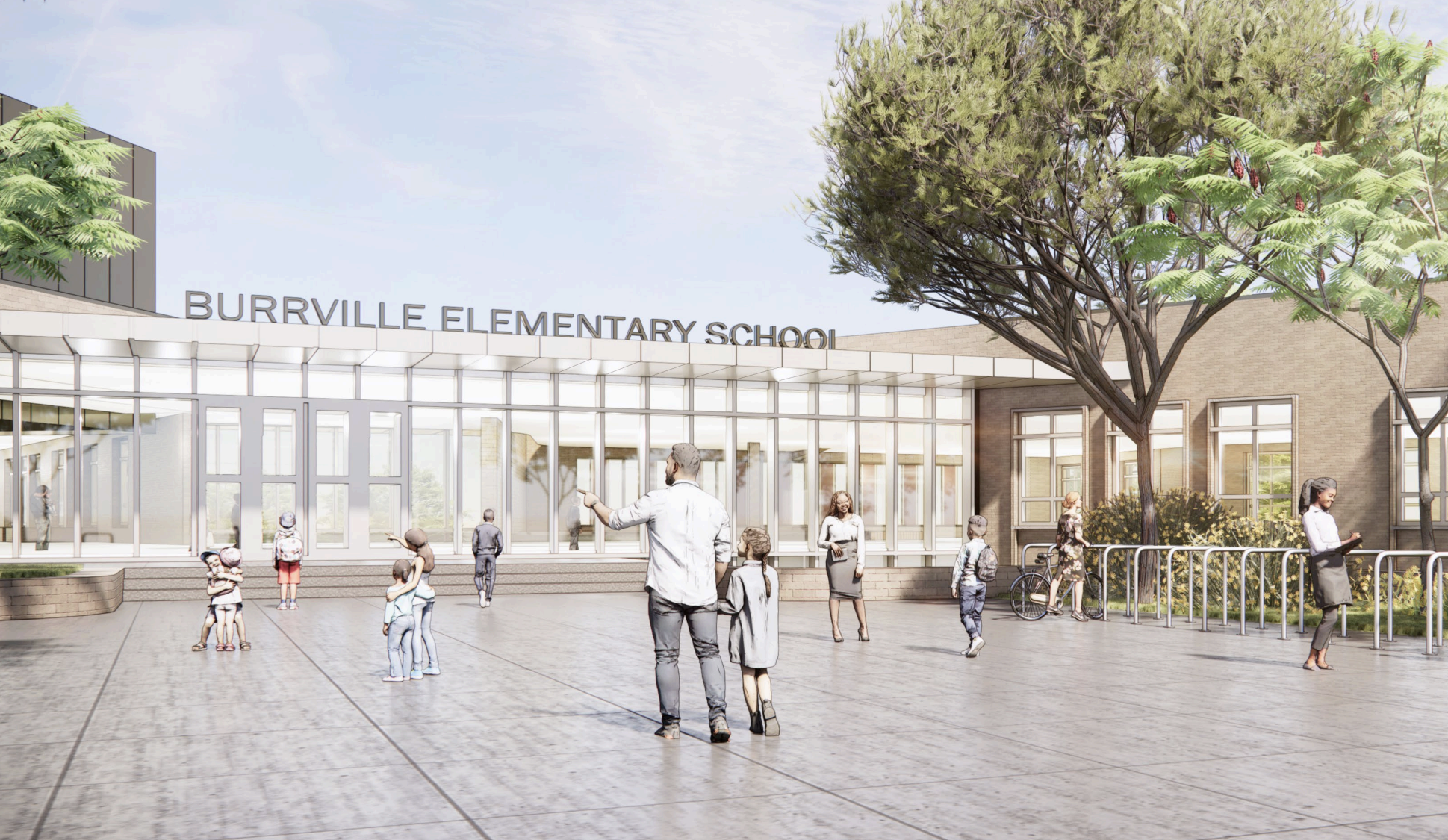
That the CFA’s recent intervention over D.C.’s plan to rebuild Burrville — which serves more than 230 students, almost all Black — was much heavier-handed seems to reflect the orientation of the new commissioners, all of whom were appointed by Trump in January. (The president fired the previous commissioners in October and left the positions vacant until his ballroom project was up for review).
The principal antagonist at the commission’s February meeting was James McCrery, a professor at Catholic University who initially served as lead architect on the ballroom. (He also served on the CFA from 2019 to 2024.) Known as an adherent of classical architecture, he broadly decried modern buildings like what D.C. was proposing for Burrville, instead idealizing older school buildings.
“There is a very strong tradition in Washington D.C. that began in the latter decades of the 19th century and ran through the end of World War II of exceptional public school buildings,” he said. “They are buildings that were built by a society that understood that when you build any public building you’re building for the citizenry, and especially when you’re building a building that is designed and its sole purpose is to form the young citizenry that those buildings have to be exceptional.”
Some of the classically built schools McCrery may have had in mind are downtown’s Franklin School (now home to Planet Word) and the Sumner School (now the DCPS museum and archives), as well as the Pierce School on the east end of Capitol Hill, the Wormley School in Georgetown, and the Peabody School on Capitol Hill.
But Snigdha Agarwal, an architect at Perkins Eastman, which is working on the Burrville design, pointed out issues with form versus function.
“[Those old schools] were largely ice-cube trays, double-loaded corridors with classrooms on both sides. There were a lot of things those buildings did well, but they're not actually an accurate reflection of modern pedagogy for how K-12 education is occurring these days,” she told the commission.
The Perkins Eastman team also argued that the context matters; a “traditional” looking school building may not fit into the neighborhood around it.
McCrery (who did not respond to a request for comment from The 51st) wasn’t convinced. “The commission and the citizens of the District of Columbia should expect more,” he said. “I recommend that they go back to the drawing board.”
As with so many other issues, the question comes down to who is better suited to decide city affairs: feds or local officials?
Though it stands little chance of passing, D.C. Del. Eleanor Holmes Norton introduced a bill that would repeal the CFA’s authority to review D.C. government projects last year. “The federal government, including the CFA, whose members are appointed by the president, should not have any authority over D.C. land-use policies and decisions unrelated to the federal presence,” she argued.
McCrery made the opposite case. “A number of mayors have been embracing modernist architecture as a way of somehow distinguishing the District government from the federal government, which I think is not the best-informed way of proceeding,” he said.
The $85 million design for the new elementary school — which is set to close after the end of the school year and reopen in 2028 — took almost a year to complete, and involved the participation of teachers, administrators, and parents.
While the CFA’s recommendations are merely advisory, city officials seem disinclined to dismiss its judgment. A spokesman for the D.C. Department of General Services tells The 51st that it will revise the proposed design for the school and present it again to the commission in April.
Becker, the former CFA member, says the renewed debate over what Burrville — or any D.C. school — should look like represents a broader problem with the current makeup of commission: Most of Trump’s appointees don’t have credentials in architecture or design. (One new member is the president’s 26-year-old White House aide.)
“It’s always a good idea to have peers in the profession review and comment on design. That’s been the benefit of the CFA, but it’s been neutered by installing folks who have no credentials to render opinions,” he says. “It seems to be a highly personal priority of really one person and some folks that are enamored with neo-classical architecture.”
Wiley says the new CFA’s input on government projects seems “arbitrary and subjective,” and that even some of D.C.’s current historic schools — like Cardozo and Eastern — might not pass muster. “Some folks from CFA wouldn’t have liked those designs because they didn’t have columns,” she says. “Are columns your barometer for design?”
But this debate is unlikely to end with this one school building. Towards the end of the discussion over the design of the new Burrville building, Cook, the CFA chairman, said D.C. officials should be prepared to receive the same treatment “for another three years.”

Steep city budget reductions mean patients are going without medicine, losing teeth, and living with pain.

They collect memorabilia and create tributes to the iconic system.

Feds say the 15th Street protected bike lane will cause more traffic during cherry blossom season, but bike advocates say it makes everyone safer.

The three-month sprint to the June 16 primary election is on.
With your help, we pursue stories that hold leaders to account, demystify opaque city and civic processes, and celebrate the idiosyncrasies that make us proud to call D.C. home. Put simply, our mission is to make it easier — and more fun — to live in the District. Our members help keep local news free and independent for all: