


How D.C. residents fought back in 2025
Life in the District was turned upside down by the Trump Administration this year. Here’s how residents responded.

Two days after Trump was elected, over 750 activists and community members met at Foundry United Methodist Church. Many organizers understood how uniquely vulnerable D.C. was and were bracing for the ramifications of his second term. For some residents, that realization wouldn’t come until later, when 2025 brought a torrent of change to the District.
“It was our attempt to make meaning of the moment and to make sure people didn't feel alone,” Elizabeth Falcon, executive director of DC Jobs with Justice, said. “And to make sure that D.C. could prepare.”
The impacts came fast, from President Trump’s February decisions to clean house at the Kennedy Center and raze the federal workforce, to the House nearly slashing D.C.’s budget by over $1 billion in March. By August, D.C. was facing the biggest challenge to its self-governance in recent history: Trump taking control of MPD and ordering hundreds of National Guard members and masked ICE agents to the streets, leading to more than 1,100 people arrested by ICE from August to mid-October.
The last 12 months have marked a new period in D.C., one where residents are reminded how vulnerable our local laws and political systems are, and how easily daily life can be disrupted by the federal government. But it’s also a year that D.C. fought back.
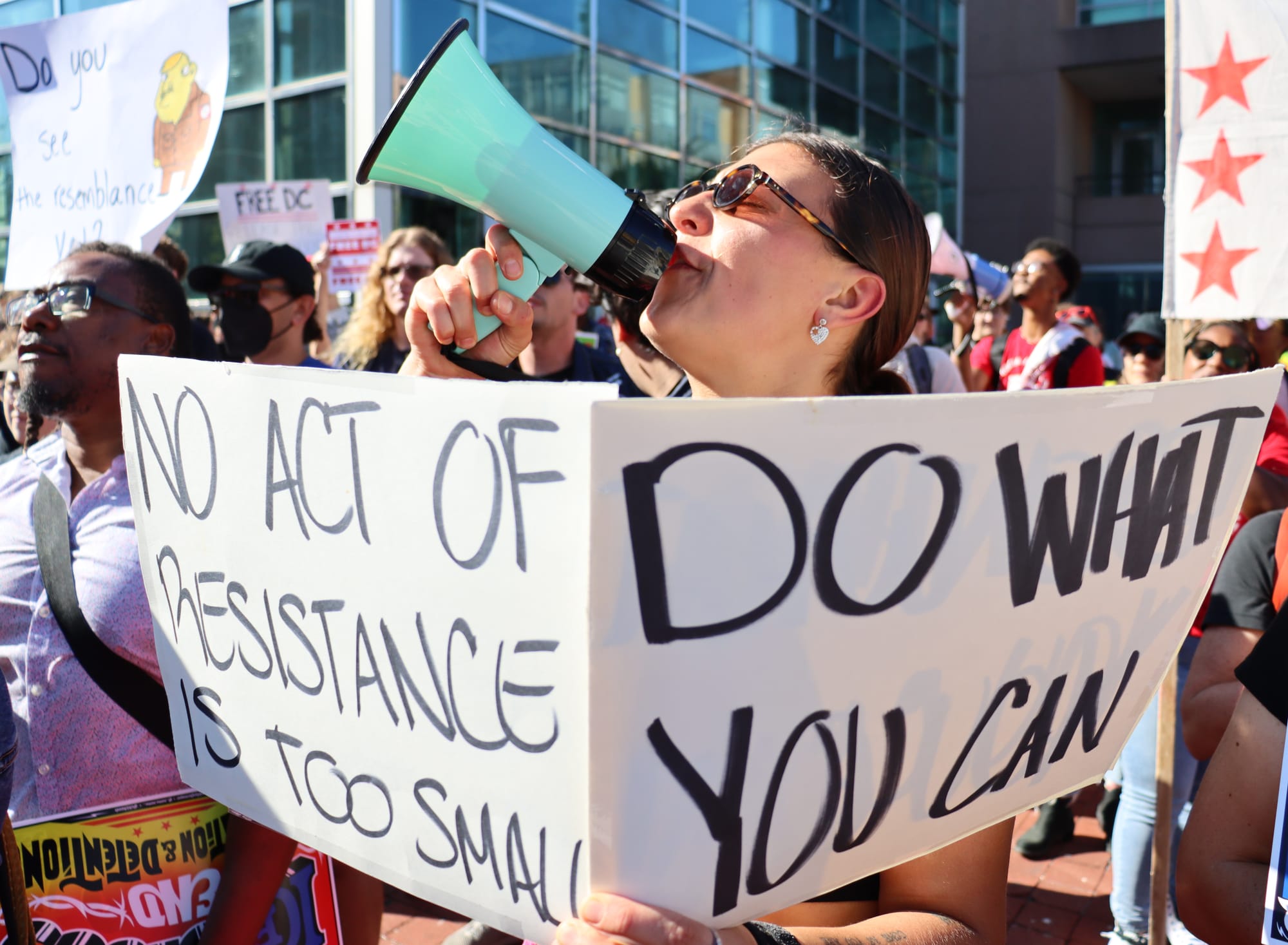
Washingtonians organized rallies and protests on the steps of the Capitol. They documented ICE sightings and made sure kids got to school safely. They chanted “Free D.C.” at soccer games and testified at D.C. council hearings about the federal surge.
“We are here to say that we are not going to sit idly by while our city is taken,” Frankie Seabron, the program manager at Black-led abolitionist defense hub Harriet’s Wildest Dreams, said. “We're not going to sit by while they try to really intimidate us into compliance.”
Mass mobilization
In the early months of 2025, organizers like Seabron knew D.C. needed a mass movement of people in order to effectively push back against the administration.
“How do we get everybody?” Seabron recalled. “And what is that rallying cry going to be?”
Early on, that slogan came through: Free D.C. In January, organizers adopted the name (which is rooted in a pre-Home Rule movement led by Marion Barry) to create a city-wide community organization focused on self-determination in D.C. Free DC’s Instagram account, where the group shares updates on federal interventions in D.C. and opportunities to take action, has swelled to nearly 65,000 followers.
The current Free DC movement really took off in August. Locals overwhelmingly opposed Trump’s escalating interventions in D.C., and their actions made that clear. One memorable example was when weeks into the federal takeover, dozens of residents followed, recorded, and yelled at federal agents near the Columbia Heights metro station until they finally left the area. Cheers erupted from the crowd as law enforcement drove away in their cars. Recording federal agent activity became a common occurrence for D.C. residents in the later half of the year, as masked law enforcement stuck around even after Trump’s takeover ended.
On online forums such as r/washingtondc and NextDoor, neighbors have posted their photos and videos to alert others where ICE is present. Harriet’s Wildest Dreams and Migrant Solidarity Mutual Aid (MSMA) also co-created a website called Film the Police for residents to upload these sightings. Madhvi Bahl, an organizer with MSMA, says they’ve received thousands of emails with recordings.
Community care
While thousands of residents actively engaged in civil resistance in 2025, D.C. communities also built and rapidly scaled up social support networks.
On Inauguration Day, MSMA launched their emergency hotline. It offers a variety of services, including providing legal referrals for people whose family or friends have been detained, as well as connecting callers to volunteers who can accompany them to their ICE check-in or immigration court appointment.
“Even if we don't speak the same language, you just have somebody to be there alongside you and with you in the process and provide emotional support,” said Nora, an organizer with the DMV Accompaniment Network, who asked to go by their first name to maintain their privacy and the security of the network. “I think it’s just really, really valuable to folks right now.”
MSMA also launched a post-detention care program for residents grappling with having their parents, siblings, or relatives taken by ICE, said Bahl, in partnership with different faith-based institutions to support this work. MSMA has also continued their mutual aid work in helping migrant households by delivering groceries, running a free store, and setting up furniture.
While the conditions in D.C. have been tumultuous, it’s also opened the door for new bonds with neighbors and the chance to create people power at the community-level.
“At the very heart of it, it's building relationships with your neighbors, building trust with your neighbors, and building the work together,” said Amad Mahbub, an organizer with Free DC. “We are prioritizing joy and building community as we do this really heavy but important work.”
Falcon of DC Jobs with Justice, has also seen new connections form at a hyper-local level. When she created a bilingual Whatsapp group for her neighborhood, she saw relationships being formed that crossed language and class lines. “Now there's literally mutual aid distributions that are happening,” she said.
Protest art
Across the city, residents have also left visual marks of their resistance. In Mount Pleasant, a neighborhood with a large immigrant population, community members put up a sign that said “Chinga La Migra, Mount Pleasant Melts ICE.” Surveillance video showed masked agents taking it down and leaving a sex toy in its place. Within hours, residents put up a new sign.
“People see those things and they feel like, “OK — what I'm thinking, I'm not in my own head,’” said Olivia DiNucci, a local anti-militarism organizer, about art and visual resistance. “Art allows us to not feel isolated.”
When a man threw his Subway sandwich at a federal agent on U Street in August, he turned into a folk hero overnight — and the sandwich became a sign of resistance. Images of a masked man throwing a sandwich in the style of Banksy were posted throughout the city. One artist created prints of subs replacing the bars on the D.C. flag, which garnered thousands of requests for copies.
Art and non-cooperation also merged together this year at mass demonstrations. At the We Are All DC protest in September, thousands walked from Malcolm X Park to Freedom Plaza. Marchers held up handmade signs with their demands: “End the Federal Invasion,” “DC Statehood Now,” “End the DC Occupation,” and of course, “Free DC.” This creativity, DiNucci said, can bring out fun even during challenging periods.
“The doom and gloom of things is getting in the way of people feeling that they have power,” DiNucci said. “Art can be inviting.”
A growing movement
Over the last year, community organizers and activists like Bahl, Mahbub, Seabron, DiNucci, and Falcon have seen a flood of residents reach out to their groups about wanting to do something. Constant news of federal interference, layoffs from DOGE, and watching community members be taken by ICE has motivated people into taking action in 2025.
Mari Franco became more engaged in day-to-day organizing in January, after being approached by a Free DC organizer at a protest. Soon, she was getting involved in her community in a variety of ways: running neighborhood meet and greets, joining walking buses for kids with undocumented parents at a local elementary school, and volunteering at HIPS, a harm reduction nonprofit.
Franco also started a small community group with friends called Organizing is for Everyone. “It’s based off the idea that we kind of each already have organizing skills, even if you wouldn't frame it that way,” she said. They meet monthly, with one person teaching an organizing skill at each meet-up.
Seabron says Harriet’s Wildest Dreams had hundreds of people attend organizing trainings and info sessions this past year. “It has been so inspiring to see the way that people are like, ‘OK, I'm not just gonna sit by. I'm gonna do something. We're gonna do something in Congress. We're going to do something at the courts. We're gonna do something in the streets,’” she said.
“And we're going to continue to be here to give folks those ways to plug in,” she added.
Mahbub of Free DC says that the sheer amount of new people that joined organizing spaces and engaged deeper with their communities through actions like building relationships with their neighbors, going door-to-door canvassing, and understanding their constitutional rights has helped them prepare for the next three years and beyond.
“That’s the essence of the work, and what’s going to keep the work sustainable,” she said.
If the last year in D.C. has been full of unprecedented changes and challenges, then it’s hard to imagine what 2026 could look like. But what is certain is that political power within D.C. will be up for grabs, with the open mayoral election and multiple seats on the council up for new leadership. Seabron says this is a time for organizers to set their own agendas.
“What does a liberated D.C. look like for Black people, for migrants, for youth?” said Seabron. “Whoever those folks are, that are going to be taking those seats, they have to be fighting for D.C.”

Read next

Does your tap water smell like chlorine? There’s a reason why.
You're not imagining things — but the water is perfectly safe.

A new map is fueling a debate on housing and displacement in D.C.
Critics of the proposed Future Land Use Map say it isn't thinking big enough.


Everything to know about Malcolm X Park’s closure
From the schedule to Trump's role in the park's restoration.

What can be done about your expensive Pepco bill?
Financial assistance, energy audits, and avoiding third-party suppliers can help.