

Dance & taxes: Your weekly Civics Roundup
Plus, a clothing swap, a cooperative movement meeting, and more ways to get involved.
Plus, a clothing swap, a cooperative movement meeting, and more ways to get involved.

From the schedule to Trump's role in the park's restoration.

Feds say the 15th Street protected bike lane will cause more traffic during cherry blossom season, but bike advocates say it makes everyone safer.

By creating content, merch, and experiences that are for and about Chocolate City


Nayion Perkins has always been a student of culture — streetwear, art, music, coffee table books.
Raised in the early aughts, he belongs to one of the last generations of D.C. natives influenced by a majority-Black city … a Chocolate City.
Today, as a co-founder of The Pack World, he acts as a steward and archivist, preserving the history, norms, and traditions left scattered with the displacement of longtime Black Washingtonians in recent decades.
“We're a city that's often been overlooked or understated,” says Perkins, 30, who launched the company with four friends in 2018 as a way to preserve D.C. history and put its culture on the map with cities like New York, Los Angeles, Houston, and Chicago.
The company aims to create content and experiences that elevate disenfranchised communities and rekindle memories for D.C. natives. Some of their early projects include clothing lines highlighting topics like gentrification and the history of violence in D.C. After The Washington Post’s Express shuttered in 2019, they released The Pack Express, a temporary free print newspaper highlighting artists, activists, and community projects taking place in D.C.
While The Pack World isn’t their full-time job, they take their mission seriously and can often be found selling merch at community events and festivals. “We're really in this for the long haul. This isn't like a money grab for us,” says another co-founder, who goes by Kluse. “We get a lot of joy and pride out of telling real stories that resonate with our people, our communities.”
In November, the company released their latest project: Proof of Life. It includes branded merch — t-shirts, hoodies, and stickers — and a 100-page book featuring interviews with community leaders like Imani Shanklin Roberts, an artist and co-founder of Shanklin Hall; Keyonna Jones, executive director of the Congress Heights Arts and Culture Center and owner of Soufside Creative; and Brandon Starkes, founder of The People’s Market, which helps small farmers grow their businesses and delivers produce to D.C.-area residents. (You can read excerpts from their conversations here).
I spoke with Perkins and Kluse about Proof of Life’s bold messaging, the nuances of being from D.C., and how Black Washingtonians can claim and preserve safe spaces as they fight to stay in the city.
How did Proof of Life come about, and what do you want people to take away from it?
Perkins: The concept came together in 2024. That was probably the busiest year we had to date, as far as vending and doing different festivals and events. And because of that, we were introduced to a lot of new people who may not have seen our other work. A lot of people would be like, "What is this about?" Through those conversations, we kind of narrowed it down to the point that everything we're doing is to show proof of life.
Kluse: At the time, we were seeing everyone post “proof of life” especially after being inactive on social media. But we started seeing it play out in real time, where it's like we — as people in an ever-changing D.C. that is not at all reflective of where we grew up — occasionally see these special glimpses and you're like, "Oh, shit, it's still there."
Like, there's ICE and the National Guard patrolling Malcolm X Park, but you still see the drum circle. There's a spark there, still. It may not be burning as hot or as big as it once did, but the proof of life is there.
And it became about capturing the everyday things and the everyday people that show us that this thing that we so deeply believe in and love and care about is still alive.
Some of the project’s messaging feels very strong to me — almost combative. Like, you say in the book that D.C. natives are "under siege" and "being held hostage by rapid development and cultural erasure." Why was it important for you to phrase it that way? You went really hard.
Kluse: We didn't come out trying to be political, but everything about living in this city — especially as a Black human being — is inherently political. It's like your existence is politicized.
Economically, our people are under attack. That's why gentrification is occurring … that is a term of economic warfare against us. It's the same as redlining. They've been doing it to us for at least 100 years now, right? Our rights are under attack. We don't have representation in bodies of Congress. If you live in D.C., you are under attack.
A lot of people might not necessarily feel that way, especially if they moved here. Because for them, you can always just leave. But I don't feel that way about it. This is a place I was born and that I intend to live and die in … and my ability to do that successfully and my community's ability to do that — and thrive in that — is under attack.
So it felt right to write about it in that way. Like, is it going to take us losing another 20 percent of the population of people that actually do want to stay here for someone to say something in a sharp tone? I wasn't going to wait for that.
I was surprised that one of the people you featured, Brandon Starkes, isn’t a D.C. native. He grew up in Prince George’s County. I’m curious why you decided to feature him. Then, in your interview with Imani, she jokingly remarks about how we’re more inclusive of people from Maryland and Virginia these days.
So more broadly, I’m wondering what you feel about the term ‘the DMV’ — which I personally don’t like. I think most people who are from D.C. will just say they’re from D.C. To me, ‘the DMV’ is a term for people from Maryland and Virginia to feel included in the city when they didn’t necessarily have our same experiences growing up.
Kluse: The term DMV has really been a point of contention. We are definitely "Where are you from?" people. Like you said, if you're from D.C., you say you're from D.C.
But I feel like that question is starting to lose some of the context. We have so many people who have been forced out of the city. Your address is no longer a reflection of where you want to be — a lot of people simply do not have the opportunity. So as a result, you have so many D.C. natives who are exiled in some way to Maryland or Virginia.
As for Brandon, I think it was important for us to have him because of how much D.C. impacted him and is responsible for his growth and maturation as a man … and also the work that Brandon puts into the city.
This community, and this concept of a chocolate city, is something that you have to be committed to being a part of and building. Just being from here ain't enough, actually.
 Nayion Perkins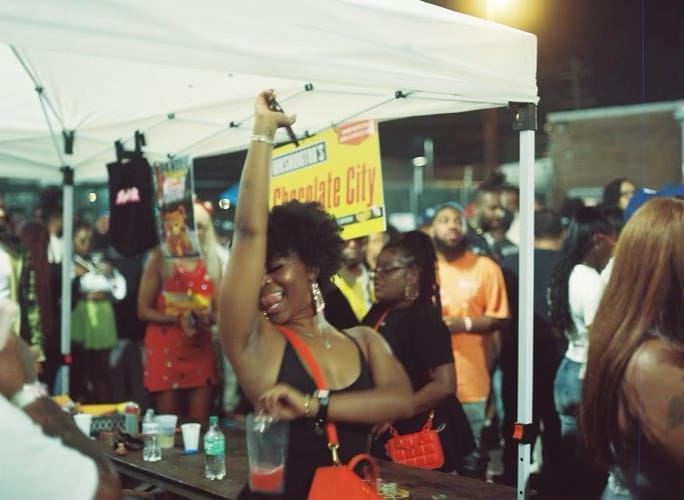
Perkins: Yeah, we don't necessarily have a thing against people who are not from the city. I think that's a common misconception. It's just that we can be honest about where we're from and still have appreciation for each other.
And as long as you're contributing to the culture, you're a welcome party. I feel like that's been the sentiment of the city for decades. Some of our greatest cultural figures — Marion Barry, Chuck Brown — are not from here, but you wouldn't know that based on how much we talk about them and how much they contributed to the community.
In the book, you say that if people want to know the real D.C., they have to go where the people are. And you called out City Center and Union Market as places where D.C. natives or longtime Black Washingtonians might not be.
But you also had your first pop-up party for Proof of Life at the Village Cafe, which is a Black, D.C.-native-owned spot in Union Market. So I’m curious about your relationship to these new developments. Do you feel like you deserve to be there as a D.C. native, or do you feel like they’re not built for you? How do you negotiate that?
Kluse: That's an interesting one. We've seen spaces transform from places that were firmly for us to places that are not for us. But we're not seeing a backfill of spaces. Like, they’re going to take this over, and as a result, another space reverts back to our community. It doesn’t work like that. So you learn to coexist to a certain extent. You have to find your pockets.
There are places like Sycamore and Oak. I love Sycamore and Oak, but I’m terrified because this is what Union Market and other spaces looked like before they gentrified. This is the setup.
So you have to mindfully engage. I’m also not one to put the onus on the people being marginalized and affected.
But this is also why we chose to spotlight places like Shanklin Hall in the city, where we can go and support. Those places are few and far between, but we really do have to patronize the ones that we have.
Some people talk about gentrification like it’s progress because of all the new developments and shiny things. But what do you guys see as progress for longtime Black D.C. residents?
Kluse: Nayion and I are TAG kids. We both went to School Without Walls. We both got our college degrees. We are everything they said that you were supposed to be — we are contributing members of society. That was supposed to mean something in terms of our ability to actually live in the city. And it's very hard for all of us.
Not just us but our contemporaries. When we say this, we're not speaking about ourselves. We're speaking about a generation of people who are experiencing a lot of hardships in the city. And I don't just mean that in terms of the day-to-day. I mean that socially, like, where are we getting together, what are we doing? And culturally, it feels like this thing that we had a promise of — that we would almost receive the relay baton of and have our kids grow up in — feels like it's been snatched from us. It's very sad and demoralizing, but it's why we keep fighting and doing this.
In terms of gentrification, the biggest thing that has been stolen from us is opportunity. I take the commitment to live and die in Chocolate City very seriously. So, I'll figure it out, but it wasn't supposed to be quite this hard. That's the thing.
Perkins: I agree with those sentiments. And outside of an opportunity for every man and woman to be able to live and maintain — which sounds simple but is the bare minimum — I would love to see a more connected community, as far as people knowing each other and being able to depend on each other.
I think we're seeing it with this snow right now, like the city was not even able to clear roads and things like that. People had to look out for each other and were like I know this person is elderly, let me go shovel in front of her house so she doesn't have to worry about that. So I think progress for me would be just a more connected and active community. There's obviously no way to measure that, but I think that’s what ultimately counteracts gentrification. Because it's not necessarily about development. For me, it’s more about the erasure of culture.

The D.C. soccer team heads back to Audi Field with their star forward, new uniforms, and hopes for another championship run.


The Duke Ellington School of the Arts graduate was recently named artistic director of the country's fourth-largest Black dance company.


The history of D.C.'s official dance.

Seven area natives share how the spirit of Chocolate City is still alive.

With your help, we pursue stories that hold leaders to account, demystify opaque city and civic processes, and celebrate the idiosyncrasies that make us proud to call D.C. home. Put simply, our mission is to make it easier — and more fun — to live in the District. Our members help keep local news free and independent for all: