

12 things to do in D.C. over Halloween weekend
Whether you’re into retro zombies, pan de muerto, or classic fall festivals, we’ve got something for you on our list.
Whether you’re into retro zombies, pan de muerto, or classic fall festivals, we’ve got something for you on our list.
Here are three ways to make our streets and sidewalks safer, and none of them are banning electric scooters and bikes.
"Once I realized that anything could be art, I think that’s when my art changed significantly. But now I need storage because I can walk anywhere and see something and think, 'Oh, I can use this.'"

"Once I realized that anything could be art, I think that’s when my art changed significantly. But now I need storage because I can walk anywhere and see something and think, 'Oh, I can use this.'"

Lex Marie knows all too well what it feels like to search for representation of yourself in spaces that rarely reflect your experience. Growing up in Prince George’s County, she remembers visiting the museums along the National Mall, where European art dominated the walls. That absence would eventually shape her artistic practice.
Today, the D.C.-based multidisciplinary artist uses conceptual art and a medley of commonplace materials, from pencils and leather belts to birthing blankets and her son’s uniform pants, to examine Black life, personal history, and the forces reshaping the city around her.
Since 2019, Marie’s work has been featured in a number of group exhibitions, including, most recently, You See Where I’m Coming From at Chela Mitchell Gallery, which was presented in partnership with local hip-hop artist Shy Glizzy and art collective League OTO .
Her installations are rooted in a desire to make visible what often goes overlooked: the taboos and social expectations that shape our lives, sometimes beneath our conscious awareness. She draws attention to the conversations that happen between parent and child on the walk to school or around the dinner table, as well as the weighty and often disorienting expectations placed on young people. Marie gathers, repurposes, and reflects these everyday narratives back to us, transforming familiar experiences into objects and installations that invite closer examination.
Marie reflects on how D.C. shapes her work, from centering Black children and public school experiences to confronting censorship, gentrification, and the city’s shifting political and cultural landscape.
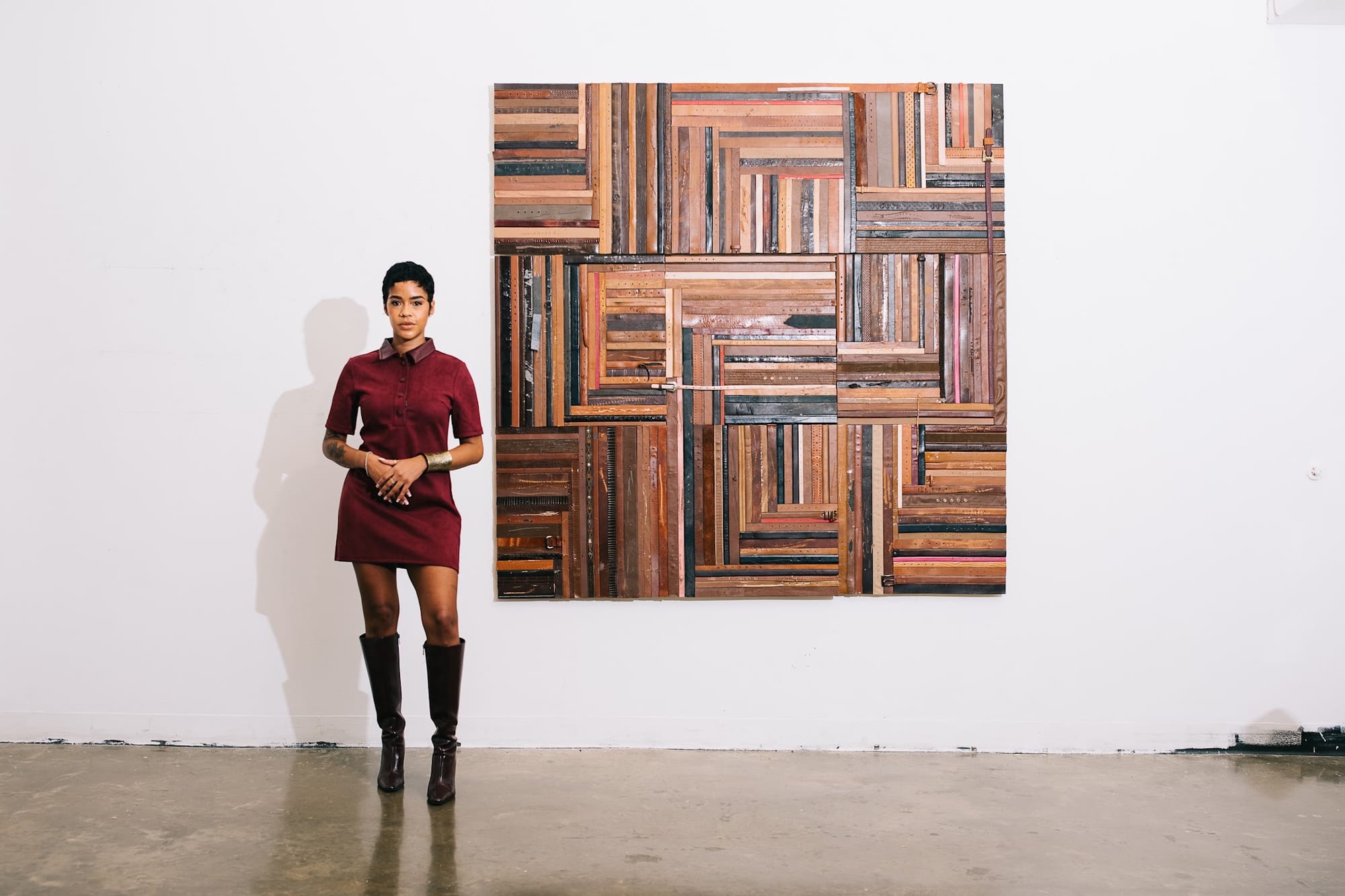
How have your experiences shaped who you are as an artist and the stories you feel compelled to tell through your work?
It’s really about the importance of telling our stories. Not seeing those stories represented made me realize how important it is to tell my own personal stories, and that my stories aren’t mine alone. They’re the stories of my sisters and my community. For a long time, I didn’t feel like other people saw our depictions and experiences as art, or as important enough to be in museums and galleries. So there’s a sense of empowerment in being able to create this work, see it in those spaces, and have it taken seriously.
What stories do you see being told in art spaces right now, and how do you see your work contributing something different to that conversation?
There's not a lot of conceptual art. Everything is representational from what I see – like happy faces and colorful murals. I don't feel like everyone is obligated to talk about difficult things, but I feel like I would be remiss not to. I think that my work can be seen as controversial and difficult to show or to receive. I try to shake the table a little bit, and I don't think that's common, especially because of the political climate of the city.
How has living in and around the nation’s capital shaped your work?
Specific to art, what’s happening right now is really alarming. We’re seeing art removed from museums, and we’ve seen throughout history how institutions can control which stories are made visible and which are pushed aside. I remember Amy Sherald’s Statue of Liberty not being shown at the National Gallery of Art because it depicted a trans person, and ultimately being moved to Baltimore. I’ve also noticed signage that seems to downplay Black history, as if it isn’t actual history.
That can be intimidating for artists. It feels like we’re moving toward a place where artists could face serious consequences for making certain kinds of work. But honestly, it makes me feel even more compelled to create. I need to be honest and true to my feelings about these issues. Living in D.C., seeing the National Guard throughout the city, encountering posters about ICE, and having to explain these realities to my son before I feel ready has been challenging. But this is our reality, and making art is how I process it. It makes me want to create even more.
What themes and issues are pressing for you now?
A lot of my work starts personally, with something my son is experiencing or something I’ve noticed. I often feel like a mother to all young Black boys, so when I see something on the news, I immediately think, ‘That could have been my son.’ Even when an experience isn’t directly his, it still feels personal.
I also try to expand beyond my own circumstances. My son hasn’t experienced corporal punishment at school or at home, but children across the country continue to face it. I approach my work from a mother’s perspective, and as things get worse, I’m probably going to push even harder because children are the most vulnerable group in all of this. Their lives are being affected, yet everyone continues to act as though everything is normal, especially when it comes to school.
We talk about the big issues, but I don’t think we talk enough about what’s happening to our children, particularly in art spaces. I know that’s not necessarily what art is for, but that’s what I’m using it for.
What becomes possible in your art when you’re not limited to a particular medium or form?
The sky is the limit. Everything can be art to me. One of my favorite materials to work with is my kid’s uniform pants. Every year he grows out of them, and I just take them and repurpose them. I love how they hold his history. Or I’ll get some from a thrift store, and just seeing all the little kids in their khakis walking down the street feels very city-like to me. Once I realized that anything could be art, I think that’s when my art changed significantly. But now I need storage because I can walk anywhere and see something and think, ‘Oh, I can use this.’ So that’s been interesting.
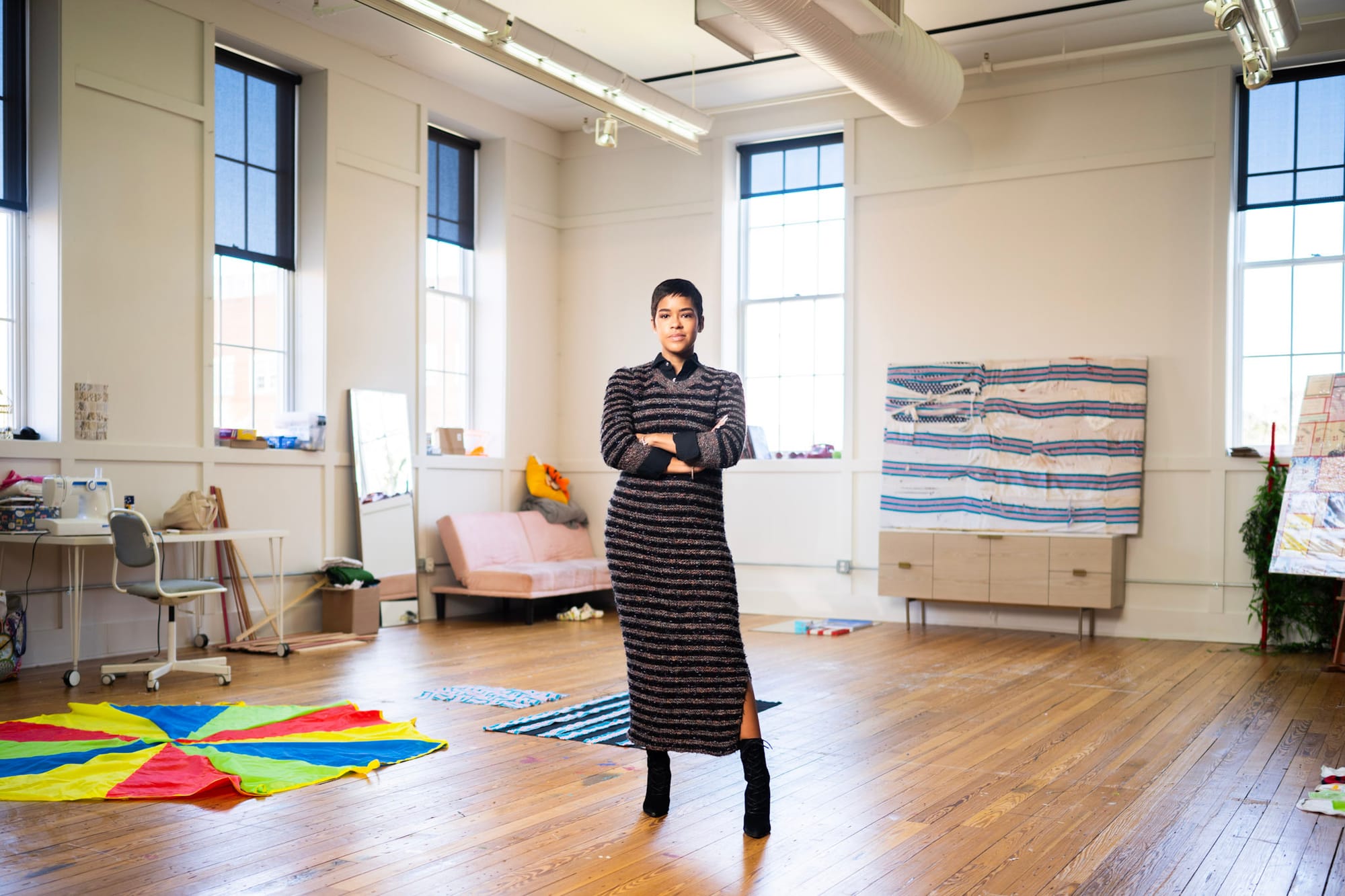
Do you think D.C. is a city where artists can thrive?
D.C. isn’t for artists at all. We have to leave. We need affordable studio spaces, more galleries, and more Black-owned galleries would be nice. I’ve always said that when you give an artist time, resources, and space, they can do anything. That’s how my career has progressed. Grants have been huge for me, and the two studio spaces I’ve had in the city were free through awards. Not having to constantly worry about how I’m going to pay for a space to create really allowed my career to take off.
The DC Commission on the Arts and Humanities has been incredibly helpful. I apply for their grants and fellowships every year, and they’ve provided resources that have made a real difference. I think that’s what artists find in places like New York and Baltimore. It’s not necessarily affordability, but actual spaces and art communities.
Art simply isn’t the city’s focus, and I don’t know that it has to be. But that lack of infrastructure makes artists feel like they can’t build sustainable careers here. I wish that artists felt like they could have actual careers and support here, and I don't think I know any artist who feels that way. Not one.
Are there any artists in D.C. that you feel deserve more attention?
I would say conceptual artist Emmanuel Massillon, mixed media artist Vanessa Villarreal, and painter Jermaine “JET” Carter.
What place in D.C. do you feel exemplifies growing up here that a museum never could, and why?
I would say Martin Luther King Jr. Memorial Library. I love that library. I think they’re making incredible use of the space, whether through the events they host, the resources they provide, or the history it holds. I go there to research for school, and their archives are fantastic. They also have gallery space, host art exhibitions, and participate in events like Art All Night.
I’ve had such great experiences there. It’s a place where history, culture, and community are all actively being shared, and I think that says a lot about growing up in D.C. in a way a traditional museum might not.
What is a place you think is overlooked, misunderstood or easy to dismiss?
Anacostia. I love Grounded Coffee Shop and Wellness Studio and the pop-ups they do there. There’s also the Smithsonian Anacostia Community Museum that I didn’t even know about until, like, two years ago. They have amazing programming, and I don’t think most people know about it.
What is your one-day creative pilgrimage through D.C.?
I’d probably start with checking out the Hirshhorn. For food, let’s go to Dogon. Then I’d want some time to just rest and walk around my neighborhood in Brookland. We could go to the Dew Drop Inn for the Fun Set. Then maybe a walk through Malcolm X Park and finish at a rooftop bar at The Wharf for some drinks. That feels like a good D.C. day.
If someone encountered your body of work 50 years from now, what would you want it to reveal about life in D.C. at this particular moment?
The truth. I want it to be a representation of what it’s like right now, whether that’s an image of my son smiling in his school uniform or work that talks about books being banned in schools. I want it to show the full truth of how children are being treated and how they’re experiencing life at this moment.
What are you currently working on?
I have a show coming up in November in Brooklyn, my first solo show in four years, and I’m really excited to finally show this work. It will be at the Bishop Gallery and it’s called I Said What I Said. If I had to describe what people can expect from the show in one word, it would be transparency.

Here are three ways to make our streets and sidewalks safer, and none of them are banning electric scooters and bikes.

Vergie “Gigi” Arandid, owner of Binge Bar on H Street, shares her recommendations ahead of No Drink November.


Including allegations of stolen signs, homemade attack flyers, mysterious MAGA figures, and a whole lot of name calling


Renters at Faria Management properties say they're battling mold, rats, sewage leaks, and intimidation. They believe a reckoning for unaccountable landlords is finally here.
With your help, we pursue stories that hold leaders to account, demystify opaque city and civic processes, and celebrate the idiosyncrasies that make us proud to call D.C. home. Put simply, our mission is to make it easier — and more fun — to live in the District. Our members help keep local news free and independent for all: