

Bowser has put out her final budget. Here’s what the big funding fights will be
There’s less money to go around for the first time since she took office.
There’s less money to go around for the first time since she took office.

The District made streateries permanent. But restaurant owners say the rules are too costly and complicated to keep them up.

Candidates want to lower the cost of living, but a slowing market and policy divides could get in the way.
The painter’s first institutional show runs at the Irene and Richard Frary Gallery through March 2026.


One fateful morning solidified Lindsay Adams’ deep appreciation of her hometown’s history and culture. As a pre-teen, she remembers her mother waking her up early to take a Black history bus tour, which stopped at local sites like the Mary McLeod Bethune Council House and the Carter G. Woodson house.
The painter has deep roots in D.C. — her grandmother’s family has been here since the early 20th century — but before that day, she had never marveled at the city’s cultural history. Learning that Woodson had migrated from Virginia like her grandfather, she particularly reflected on how Southern Black transplants’ self-determination had shaped the culture of the city she knew.
In the years since, Adams has paid closer attention to local architecture, stopping to read historic markers and research more about places like Alma Thomas’ Logan Circle home.
“I look at things, both my work and the world around me, with a deep sense of empathy, of really wanting to understand what is happening around me,” says Adams. “I’ve always had the inexplicable desire to want to know and understand the history of a place.”
Through her art, Adams focuses on geographic impermanence, the idea that no matter where you are in the world, you carry your roots with you. In “Ceremony,” her first institutional show, Adams explores the history of Black migration in the United States through ambitious, unrestrained abstract paintings.
The exhibit is on display at the Irene and Richard Frary Gallery, near the U.S. Capitol, until March 7, 2026. Part of the John Hopkins University Bloomberg Center, the gallery’s exhibition is the first to feature a D.C. artist, pairing Adams’ new works with previously unseen objects from the archives of the university’s Sheridan Libraries.
Adams holds the concept of “Ceremony” close to her heart. She left D.C. in 2022, and earlier this year, completed an MFA in painting and drawing at the School of the Art Institute of Chicago. She loves Chicago, she says — drawing parallels in the cities’ history and sense of community — but she credits her artistic formation to her upbringing in the District. Growing up in D.C., she had access to dozens of museums, many of them for free. As a child and young adult, she loved visiting various Smithsonians and the Phillips Collection. She also took art classes and eventually attended the summer camp at the Corcoran School of Art and Design in 2000.
Leaving her hometown showed her that “belonging is not rooted in geographical permanence, it comes from more of an ephemeral core and understanding the context,” Adams says — a guiding philosophy that bleeds through in her paintings.
Her largest work in the show, Kind of Blue, is named for the 1959 Miles Davis album. The never-before-seen diptyque, replete with blue shades from deep sea to indigo and scatters of ochre, mimics the improvisation of Davis’ “All Blues.” The exhibit also includes paintings of flowers in saturated fuschias and greens, resembling lotuses and drawing the eye above and outside of the canvas.
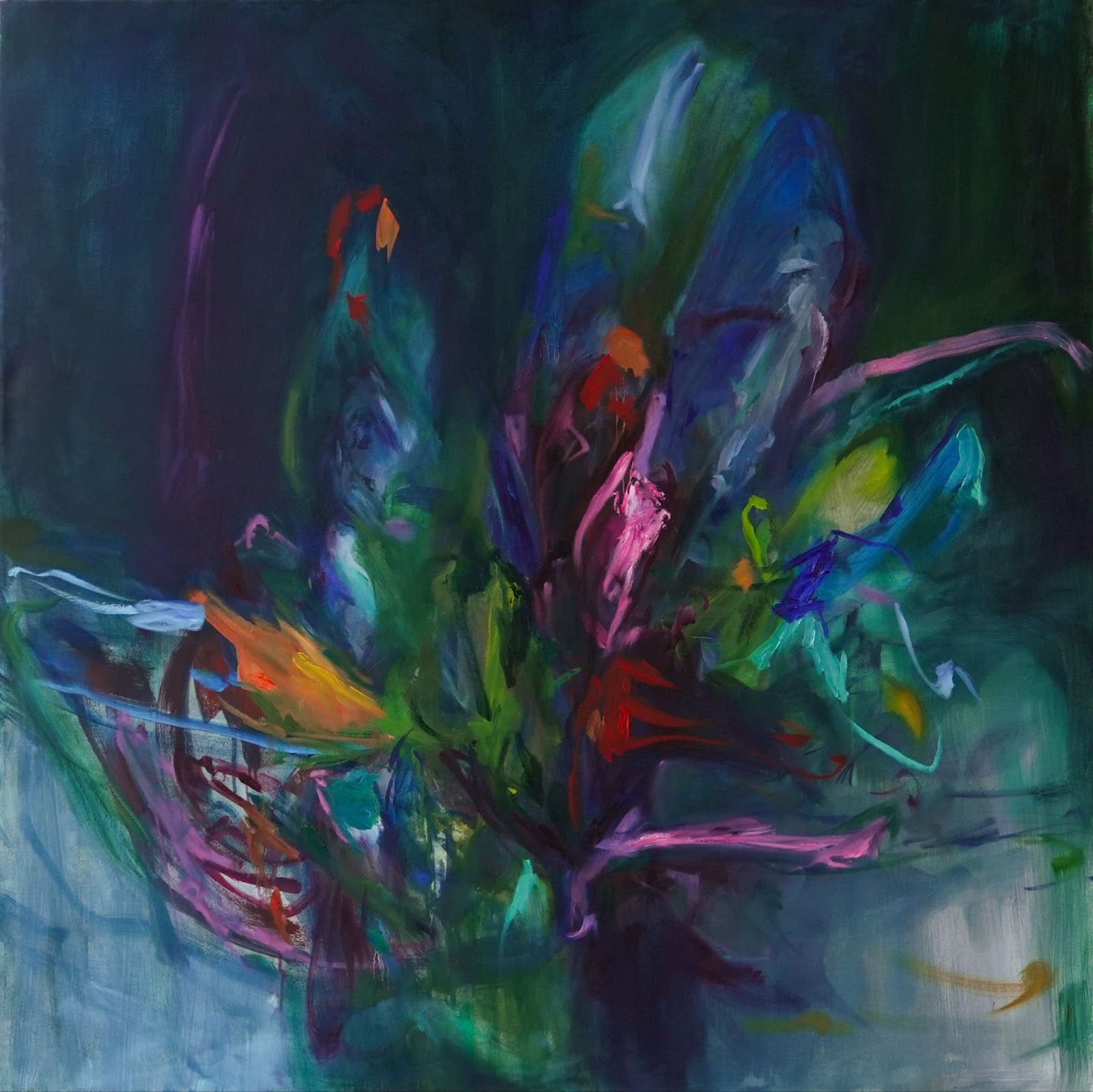

Two paintings by Lindsay Adams from "Ceremony." Left: "Lotus Blossom (1968)," 2025, 48" x 48", oil on canvas. Right: “Kind of Blue," 2024, 72" x 168," oil on canvas. (Courtesy of Lindsay Adams)
For “Ceremony,” Adams and curator Claudia Watts arranged these dreamlike paintings alongside archival materials that explore how Black Americans have created their own spaces through travel. It brings together documents such as the Green Book — a mid-20th century guide of safe spaces for African Americans driving through the South — and ephemera from trips to Europe, such as a letter Hazel Scott wrote to Billie Holiday from Cannes, France, and a 1954 Show magazine spread on Holiday’s successful European tour. The exhibit highlights how, despite racism’s hold on Black Americans’ opportunity, mobility has also been a source of power.
As a rising star in the art world, Adams is often on the road. But the show at the Frary Gallery, along with work currently appearing in an exhibit at Hamiltonian Artists, have also given her reason to visit home.
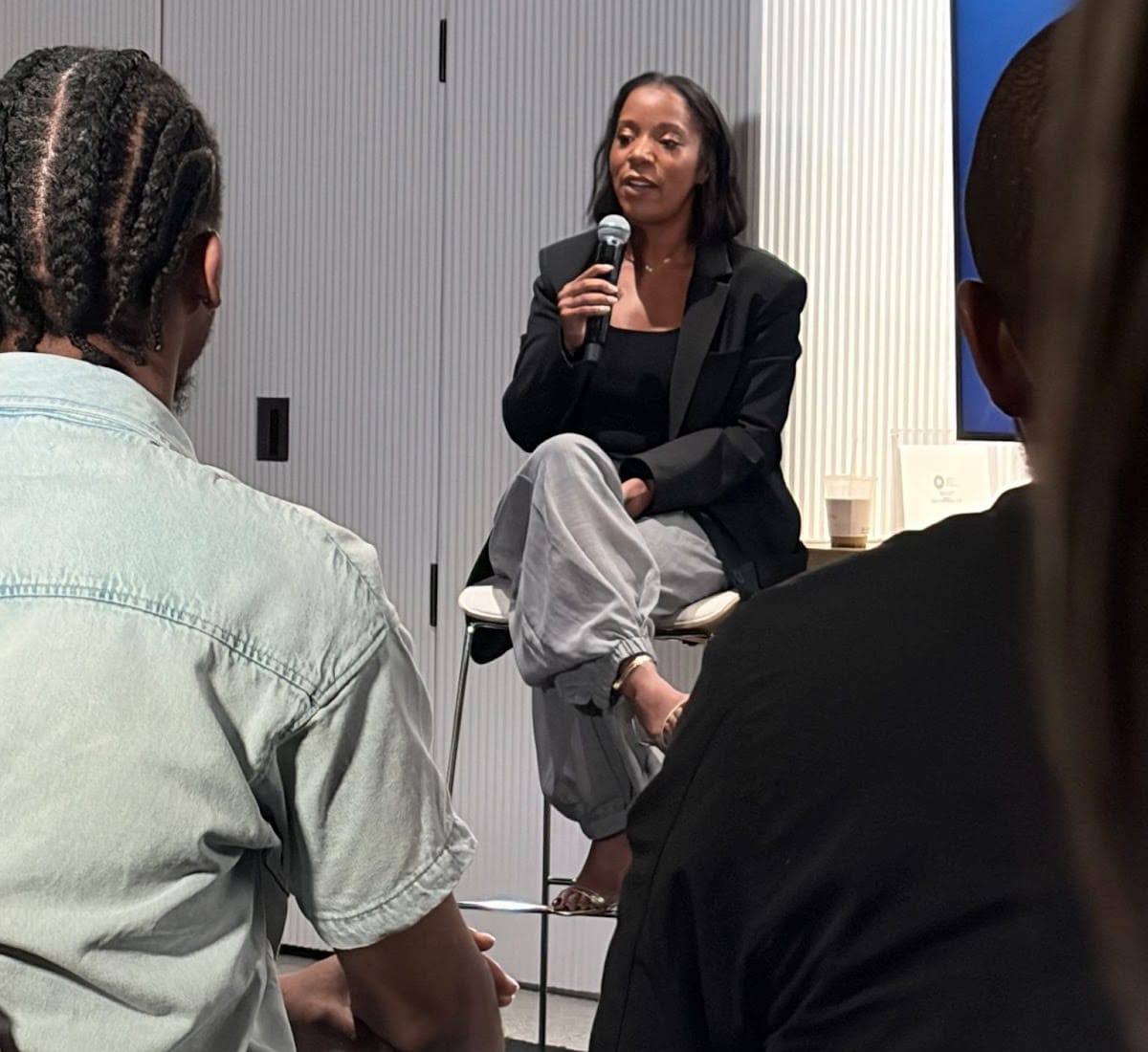
“There is conversation around whether D.C. is a good place for artists,” says Jamal Gray, a curator with Torrents, a project of CulturalDC focused on Black artistic innovation. He notes that the region can be a wonderful place for development, with grants from the DC Commission on Arts and the Maryland State Arts Council, but it often isn’t enough.
“Artists have to go to New York, Los Angeles, or London to make a career in art making,” he explains.
Gray has been part of efforts to change that, including the Umbrella Arts Fair, an annual fair run by USAN USAN. Adams (whom he asked to speak at this year’s fair) points to it as a place where D.C. artists are shown and supported, along with the Chela Mitchell Gallery; The Nicholson Project, an artist residency in Southeast; and Down Gallery, run by Maleke Glee and Quinci Baker.
With friends and peers keeping the heartbeat of the arts scene she grew up in, Adams will always be connected to the District.
“Even though I’m not physically there, I’m there,” she says. “D.C. would never not continually be a part of my story. And I wouldn’t allow it not to be.”
Correction: This article has been updated to reflect Adams’ current academic status, to remove incorrect information about an exhibition earlier this year in Los Angeles, and to correctly credit the team behind Down Gallery.

The District made streateries permanent. But restaurant owners say the rules are too costly and complicated to keep them up.

D.C. is a city full of creatives, but sometimes finding community takes a little research.


The artist and activist has been photographing an ever-changing city for more than six decades.


The best present is … the promise of future presents, especially when they celebrate our city.

With your help, we pursue stories that hold leaders to account, demystify opaque city and civic processes, and celebrate the idiosyncrasies that make us proud to call D.C. home. Put simply, our mission is to make it easier — and more fun — to live in the District. Our members help keep local news free and independent for all: