

Opinion: Regulators aren’t the main reason for your spiking energy bills
The officials who oversee Pepco don’t have control over a majority of the increases in your bill, writes Public Service Commission Chairman Emile C. Thompson.
The officials who oversee Pepco don’t have control over a majority of the increases in your bill, writes Public Service Commission Chairman Emile C. Thompson.
Steep city budget reductions mean patients are going without medicine, losing teeth, and living with pain.

They collect memorabilia and create tributes to the iconic system.

They collect memorabilia and create tributes to the iconic system.

I knew I was talking to the right person when David Anderson was recognized at the Metro pop-up shop in L’Enfant Plaza.
“Are you the paper model guy?” a stranger nervously asked.
Anderson was holding an eight-inch-long paper replica of a Metro railcar in his hands, one of the dozens of models he has painstakingly recreated and shared on social media under the handle @DCMetroMaker. Anderson doesn’t just ride Metro, he reveres it. And he’s not the only one.
The 21-year-old (who says this wasn’t the first time he’s been recognized) and his newfound friend showed off their fare cards – including ones they had picked up from other systems – before we resumed our chat.
While Metro is simply utilitarian for most of us, it’s an object of fascination for a small-but-dedicated group of fans – a transit system that defines the region and serves as a placemaking icon.
The Washington Metropolitan Area Transit Authority is marking 50 years of service with a celebration at Metro Center on Friday morning (and there’s an unofficial birthday party at Metrobar, itself created out of a decommissioned railcar). But since Metro doesn’t have its own archives or museum, diehards like Anderson have become a decentralized network of historians, transit archeologists, and keepers of the faith. They scour eBay and antique stores for memorabilia, collect official WMATA schwag that others may simply toss in the trash, archive old photographs, and talk all things Metro on Reddit and Discord.
“For most people, the Metro is the one part of the day they want to skip because it’s their commute,” says Thom De Boo, a D.C. resident and YouTuber who may well qualify as a transit influencer. (He has 113,000 followers.) “But for me finding something exciting in something so mundane makes life so cheerful.”
Anderson’s been alive for less than half the time Metro has, but he’s been fascinated by the transit system since as early as he can remember.
“My Dad took the Metro to work every day, so my first Metro ride was when I was three. I was obsessed with it. The map was my main obsession. I could draw it by heart when I was very young, and I could name almost all the stations. I had maps in my room,” he recalled as we perused the Metro-branded t-shirts and tote bags at the pop-up shop, which is open until April 12. (Meeting there was Anderson’s idea, of course.) “It just kinda grew from there. Being able to see the system run in perfect time, everything is organized, it was just always so cool for me.”
As a kid, he used Lego to build his own model Metro railcar. He attended the opening of the Silver Line’s first new five stations in 2014, the remaining six stations in 2022, and the new Potomac Yard station in 2023. It was around then that he started picking up Metro odds-and-ends, including a Willy Wonka-style ticket to be first to ride the Silver Line, Metro-branded water bottles, and felt pennants. (He’s since digitally recreated and printed dozens of other Metro pennants.)
With the help of eBay, that collection has continued to grow. Anderson got a decal that was put on Metro’s railcars for the system’s 25th anniversary, as well as a commemorative map and photography book from the same milestone. He also picked up an old Metro jigsaw puzzle and an employee system map listing the special codes that are used for each station during emergencies. He’s got a small collection of old paper farecards and SmarTrip cards – when we spoke Anderson had just procured the new cherry blossom-themed card – and, his best find: a pair of blue-vinyl Metro seats.
“I got those from WMATA itself. It was just extra supply they had, and I saw it and said, ‘I have to have that,’” he says. (For comparison, diehard sports fans were able to buy old seats out of RFK stadium before it was demolished.)
D.C. resident José Romero has his own small collection of Metro memorabilia – Metroabilia? – including old metal tokens that were used for Metrobus before the rail system was even built out. He also has old Metro user manuals, including one from 1977 – when there were only two lines and two-dozen stations.
“They are an amazing part of local history and I hope more people collect before these pieces disappear forever,” says Romero, 48, who works in IT and lives near the NoMa Red Line station.
That these collectors exist serves a bigger purpose, says Zachary Schrag, a George Mason University professor who literally wrote the book on Metro: “The Great Society Subway: A History of the Washington Metro.” Without them, he says, some of Metro’s history may well be lost altogether.
“Historically, the agency has been very bad about preserving its own history,” he says. “They’ve never hired a librarian, they’ve never had an archivist. The culture is not strong in terms of that. It’s not like New York or Los Angeles where they have more established institutions for preserving their own history.” (Metro did not respond to questions about its archival practices.)
Schrag says he doesn’t own much Metro memorabilia himself. But his wife did score a prized possession for him: one of Metro’s iconic reddish-brown hexagonal floor tiles. “I went to a craft store and got some felt for the bottom,” he says. “It’s either a large coaster or a small trivet.”
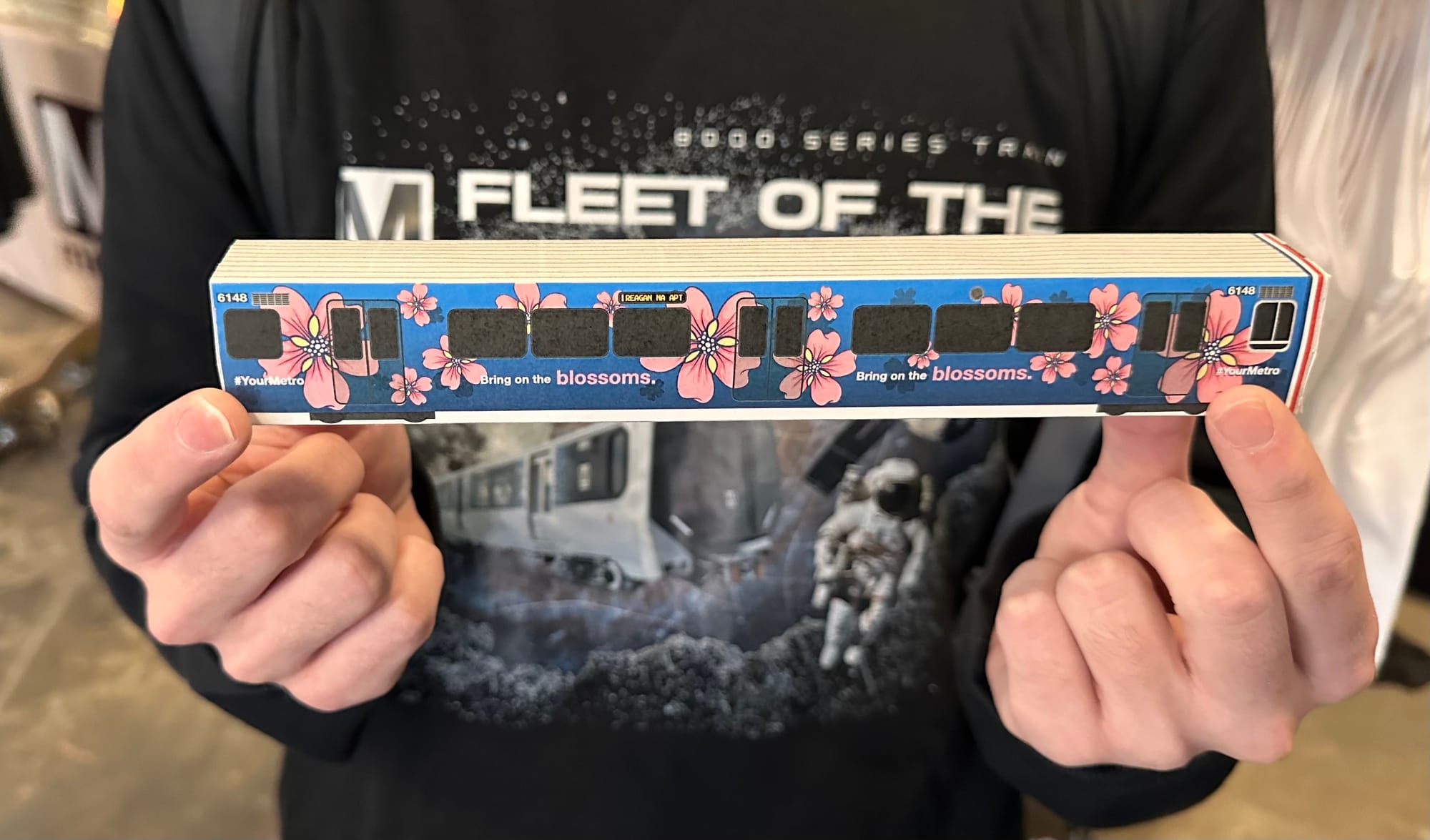
Many Metro enthusiasts are not just collectors, but creators.
Anderson, who grew up on the Red Line in Maryland but now uses the Green Line to get to the University of Maryland, started making his paper models amid the pandemic. He’s made 150 of them to date based on real railcars that Metro has used over the years.
“That led me down a rabbit hole of finding more designs to make. I looked into Metro’s history and it’s not as well documented as other systems,” he says. “Finding pictures of Metro’s history was just so difficult, so I started archiving all the ones I found online and now I have 3,000 images saved. I’m trying to save everything I can.”
De Boo, 26, has similarly used Metro’s history for inspiration. After learning that a designer had been commissioned to make icons – or pictograms – for every station when the transit system was first built, he decided to create his own versions. De Boo not only designed a new pictogram for all 98 stations, but made a 30-minute video explaining the process.
The pictogram for the National Zoo’s station? A panda, of course. And McLean? A piggy bank (in reference to the Capital One Bank headquarters). As for Cheverly, it’s a tux, since Tuxedo, Maryland is near the station.
Ethan Ableman, 31, made his own useful Metro graphics: detailed diagrams of every station showing exactly where the escalators, elevators, and exits are located, allowing people to figure out how to most quickly get out of a station. Last year, a group of friends used his diagrams on a quest to not only visit all 98 stations in one day (known as a Metro speed-run), but actually swipe into and out of them.
For Ableman, what makes Metro such an obsession – he’s been known to watch every board meeting, and write summaries that he posts on the WMATA subreddit – is what it means for D.C. “It’s become a very palpable symbol of the city,” he says. “When people outside the region think of D.C., they think of the monuments and the Mall, but I think of the Metro and how it looks.”
And if there’s one thing that ties many of Metro’s diehards together, it’s the value they see in the service it provides.
“Most kids want a car to have the freedom to go wherever they want, but just being able to hop on the Metro and get anywhere around D.C. is great,” says Anderson. “In the past few years, I’d choose a stop on the map and go there and walk around the stop for a few hours and see what’s there because it’s fun, and why not?”
As our conversation in the Metro pop-up shop wound down, Anderson bid his farewell. He was planning on buying a few things for himself – and head off to find Metro’s commemorative cherry blossom-wrapped train.

Steep city budget reductions mean patients are going without medicine, losing teeth, and living with pain.

Feds say the 15th Street protected bike lane will cause more traffic during cherry blossom season, but bike advocates say it makes everyone safer.

The three-month sprint to the June 16 primary election is on.

It never became the network D.C. promised, but it did shape life along the corridor.

With your help, we pursue stories that hold leaders to account, demystify opaque city and civic processes, and celebrate the idiosyncrasies that make us proud to call D.C. home. Put simply, our mission is to make it easier — and more fun — to live in the District. Our members help keep local news free and independent for all: