

Why support billionaire-free news TODAY?
Your gift will be DOUBLED with less than a week left in the fundraiser to grow our editorial team
Your gift will be DOUBLED with less than a week left in the fundraiser to grow our editorial team

Plus, recess at the Capitol, a community clean-up, and more ways to get involved in D.C.

Pepco has faced increasing scrutiny over expensive customer bills in recent months. A new ruling could have a lasting impact on how the utility calculates its rates.

Karamo Brown's visit to the DC History Center, which documents queer history in the District, was featured in the final season of the hit Netflix series.

Attendees of a Queer Eye watch party at the DC History Center last Friday got a big surprise when the building they were sitting in showed up on screen.
The hit Netflix show has served up makeovers, home renovations, and a lot of emotional conversations across the country over the last eight years, and last summer The Fab Five filmed their final season in the District. While national media attention has focused on allegations of emotional abuse and bullying, its first episode put a spotlight on an under-appreciated aspect of D.C.: its rich queer history, and the work community institutions are doing to preserve it.
“I thought the episode did an incredible job of showing how much D.C.'s queer history is connected to D.C.’s queer present,” said Emma O'Neill-Dietel, Totman Fellow at the DC History Center. “It's especially important to study and to share queer history to unearth those stories for the people who need them as role models, as motivation, as something to carry them forward in the present.”
The season premiere, which was played at the watch party, follows sisters and native Washingtonians Jo and Dorriene Diggs. When Dorriene’s partner of 40 years, Diane, passed away in 2020, Jo took her in. At first glance, sharing a home seems to be the only thing the two sisters have in common. Dorriene is reclusive, staying in her bedroom and avoiding relatives, and Jo is outgoing and family-oriented. The Fab Five are determined to bring Dorriene out of her shell and repair the relationship.
Relatively early in the episode, Dorriene begins to open up about the difficulties of being the only lesbian in her family and the pain of losing Diane. Karamo Brown takes the sisters to the DC History Center to talk with Ashley Bamfo of the Rainbow History Project, a volunteer-run archival project that documents queer life and activism in the District, including by recording oral histories.
Throughout the episode, the audience at the DC History Center’s screening laughed, cried, and clapped as the sisters discovered more about each other, and as Dorriene recognized that her experience as a Black lesbian growing up in the District in the 1960s and 1970s mattered, not only to her but to future generations.
“I felt that I could relate to her story, very much so,” said Bamfo, who serves as the organization’s treasurer. “She's an elder, and we’re trying to hear stories of elders in our community, and elders who have paved the way for us to be who we are as well.”
Josette Desmone, who attended the screening with her partner Kai Walther, said that she’s used to engaging with queer history in writing, so watching a personal story represented “as part of the “historical record” on a show like Queer Eye “really brings that history to life and makes it all that more meaningful.”
The DC History Center’s collaboration with the Netflix production team fell into the organization’s lap, said Laura Brower Hagood, the organization’s executive director. “They did their homework,” she told The 51st. “I think they really understood the importance of Dorriene’s story.”
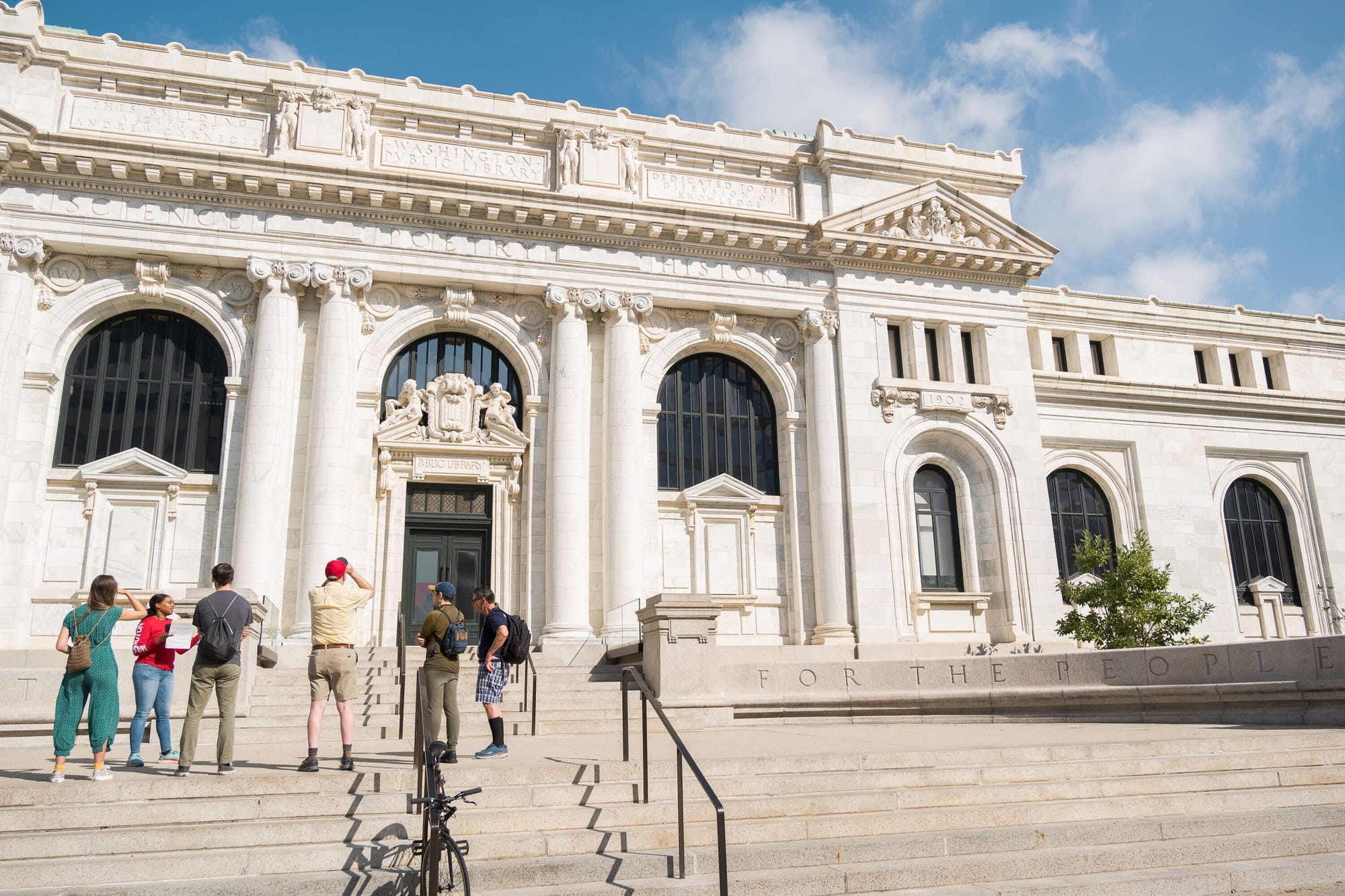
Located on the upper floor of the Apple Carnegie Library, the center is home to tens of thousands of archival materials — from books and periodicals to photographs, maps, and other significant objects. Since 2008, the center has held the Rainbow History Project's physical archives which, according to Hagood, is currently visitors’ most-requested collection, along with the center’s largest and fastest-growing. Since launching in 2000, the project has accumulated and preserved over 40 collections featuring artifacts such as buttons, banners, photos, pamphlets, and newsletters on topics including the Lesbian and Gay Chorus of Washington and the AIDS Memorial Quilt. Anyone can access these materials in person by making an appointment.
Online, the Rainbow History Project has several digital collections, including a list of noteworthy local LGBTQ+ “community pioneers.” It includes changemakers like trans right activist Earline Budd, who successfully sued a D.C. skating rink for barring her from entering due to being a trans woman in the late 1980s. There’s also Lou Chibbaro Jr., Washington Blade Senior Reporter who has covered queer stories in the District for over three decades, Carlene Cheatam — one of the primary organizers of Black Pride in D.C., and internationally-renowned documentary artist Joan E. Biren.
There’s also their Places and Spaces database, a map of significant locations for D.C.’s queer past and present. Washingtonians can use the map to find places like the Adams Morgan house that was once home to lesbian communal living and writing group The Furies Collective in the 1970s — as well as institutions still around today, such as St.Thomas’s Episcopal Church, which held the Alliance of Multi-Cultural Bisexuals conference in 1992.
And as seen in the Queer Eye episode, the Rainbow History Project also records oral histories. These first-person accounts let queer Washingtonians describe how they navigated life.
“One thing we always say is that everyone has a story,” Bamfo said. She added that they've procured so many audio interviews that they're always welcoming more volunteers to help them with their backlog.
Researchers can filter conversations by historical period or by searching through hundreds of tags, like religion and faith, bars and clubs, or education and schools. The interview Dorriene recorded at the center isn’t yet in the collection, but Bamfo said the Rainbow History Project is in talks with Netflix to acquire it.
The Rainbow History Project’s physical and online records aren’t the only ways to access the District’s LGBTQ+ archives. The D.C. Public Library’s People's Archives, for example, has a focus on local LGBTQ+ culture. The Queering the District podcast dropped its first season last year, which highlighted the history of D.C.’s queer third spaces — like the city’s longest-running lesbian bar. And in February, Off The Mall Tours is offering a walking tour called “Queer Black Broadway,” where you can learn more queer Harlem Renaissance artists in early 20th century Washington.
“You can find a piece of yourself, I think, in every part of queer history in D.C.,” said Bamfo. “I feel like it makes the community very melted together.”
“It's just very colorful,” she added. “Maybe just like a certain flag we all know.”

The Duke Ellington School of the Arts graduate was recently named artistic director of the country's fourth-largest Black dance company.


The history of D.C.'s official dance.

By creating content, merch, and experiences that are for and about Chocolate City


Seven area natives share how the spirit of Chocolate City is still alive.

With your help, we pursue stories that hold leaders to account, demystify opaque city and civic processes, and celebrate the idiosyncrasies that make us proud to call D.C. home. Put simply, our mission is to make it easier — and more fun — to live in the District. Our members help keep local news free and independent for all: