

Find your action: Your weekly Civics Roundup
Plus, celebrating five years of Harriet's Wildest Dreams, and more.
Plus, celebrating five years of Harriet's Wildest Dreams, and more.

Say goodbye to the cherry blossoms — and hello to a spicy comedy festival, a basketball tournament featuring local bands, and more.

It never became the network D.C. promised, but it did shape life along the corridor.


When the DC Streetcar opened in 2016, it was to be the start of something greater: a network connecting underserved neighborhoods to the rest of the District and a stimulant for redevelopment on H Street. But the line never grew past its initial 8 stops and 2.2 miles of track, and, just a month after its tenth birthday, it will shut down entirely this month.
While some residents are ready to put an end to the extra hassles the streetcar brings to the roadway, many others have come to rely on it and are mourning its impending loss. With less than two weeks until its last run rattles down the Hopscotch Bridge, riders are reflecting on the role it played in the corridor — and making alternate plans to get around.
Henry Sattlewhite lives on the eastern end of the H Street/Benning Road Line and frequently takes the streetcar to go grocery shopping, visit Family Dollar, and see his doctor. When the line shuts down on March 31, he thinks he’ll take the bus, but isn’t sure.
“My doctor told me to catch the 90 bus, whatever… catch it and come back home,” Sattlewhite said. But he isn’t confident. “I don’t know what we’re going to do now.”
Candice Jackson regularly rides the streetcar with her son from their home on 19th Street, near the route along Benning Road, to his preschool near Union Station, at the end of the line.
She emphasized the impact it will have for families taking children to schools along the corridor: “It’s going to be a little bit harder for parents, single parents,” Jackson said. “They gotta take their kids back and forth.”
Jackson acknowledges she can take the bus — and sometimes does — but says those who claim it can easily replace the H Street Line understate the reliability of the streetcar.
“The bus … it may save two minutes, but it may take 20 minutes,” she said. “The streetcar, you know it’s definitely coming.”
The D20 and D2X Metrobus lines parallel the streetcar’s route down H Street and Benning Road, in fact going even farther, bringing riders to Metro stations at Minnesota Avenue and Gallery Place. WMATA and DDOT have suggested streetcar riders shift their commutes to these buses while replacement plans take shape, but bus riders worry that it will have the effect of making their rides longer and more crowded.
Alana Faust and Trey Moore both take the D20 to work downtown. A little before 9 a.m. on a recent Tuesday, they were waiting at the crowded bus stop at H and 6th Streets with Paige Smith, a streetcar rider who chatted with them while keeping an eye on the stop at the opposite side of the intersection. All three were upset about its demise.
“It’s gonna cause a lot of disruption for a lot of people,” Moore said. “More people on the D20, and longer commute times.”
As Faust and Moore craned their necks to watch a D20 bus crawl through H Street traffic, Smith said she worried especially for the elderly and disabled people who rely on the streetcar as an accessible and fare-free link along the corridor. Though the city initially planned to charge riders, it never implemented a payment system.
Smith argued that it would be unfair to remove a free transit option that Northeast residents had relied on for a decade. “If they’re going to do that, they need to come up with other free alternatives for people,” she said, before running to meet the streetcar on the other side of 6th Street.
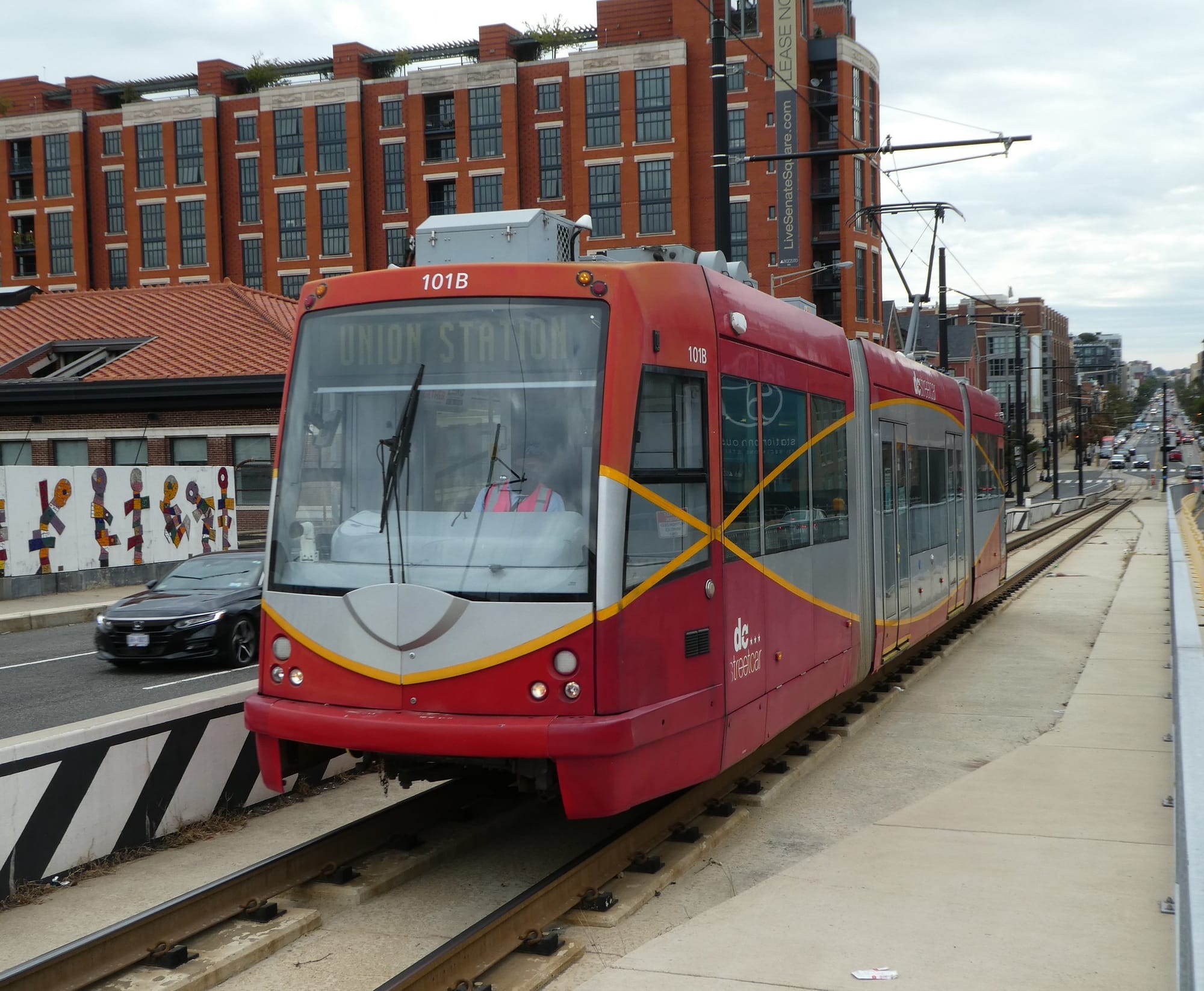
Transportation planners originally envisioned the line as part of a system extending to Georgetown and Anacostia, with crosstown routes along K Street. After a failed push to build the first route in Anacostia, then-Mayor Anthony Williams first broke ground on the H Street/Benning Road line in 2007. It was a key component of a 2000s-era District plan to lure new businesses and development to the H Street corridor.
Ken Petersen has lived in the neighborhood since the early 1990s and remembers the city’s push to redevelop the corridor well. “I’ve seen H Street totally transform,” he said.
A once-vibrant corridor for Black nightlife and culture, H Street had suffered since unrest in 1968 following the assassination of Dr. Martin Luther King, Jr. devastated the neighborhood. Back when he arrived in the 1990s, Petersen said he couldn’t get taxis to drop him much further east than Union Station: “They’d just stop at about 10th Street,” he recalled. “It was really hard to get people on to the idea of H Street being a destination.”
Bars and businesses had begun to return to H Street in the 1990s and early 2000s, and the District thought a streetcar could help further revitalize the neighborhood. Petersen remembers the streetcar’s arrival as a core piece of the redevelopment: “We’re going to have kind of a novel form of transportation, it’s gonna be free, and maybe pull people onto H,” he said.
For a time, the corridor seemed to be thriving. Restaurants opened, housing construction boomed, and core services like grocery stores and pharmacies returned, though the growth also often had the effect of pushing longtime residents out of the neighborhood.
Rashaun Parks, a UDC student and filmmaker who works in a studio on H Street, credits the streetcar line as one of the reasons he chose to put his office there.
Once it stops running, Parks says he’ll drive into the office instead. It costs $8 to park at his office — a heftier toll than the free streetcar ride. Plus, he’ll miss out on exploring the businesses and shops as he heads down the corridor after work: “I wouldn’t be able to get down H Street and go to all the fun stuff.”
Not everyone is mourning the end of the streetcar, though. Josh Opare and his family run Open Crumb, a Ghanaian cafe on the corner of H and 8th Streets. He says the streetcar has been nothing but a boondoggle.
“It’s a gigantic waste of our city’s resources,” Opare said. “As a District resident, I’m seeing how little money we have right now. Looking back at it, I don’t think it was really thought out as clearly as it should have.”
Opare argued that any impact the streetcar had on H Street’s redevelopment had long vanished. And indeed, the neighborhood has struggled in recent years (as one Washington Post headline put it: “H Street was once a symbol of D.C.’s rebirth. Now, it’s barely holding on.”) He says the streetcar only makes it more difficult for customers to find parking and clogs traffic on the corridor.
“It has no real practical use because it’s slower than walking. … It goes just, like, the length of H Street,” Opare added. “If you have a transportation system that makes it harder to park … it has to be really beneficial to the area. And this wasn’t.”
The District Department of Transportation reported 853,445 streetcar rides in the 2025 fiscal year — the line’s highest ridership since the COVID-19 pandemic, but still a far cry from 2019, when it counted almost 1.2 million rides. The District spends around $10 million a year to operate the line (its shutdown follows the District’s elimination of DC Circulator bus service at the end of 2024, for similar budgetary reasons.)
“I’ve never seen how it could be economically viable,” said Peterson, who isn’t surprised the streetcar is shutting down.
But over the past decade, it became integral to his family’s life. Living on 13th and G, he takes the streetcar to Capitol Hill Hot Yoga — owned by his wife — at 4th and H, and uses it to bring his daughter to school at Two Rivers Public Charter School, by the streetcar’s eastern terminus. “It connects all the dots in my life,” Petersen said. “It’s just been so easy.”
For commuter Lindsay Daniels, the open question remains the streetcar’s replacement: If the original project opened late, went over budget, and only lasted a decade, what can H Street riders expect from DDOT in the future?
When the closure was initially announced, Mayor Muriel Bowser said that the streetcar would be replaced by electric buses that are powered by the existing overhead cables in 2028 or 2029. But the closure came a year earlier than originally planned, and it’s not clear if or when they will be put in place (a separate plan to add bus-only lanes to H Street has also been paused.) DDOT did not respond to a request for comment about replacement service.
A spokesperson for WMATA said it doesn't have any immediate plans or a timeline for running electric buses in the corridor. The transit agency also said that existing Metrobus lines have sufficient capacity to accommodate streetcar riders, so there aren't any immediate plans to add or change service, though it will monitor conditions along the corridor and adjust if necessary.
Daniels lives on the corner of 10th and H Streets and takes the streetcar to Union Station on her way to ride the Metro to work. Sometimes, she walks to the station — but due to chronic pain, the streetcar is her preferred mode of transit for the first part of her commute.
Like Petersen, she sees the city’s rationale for shutting down an expensive and singular transit service. Yet Daniels feels the District had an opportunity to connect disjointed neighborhoods and fears that, with the streetcar’s shutdown, they will abandon that goal. If the streetcar had continued down Benning Road, it could have connected lower-income communities in Northeast not only to H Street but to the wider city, she said.
Come April, Daniels will take the bus all the way to work, or perhaps walk to the Metro at Union Station. But she’s more focused on what the District government’s next steps are.
“They need to think through what the replacement’s going to be, and how it’s going to serve the population,” Daniels said, as the streetcar slowed to a stop at 3rd Street and passengers disembarked with grocery bags and strollers. “Here, and further out.”
This story was updated with comment from WMATA.

Steep city budget reductions mean patients are going without medicine, losing teeth, and living with pain.


They collect memorabilia and create tributes to the iconic system.


Feds say the 15th Street protected bike lane will cause more traffic during cherry blossom season, but bike advocates say it makes everyone safer.

The three-month sprint to the June 16 primary election is on.
With your help, we pursue stories that hold leaders to account, demystify opaque city and civic processes, and celebrate the idiosyncrasies that make us proud to call D.C. home. Put simply, our mission is to make it easier — and more fun — to live in the District. Our members help keep local news free and independent for all:

