Renters at Faria Management properties say they're battling mold, rats, sewage leaks, and intimidation. They believe a reckoning for unaccountable landlords is finally here.
D.C. tenants say Buwa Binitie runs an empire of neglect. Now, they're fighting back.
Renters at Faria Management properties say they're battling mold, rats, sewage leaks, and intimidation. They believe a reckoning for unaccountable landlords is finally here.
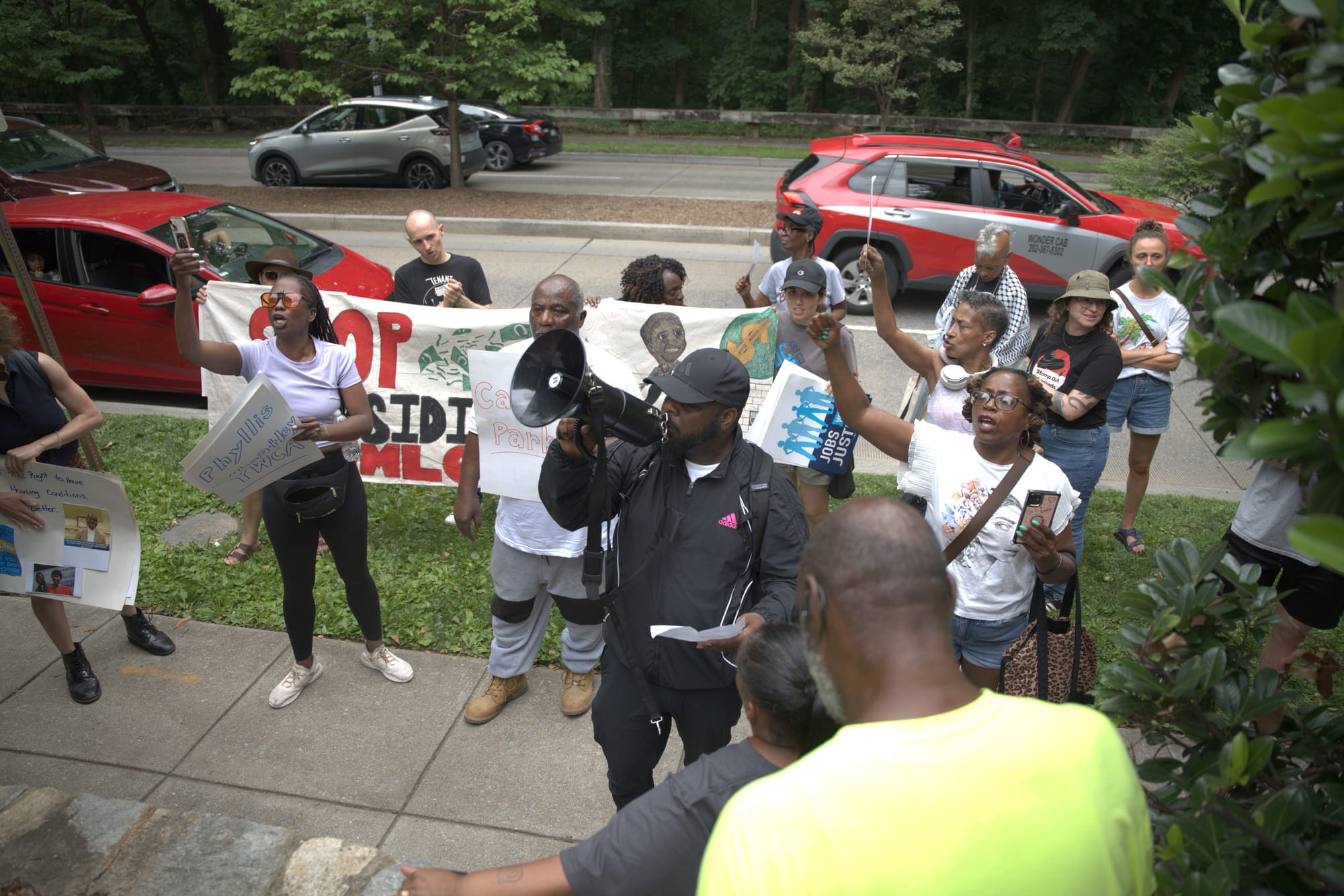
Nathan Hunter-El, an organizer with Empower DC and a former resident at the Faria-managed Capitol Vista Apartments, leads a coalition of Buwa Binitie's tenants in a march through his neighborhood. (Abel Berhane)
They strategized in libraries, nonprofit halls, and public parks, united by one goal: get Buwa Binitie out of D.C.
Drawn from across the prominent developer’s sprawling housing portfolio, dozens of his tenants had united in their shared misery for months, first finding solace in others who understood their struggles, then motivation to fight their circumstances together. Now, on a sweltering June afternoon, they were bringing the battle to his doorstep.
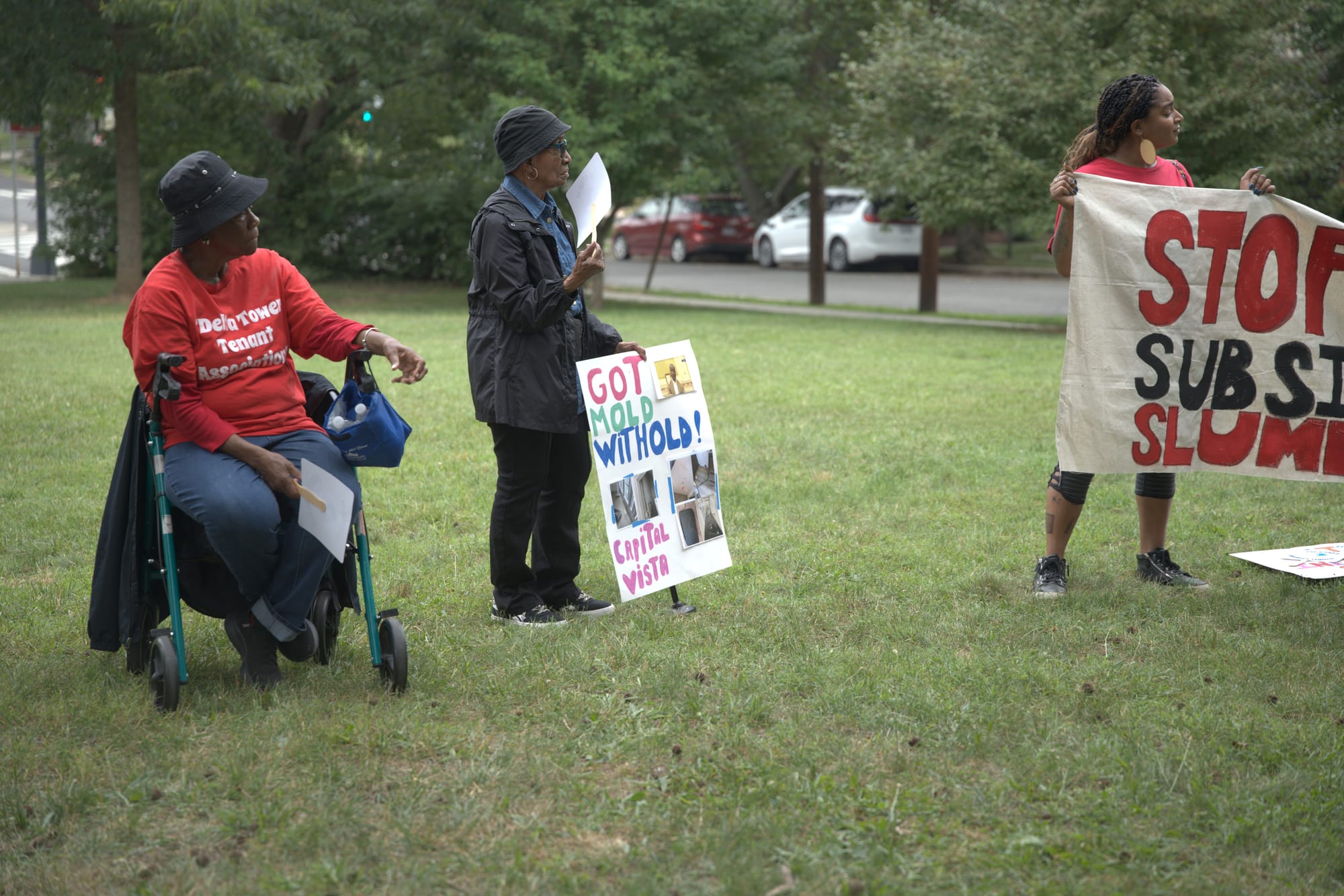
“We should not be meeting today to ask for basic living conditions that should be mandatory,” David Da Silva, tenant association president of The Residences at Georgia Avenue, said to his fellow renters. They had gathered at Marvin Caplan Park in upper Northwest for their first major action as a cross-building coalition: a march to Binitie’s own home three blocks away to demand changes to theirs.
They walked from the park, moving slowly to accommodate seniors with walkers, carrying a letter that read: “We cannot accept the continued neglect of our homes, the disruption to our peace of mind, or the harmful impacts these conditions have had on our children and families.”
Binitie and his company, DP Management LLC, better known as Faria Management, oversees more than 1,000 apartments in D.C., according to their website. For these tenants, it amounted to an empire of neglect. At the Benning Park Apartments in Marshall Heights, they said raw sewage was seeping from the ground into their building; at Cascade Park Apartments in Washington Highlands, they said rodent infestations plagued their homes, and at Columbia Heights’ Urban Village Apartments, they said mold grew “like an experiment in a petri dish.”
For years, tenants in Faria-managed properties have waged individual battles — filing complaints that led to millions of dollars in housing code violations, testifying in front of the D.C. Council, contacting the city’s Attorney General, and filing lawsuit after lawsuit. Many believed their problems were theirs alone, until tenant organizers brought them together this year, uniting them across buildings and across their accounts of brutal living conditions. Now, tenants believe they finally have a shot at real change, not just for themselves but for renters across the city.
As DaSilva told his fellow tenants that day in the park: “Let's stand together from Southeast to the tip of Northwest. We have got to fight because Buwa has got to get the fuck on out of D.C.”
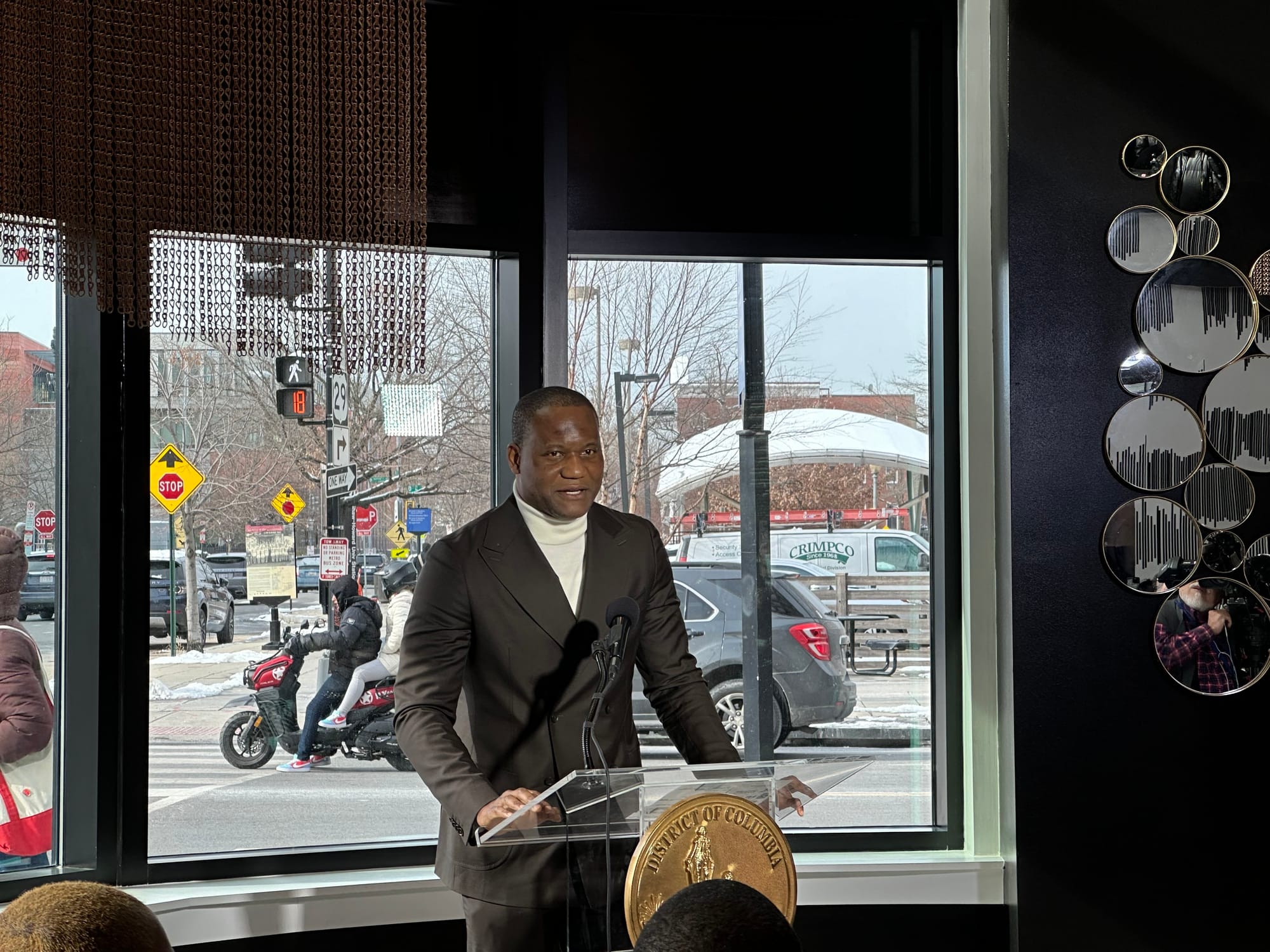
Buwa Binitie at a 2024 groundbreaking for a new building in Shaw. (Alex Koma)
Truth and consequences
Binitie has been thrust into the headlines in recent weeks. First, D.C. Attorney General Brian Schwalb sued him for “extreme and pervasive disrepair” at his Florida Avenue location, the Delta Pearl. Then, his lawyer — former D.C. Attorney General Karl Racine — crashed a news conference the tenants had organized to publicize their plight and urge D.C. Council to reject a proposal to give a chunk of public land at the St. Elizabeth’s Hospital campus in Southeast to Binitie.
But the rise in public attention has often obscured the people who helped lay the groundwork for this reckoning.
"They are truly incredible," supervising attorney with Bread for the City, Christine Kim, said of the tenant coalition. "In the face of intimidation and retaliation, they've come together to build power among the residents."
Binitie did not respond to a detailed list of questions from The 51st, despite multiple emails. But in July, he responded to the tenants’ coalition in an email obtained by The 51st, saying he was committed to providing “safe, decent, well-maintained housing.” He blamed “significant and prolonged rent delinquency” for the tenants’ problems.
“[The] level of nonpayment has materially impaired the properties’ ability to pay for basic necessities, including utilities, trash removal, maintenance vendors, staffing, insurance, security, repairs, and general upkeep,” he wrote.
While the judge in the Delta Pearl case ordered at the end of September that Binitie and his companies fix a litany of severe housing code violations — including repairing the elevators, sanitizing the stairwells, providing security, treating rodent infestations, and addressing the non-working HVAC systems — the tenants say the Delta Pearl is only the tip of the iceberg, and that their efforts are just getting started.
Benning Park lights the match
For many residents, the alleged scale of the problem at Faria properties became clear for the first time last October.
“Since moving into Benning Park, my family has endured serious issues: water leaking in the bathroom and from the toilet, a partially detached sink, and a bullet hole in the bedroom window, and mold growing on the walls,” said Charelle Williams of her life in the Southeast apartment complex at a D.C. Council Committee on Housing roundtable on improving substandard conditions in the city’s rentals.
Williams described the worsening impacts of the mold and rat infestation on her son’s asthma, and said that multiple complaints had gone unaddressed. Former Benning Park tenant Cheryl Woodland described her mother, who was still a resident, going without a refrigerator for an entire year. She said they’d bring in coolers to keep her food on ice, adding that they also woke up to dead mice in the middle of the apartment.
Sitting a few feet from Binitie, who also testified, Woodland described feeling like she was sinking in a pool while a lifeguard watched, but since “he’s dressed up in a nice shiny suit,” she said, there’s “no need in trying to get his attention.”
“So you feel like you're just going to drown,” said Woodland.
Benning Park resident Shayna Woodward, who also testified, said in an interview later that sewage leached into her building’s basement. Once, she said the ceiling in her kids’ room caved in. She couldn’t get it repaired for an entire month.
In his in-person and written testimony, Binitie said Benning Park was a "stark example" of property deterioration caused by tenants not paying their rent.
“We are seeing tenants with months of unpaid rent weaponize [Department of Buildings] filings — not as a means of ensuring safe housing, but as a tactic to delay or avoid rent obligations,” he said. “This undermines the integrity of our housing system and places further strain on providers attempting to stabilize properties.”
The Small Multifamily & Rental Owners Association, an industry group, has estimated, based on self-reported data from landlords, that D.C. has over a billion dollars in unpaid rent, which has impacted affordable housing development and management. Housing advocates argue, however, that any problems with unpaid rent stem not from tenants’ unwillingness to pay but from a severe lack of affordable housing, and in some cases, substandard conditions.
In D.C., tenants can file a lawsuit in Housing Conditions Court, have some or all of their rent reduced in an eviction case, or withhold rent if they experience serious housing code violations.
While Faria ceased management of Benning Park the following month, the testimonies served as a catalyst. With the help of housing advocates and organizers, renters at other buildings began to connect the dots. It wasn’t just one Faria-managed property in D.C. facing accusations of neglect; it was almost all of them.
(Abel Berhane)
Stronger together
In early 2026, legal providers and organizers started connecting tenants at Faria properties to each other. Advocates at organizations including Bread for the City and Empower DC had been working with tenants at Benning Park since the previous year as part of the Eviction Prevention in Communities project, a government-funded initiative that helps low-income tenants avoid displacement.
"We had identified huge issues at Benning Park, but as we talked with this larger group of people, folks were seeing the same things at a lot of different properties,” Farah Fosse, community development director at Empower DC, tells The 51st. “Legal service providers were working on cases that were raising big red flags. That was when we realized we had to do outreach at all of those properties.”
That work quickly bore fruit. By the spring, organizers from DC Jobs with Justice helped connect tenants from a slew of Faria properties — Delta Pearl, Fortitude at Delta Towers, Capitol Vista, Cascade Park, Justice Park, Urban Village, Benning Park, Todd A. Lee Senior Residences, Phyllis Wheatley YWCA, and The Residences on Georgia Avenue — all of whom joined the fight.
"They all came together because they don't like what he's doing,” William Bates, tenant president at Fortitude at Delta Towers, a 179-unit senior housing building, said. "It's so, so horrible."
As the tenants spoke with each other, they started to realize they’d been sowing the seeds of this fight for years.
Individually, they’d filed a slew of lawsuits against Faria, alleging issues like severe mold contamination, rodent infestations, broken doors, and non-working heat and air conditioning.
In response to one lawsuit from a tenant at Delta Towers reviewed by The 51st, a judge ordered Faria last July to immediately fix a door that hadn’t locked for months, noting that the tenant felt unsafe while she battled serious health conditions.
Since 2024, in lawsuits reviewed by The 51st, tenants from Benning Park have sued Faria for mold, rodent infestations, leaks, lack of hot water and heat, and sewage accumulation. In one case, the judge issued an order demanding Faria immediately complete repairs, citing the "potential for immediate, irreparable harm given the health and safety concerns.”
At Todd A. Lee Senior Residences, in a lawsuit filed last November reviewed by The 51st, a tenant alleged the property hadn’t had a manager on site for more than three months.
Tenants also fought back against what they said were unfair evictions, citing persistent housing code violations. (Between June 2025 and February 2026, Faria was one of the top ten eviction filers in the District, filing 150 cases, according to data from New America.)
In March 2024, after Faria filed to evict a Capitol Vista tenant for unpaid rent, the judge ruled that Faria failed to provide a reasonable accommodation during mold remediation and ordered a fine of $100 per day until that changed in a ruling reviewed by The 51st.
At Cascade Park, a tenant documented 15 separate housing deficiencies in a now-sealed December 2024 eviction filing reviewed by The 51st, including severe mold, leaks, peeling paint, rodent infestations, broken appliances, and non-working electrical outlets. At Delta Pearl, a tenant who received an eviction filing reviewed by The 51st said they suffered an asthma attack because they were forced to climb humid, feces-filled stairs in a building without working elevators or air conditioning.
Tenants have also been contacting D.C. authorities about Faria for years.
“We reached out to the Attorney General; we reached out to the Department of Buildings, who gave him back-to-back fines,” said Bates.
In a July 2024 email to Faria, D.C. council staff, and Department of Buildings officials reviewed by The 51st, a tenant expressed “grave concerns” over “ongoing and unresolved issues” in his Capitol Vista apartment. “Despite numerous notifications and legal actions, the unit continues to suffer from severe mold contamination and water damage, presenting significant health risks,” he wrote.
Collectively, tenants in Faria-managed properties had contributed to so many Department of Buildings complaints that 12 properties owned or managed by Binitie’s companies have racked up over $2 million in housing code violation fines, according to DOB records. Most of those individual fines run from about $100 to more than $2,500.
For tenant organizers, this level of fight, while also facing such housing circumstances, is remarkable.
“Many live in horrific conditions — mold, no functioning stove or refrigerator, alarm that blares nonstop, no AC, no elevators,” said Kim of Bread for the City. “Yet they show up and continue to fight on behalf of themselves, their children, elders, and our community,” she said.
"We didn't lash out ... We organized.”
In April, a few dozen tenants met at a conference hall in the True Reformer Building on U Street for their second in-person meeting. New to the group was Renee Flood-Wright, a tenant leader from Urban Village, where residents say Binitie and his partner on the deal, Omar Karim, broke promises they made before tenants signed away their rights to purchase the complex under D.C.’s Tenant Opportunity to Purchase Act.
“I know y'all are tired because I am tired. I have been fighting for five years,” Flood-Wright told the crowd. Still, her message was one of resilience: “We are powerful people ... We're here because we built this.”
Urging the group to look beyond Faria and investigate Binitie’s other companies, Flood-Wright received cheers.
Da Silva also addressed the group, urging tenants to pack upcoming D.C. Council hearings. “We need to find out next time Buwa goes to testify,” he said, “so the councilmembers can ask him: ‘Hey, what’s going on with all these buildings?’”
The tenants' frustrations were mounting. While Binitie had largely declined to engage with them, Faria employees had shown up to their first in-person meeting earlier that month. About 50 tenants had packed into a small conference room at Martin Luther King Jr. Memorial Library. While they discussed their struggles to get a response from management, multiple Faria employees stood watching the tenants through the glass partition for the duration of the meeting.
Rosaline Bangura, a former Faria senior community manager, was one of the employees who showed up at MLK Library. She told The 51st they weren’t there to intimidate tenants but attended at the request of “upper management” to hear their complaints.
Deciding not to take what they believed was intimidation lying down, the tenant association at the Residences at Georgia Avenue filed a lawsuit in June, alleging that Faria and Binitie's company, 4100 Georgia Avenue LP, were illegally interfering with their right to organize.
MLK Library wasn’t the first time tenants say they’ve experienced this kind of pressure.
Last December, Delta Pearl resident Shawana Taylor arranged for a representative from the Office of the Tenant Advocate to meet with the renters about organizing a tenant association. When Nicole, the OTA representative who asked to be identified only by her first name to protect her privacy, arrived, she said she was met by building security.
“Y’all don’t want anybody to help the tenants,” Taylor told the security guards and manager in a video of the incident obtained by The 51st. “All [Nicole] was trying to do was help tenants with evictions and unsafe things."
According to Nicole, members of the leasing office then called the police. When officers arrived, they first told her to leave, before eventually agreeing that tenants’ right to organize was protected by law.
“Tenants were outraged that the meeting was being effectively shut down by the police,” Nicole later told The 51st. “The leasing office got into a shouting match with the tenants, which only escalated the situation.”
In their lawsuit, the tenant association at the Residences at Georgia Avenue also said that Faria blocked their access to a community room, claiming it was closed indefinitely for renovations, and tore down their flyers. They also said management issued a building-wide rent increase just one hour before a scheduled tenant association meeting.
In a similar lawsuit filed this month, also reviewed by The 51st, the Delta Towers tenant association alleges that Faria has subjected Bates and the rest of the board to repeated eviction threats, claiming that door-knocking and tenant organizing violate their "no soliciting" clause.
But through it all, Bates says: "We didn't lash out ... We organized.”
Tenants deliver a letter to Buwa Binitie's own house, demanding that their living conditions improve. (Abel Berhane)
“We’ll be back”
Binitie is pushing back against the Attorney General’s Delta Pearl lawsuit. While a recent filing reviewed by The 51st highlights the defendants’ compliance efforts, including providing portable air conditioning units during repairs, fixing locks, hiring exterminators, and boosting security, Binitie says he was “improperly named” in the lawsuit.
Meanwhile, the tenants’ efforts seem to have halted — at least for now — Binitie’s acquisition of the St. Elizabeth’s land.
“It forces Buwa to the table to do right by the residents at 1400 Florida Avenue Northeast,” said Ward 5 Councilmember Zachary Parker in a social media post of the decision to table the proposal. Parker also pushed back against using unpaid rent as a justification for substandard housing conditions: “All residents deserve dignified housing, and to suggest that just because some residents are not paying rent we should expect and allow rotting trash in hallways, mold, rats, and more is unacceptable.”
While the legal and political machinations continue, tenants say they have their eyes set on bigger targets.
They’re pushing for passage of the LIEN Act and the STRONG Homes Amendment Act, a pair of bills that would make it easier to hold negligent landlords accountable by giving the government the ability to more quickly stop those with serious housing code violations from selling or refinancing their properties, deploy District funds to repair severe housing violations, and use court-ordered receiverships or forced sales to strip control of properties from chronic bad actors.
“Landlords know they can ignore bad conditions and walk away without facing more than a citation or a fine,” Nathan Hunter-El, an organizer with Empower DC and a former resident at the Faria-managed Capitol Vista Apartments, testified at a recent Committee on Housing roundtable. “D.C. needs to send a stronger message that maintaining safe housing is not an option; it is the law.”
The issue extends far beyond his former building, Hunter-El noted. “This is not just about targeting one bad actor. This city must stop giving resources to landlords who repeatedly mismanage what is entrusted to them and neglect resident safety,” he said.
As Hunter-El put it at Marvin Caplan Park on that sweltering June day: “This fight is not just a moment,” he said. “We got to use our will, our strength, our voices to fight.”
Binitie didn’t answer the door that day, but the tenants made him a promise: “we’ll be back,” they chanted as they left.
This Halloween, the tenants will make good on their commitment. They plan to go “reverse trick-or-treating” to warn Binitie’s neighbors about him and call for “slumlord accountability.”
“Faria Management House of Horrors,” the poster reads, “It’s not a haunted house ... it’s your home."
The team plans to ask for an exemption to the city's climate law that would allow it to add a natural gas-burning plant, which is worrying environmentalists and lawmakers.
With your help, we pursue stories that hold leaders to account, demystify opaque city and civic processes, and celebrate the idiosyncrasies that make us proud to call D.C. home. Put simply, our mission is to make it easier — and more fun — to live in the District. Our members help keep local news free and independent for all: