

In these hyperlocal ANC races, there's no shortage of drama
Including allegations of stolen signs, homemade attack flyers, mysterious MAGA figures, and a whole lot of name calling
Including allegations of stolen signs, homemade attack flyers, mysterious MAGA figures, and a whole lot of name calling

Renters at Faria Management properties say they're battling mold, rats, sewage leaks, and intimidation. They believe a reckoning for unaccountable landlords is finally here.
With food prices on the rise, these restaurants still provide real value.

Robert White, Free DC, and other partners are deploying residents to campaign for Democrats in key House races as part of a new political initiative.


Democratic nominee for congressional delegate Robert White has a vision: hundreds of D.C. residents in cars, vans, and buses, on their way to nearby states to help elect candidates who will fight for D.C. autonomy.
Starting Labor Day weekend, he and other local leaders hope to turn that goal into reality through White's new political project, Defend DC.
“Congress has used its power over D.C. to attack us, so Washingtonians are banding together to use our collective power to change Congress,” said White at the launch. “We are going to where the votes are.”
The initiative aims to help elect strong advocates for home rule and statehood by deploying D.C. residents to door-knock in places like Virginia, Pennsylvania, and New Jersey, where congressional races could help determine control of the House of Representatives. Republicans now control both chambers of Congress, but with a razor-thin margin in the House, that could change — an opening organizers believe is critical to the lives of D.C. residents.
The party that controls Congress will shape the final two years of President Donald Trump’s administration — and with it, D.C.’s future, said White. “The outcome of the midterm elections coming up in November will impact D.C. more than anything for the next several years or decade,” White told The 51st. “It is the difference between us having a firewall during his last two years, or not having any protection at all.”
Defend DC launched with nearly a dozen coalition partners, including the DC Democratic Party, the D.C. chapter of the NAACP, the DC Latino Caucus, statehood advocacy group Free DC, and other local political and civic groups.
“This past year, D.C. saw unnecessary federal intervention,” said D.C. NAACP president Carmel Henry at the event. “What happens in the District of Columbia is a cautionary tale to all communities across the United States.”
Republicans in Congress have provided little to no check on President Trump’s efforts to interfere in the District, from his seizure of the Metropolitan Police Department, to his use of federal agents for immigration enforcement, to his deployment of the National Guard on the city’s streets (where they’ll be for the rest of his term).
“There has to be a political cost for attacking D.C.,” Keya Chatterjee, executive director of Free DC, told The 51st. She gave the example of Representative John McGuire, a Republican who represents Virginia’s 5th District and who introduced a bill to codify President Trump’s “Safe and Beautiful” executive order — which paved the way for the surge of federal law enforcement and the targeting of immigrants in D.C.
“This is what Congressman John McGuire is spending his time trying to make permanent, instead of addressing the actual real needs of the people in Virginia's 5th Congressional District,” Chatterjee told The 51st. While McGuire’s seat is considered a safe seat for Republicans, Democrats are putting resources behind his opponent, former congressman Tom Perriello. Chatterjee also thinks Democrats have a shot, thanks to voters' strong dissatisfaction with the Trump administration.
At the launch, Free DC’s new midterm action director Greg Jackson announced that volunteers will be trained to canvas for candidates like Perriello. “For generations, politicians have assumed that there will be no consequences for attacking D.C. … That because we don't have a vote, that we can't threaten their power,” said Jackson at the event. “Well, that changes today.”
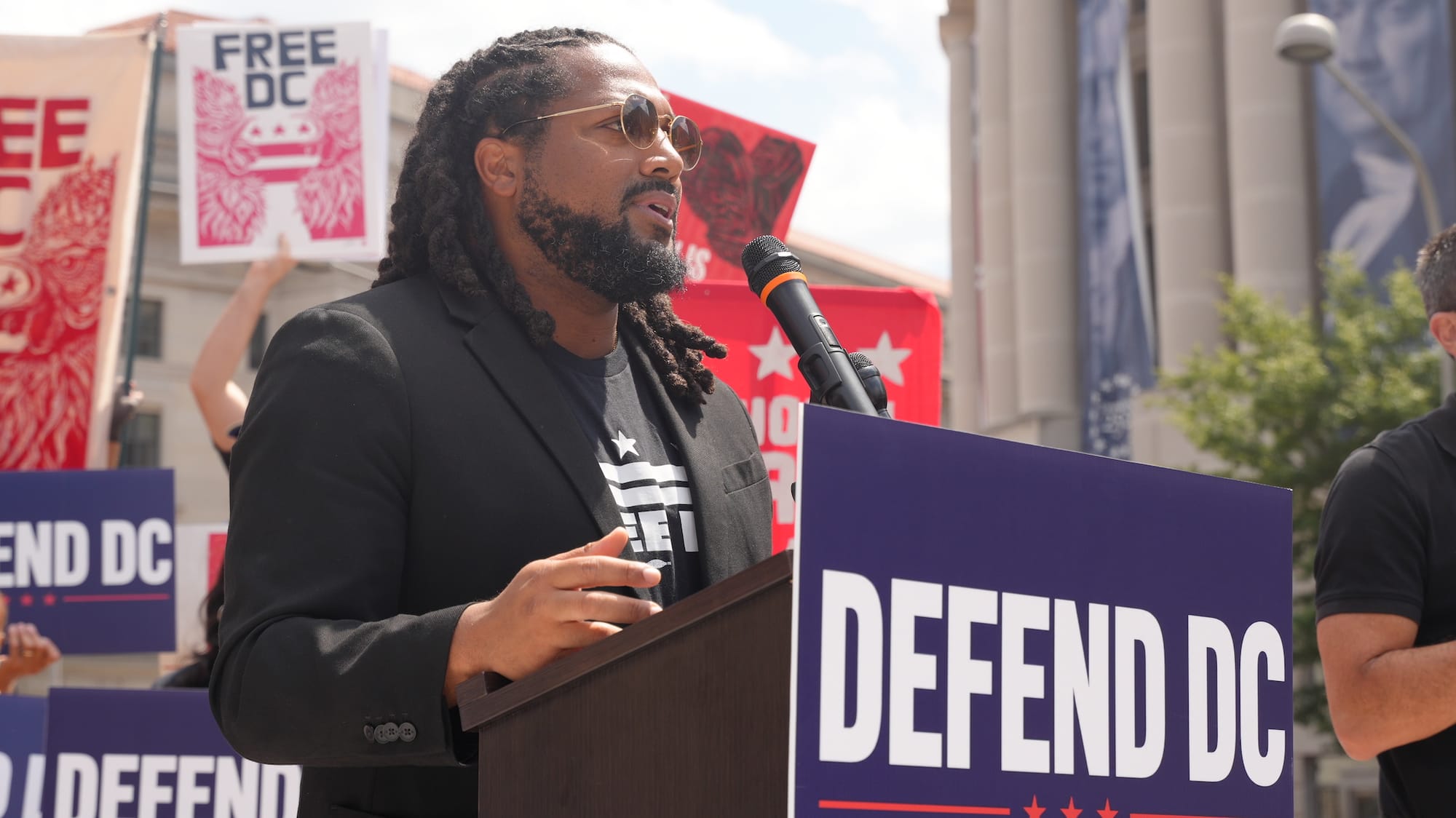
White also believes that the midterms can be “the spark” to create a more lasting, effective statehood movement.
Redistricting battles set off by Trump and changes to the Voting Rights Act by the Supreme Court have significantly shifted the balance of power to Republicans in Congress. The way to combat this, White argues, is to propel D.C. towards statehood, which would give the Democratic Party two more senators and a member of the House. “There is an insistence from Democratic voters that leaders start fighting back at this point,” said White. “So I think that right now, D.C. statehood becomes a mandate in a way that it felt like a pipe dream in the past.”
The barrage of federal overreach has put a national spotlight on D.C.’s lack of representation, which organizers believe could be an opening.
“There are many, many more people now who understand how deeply unjust it is that we don't have equal rights under the law,” said Chatterjee. “It's just not a way to run a democracy — to not let the people in the capital have equal rights under the law, and that is becoming more and more visible.”
During the June primary, White campaigned on bringing statehood and home rule to a national stage. "People can't support an issue that they don't hear about, that they don't see," he said during a debate among congressional delegate candidates in May.
Still, bringing the fight for statehood out of the District’s borders isn’t a new strategy.
“When we organize around statehood here at home, the results are going to be naturally limited,” said Paul Strauss, who has traveled across the country making the case for D.C’s autonomy as D.C.’s shadow senator for the past three decades. “We can't just keep talking to ourselves.”
Strauss said White has some challenges ahead of him when he presumably takes office next year, namely that he doesn’t have the same seniority or relationships of his former boss, Congresswoman Eleanor Holmes Norton. Still, Strauss has thrown his full support behind White, who he said is an “energized” leader.
Some statehood stalwarts, however, wonder whether circumstances are different enough to trigger change.
Mike Brown, who served as one of D.C.’s shadow senators for nearly two decades before retiring in 2024, said any initiative that helps advance statehood is a good one, but he’s concerned that such an effort might be “bluster.” It’s tough to get representatives to care about statehood when their constituents are facing so many other pressing day-to-day issues, he said, like putting food on the table for their families.
He also noted the persistent lack of resources for D.C.’s representatives. The shadow congressional delegation — made up of two shadow senators and one representative — is tasked with lobbying for statehood, but they aren’t paid a salary, nor do they have a vote.
“When you don't have the resources to follow through on anything, you're not going to make it happen,” Brown said.
Brown also doesn’t think there’s sufficient support from the District government on statehood, making it difficult to coordinate between the shadow delegation, D.C. Council, and other groups.
But that’s part of what makes Defend DC different, White said. He described the initiative as a “coalition builder” that will bring together multiple organizations to work towards their shared goal of statehood — an element he said that has been missing from past efforts.
“I think there have been a lot of different statehood efforts, and what is new about this is they're all working together,” At-Large Councilmember Elissa Silverman, who was in attendance at Monday's event, told The 51st.
White is also launching a leadership PAC called DC51, which will be used to raise funds for candidates and “build long-term political infrastructure” for defending home rule and advancing statehood. He said there are plans to eventually bring on permanent staff for both Defend DC and the DC51 leadership PAC.
White says it was when thousands of people participated in a march organized by Free DC in the first year of Trump’s presidency that he realized something in the city had shifted.
“We have a moment of opportunity. D.C. residents are ready to seize it,” he added, “and I think all we have to do as leaders is create an easy way for people to plug in.”

Including allegations of stolen signs, homemade attack flyers, mysterious MAGA figures, and a whole lot of name calling

Renters at Faria Management properties say they're battling mold, rats, sewage leaks, and intimidation. They believe a reckoning for unaccountable landlords is finally here.

Where the competitive local races are, an unusual At-Large voting situation, the fate of foie gras, and more.

Yasmin Williams is helping to book artists for the free Millennium Stage concert series.

With your help, we pursue stories that hold leaders to account, demystify opaque city and civic processes, and celebrate the idiosyncrasies that make us proud to call D.C. home. Put simply, our mission is to make it easier — and more fun — to live in the District. Our members help keep local news free and independent for all: