

The Southwest Waterfront is getting a radical new arts space
The Revada Arts Center will be home to a theater company, film house, and “anti-opera” collective.
The Revada Arts Center will be home to a theater company, film house, and “anti-opera” collective.

Live music, silent reading, fall festivals, and more to explore around the city.

As a new parent, I needed activities that were child-friendly but not child-centric. These spots did the trick.
The Revada Arts Center will be home to a theater company, film house, and “anti-opera” collective.

If you had asked Shanara Gabrielle whether she’d ever oversee a multi-million renovation project and open a major arts building in D.C. a few years ago, she’d have laughed.
“I'd be like, no, we don't need a building for art,” says Gabrielle, who’s been the executive artistic director at Theater Alliance, a non-profit theater company in D.C., for just over two years. Throughout her career, she’s produced shows in several nontraditional spaces, including a musical at a park and another on the street in front of a downtown D.C. office building, and she’s grown accustomed to getting a little scrappy when it comes to finding performance venues.
But her days of searching for space are coming to an end: Theater Alliance and two partners are set to open the Revada Arts Center, a new multidisciplinary arts space in Southwest, later this month.
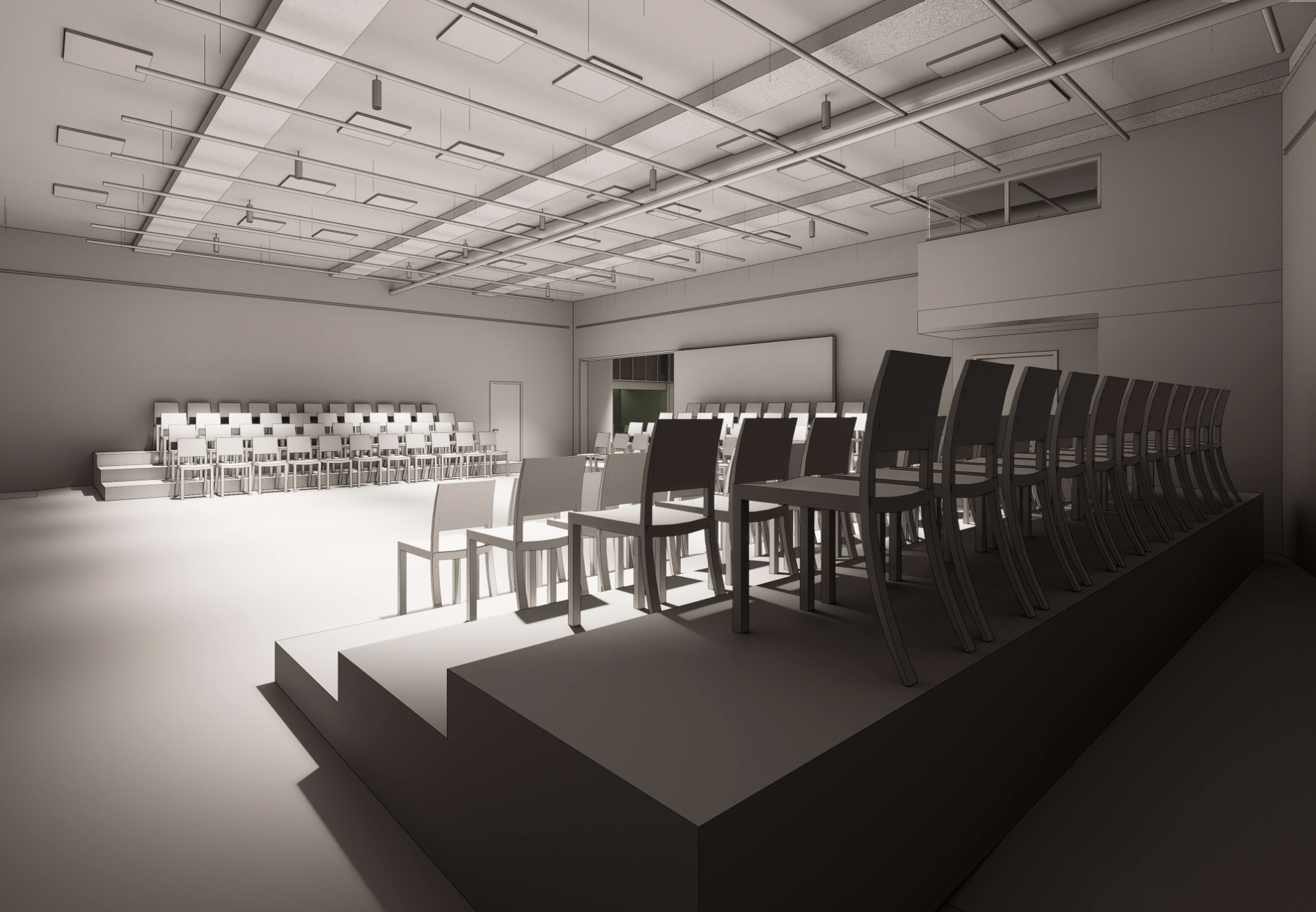
The 9,000 square-foot facility houses a 140-seat black box theater, a 58-seat cinema and proscenium performance space, along with a rehearsal hall and co-working areas. It will serve as a long-term home for several nonprofits and also allow short-term bookings for performances.
At a time when many small and midsize arts organizations are struggling to keep their doors open, the partners behind Revada say they hope to pilot a sustainable business model that will allow each of them to develop their own radical programming, bring in new audiences, and perhaps inspire creative communities in other cities to do something similar.
“We're creating a new model in this space that I think is really the first in the nation,” Gabrielle says.
While Theater Alliance holds the lease and most of the financial risk, it plans to operate with a shared vision and governance structure with its two main partners: IN Series, the local “anti-opera” opera company that’s been around for more than 40 years, and 4EYE Film Center, a new filmhouse. The three organizations will plan programming around each other and share expenses for things like carpentry and lighting equipment.
“The principles are very mutual aid, very co-op, very solidarity economics,” according to Gabrielle.
But at the same time, “the documentation of how it works is extraordinarily tight,” she says, adding with a laugh: “Anybody who's been through a custody agreement has very good practice with it, because it's like, In Series gets the Christmas show in odd years, and Theater Alliance gets the Christmas show in even years.”
Three additional residency partners, set to be announced at a later date, will hold long-term subleases. And other local organizations will be able to rent the space for performances, rehearsals, screenings, and other events through a community access program.
The launch comes as the chaos engulfing the Kennedy Center roughly three miles up the road has raised questions about the status of D.C.’s local arts scene. In a statement, Ward 6 Councilmember Charles Allen heralded the new Southwest space as a “smart partnership, timed at a moment when federal politics have changed the local landscape for arts.”
But IN Series artistic director Timothy Nelson says the Kennedy Center’s clients and the Revada’s are completely different. The new venture, he says, is meant to serve grassroots performance groups that thrive in intimate venues and can’t afford to spend tens of thousands of dollars to put on a single show.
“It's a different philosophy,” Nelson says. “Those organizations that could afford to present at the Kennedy Center are not the ones I worry about.”
Nelson says the Revada partnership will allow IN Series to spend less time looking for locations for its shows, which typically happen across several venues, and the shared resources will free up line items in the budget.
“When we all put our needs in the same bucket, suddenly we're able to create employment opportunities and creative opportunities for our teams that resemble closer to full time work,” he says.
4EYE Film Center, the other founding partner, might not have existed at all without this collaboration. Founder and executive director Emily Lenzner launched the nonprofit last year after a failed attempt to turn the historic Uptown Theater in Cleveland Park into a third space and arts center.
Lenzner is a newcomer in non-profit arts leadership (she previously ran communications for the Motion Picture Association and, before that, Atlantic Media and ABC News). But in the process of crafting a proposal for the Uptown, which she did out of personal concern for its future, she discovered what she really wanted to do: create an arthouse cinema that sparks community engagement through film. To do that in D.C., where space is both limited and expensive, she would need support.
The idea to lean on Theater Alliance came up two years ago over a lunch meeting with Gabrielle. The concept was a “no brainer,” allowing Lenzner to launch her film organization while joining a supportive community before she’d even begun.
“As someone who's starting something fresh — a startup nonprofit — and to be able to do that with partners who have been in this work for a lot longer than I have, that's helpful to me,” Lenzner says. “I can learn from them. We can collaborate. There's a lot of opportunity for cross-promotion and marketing.”
4EYE, named because of the center’s proximity to Fourth and I streets SW, will host regular discussions after screenings, collaborations with the other partners, and a “Made in D.C.” series for local films. Ticket prices for film screenings will cost around $16 for adults and $13 for students and seniors, with some free screenings planned for community groups.
All of the planning has been “less daunting,” says Lenzner, since she’s not covering rent or utilities alone.
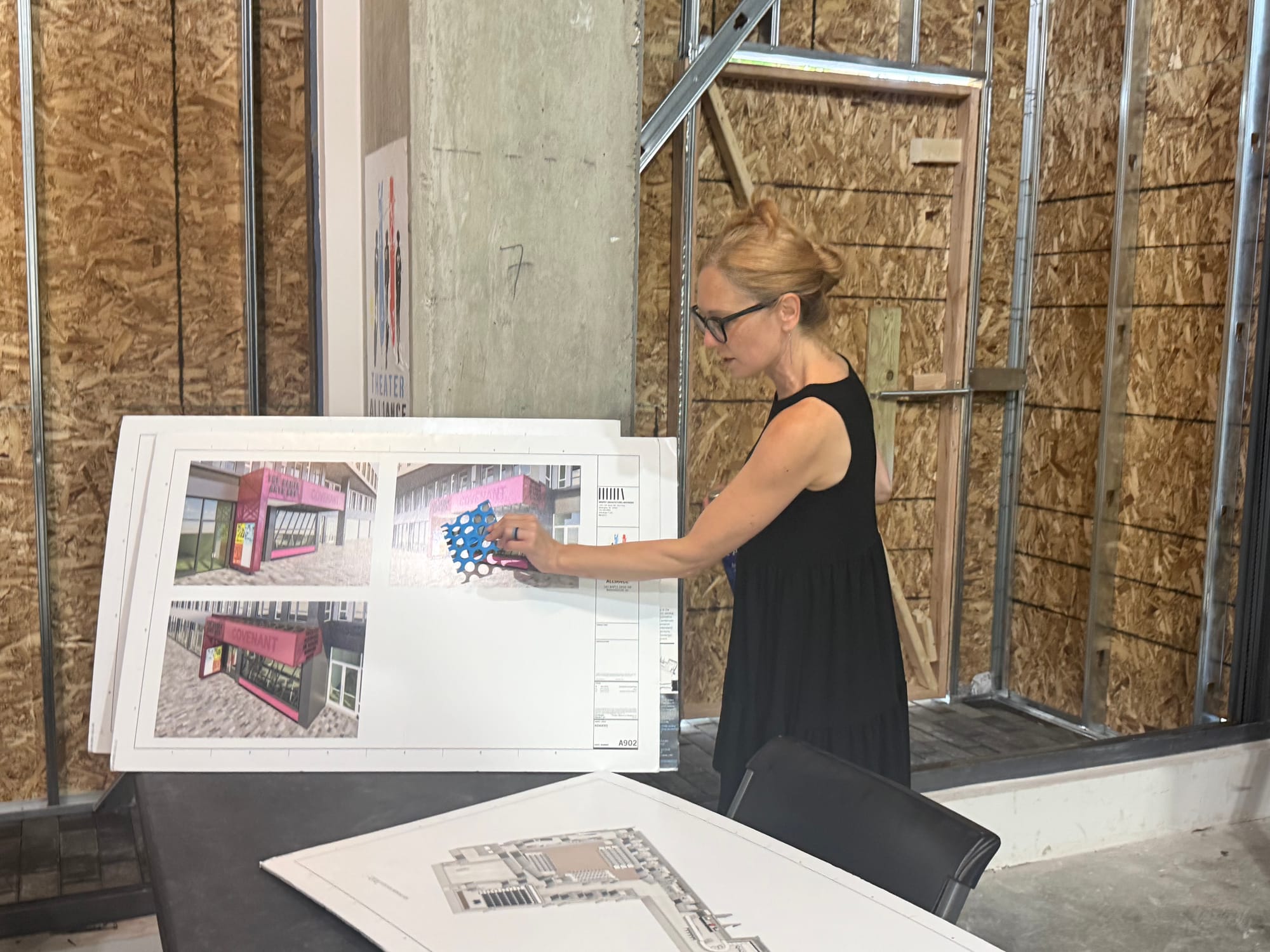
Shanara Gabrielle in the building during construction. (Courtesy of Theater Alliance)
Theater Alliance, which has been producing socially conscious work since its inception in 1993, “has always been a third-place sort of organization,” Gabrielle says. “People gather there for more than just coming to theater.”
The company operated out of the Anacostia Playhouse for just over a decade before being evicted in 2024 (Theater Alliance alleges that the playhouse had been misusing its funds) — right around the time that Gabrielle was named the incoming artistic director. It became clear to the board that having a permanent home would be key to the theater company’s future.
After getting evicted, Theater Alliance found a temporary home at the Westerly development at 340 Maple Drive SW and occupied it under a pop-up permit program that allows tenants to obtain leases for up to a year on short notice, with the goal of filling empty downtown commercial space post-pandemic. Gabrielle says the building was a “totally empty cement box” with little electricity, but was happy to have found anything at all.
Over the next year and a half, more than 5,000 patrons attended the five shows Theater Alliance produced there, even while the only available bathrooms were in the preschool next door.
Eventually they signed a 15-year lease with the landlord, Hoffman & Associates, and launched a major fundraising campaign.
Ultimately, Theater Alliance brought in more than $5 million from individual donors, a large grant from the D.C. Commission on the Arts and Humanities, and support from the Revada Foundation, a family foundation in Alexandria after which the center is named.
Now, two and a half years after receiving that eviction notice, Theater Alliance and its partners will launch the Revada with a multi-day event from October 23-27, including an opening ceremony, a film screening, free headshots, acting workshops, and live music performances.
As the celebration approaches, Gabrielle says she’s most excited about the diversity of art forms built into the organization’s structure.
“We're talking about opera and music, film, and theater, right?” she says. “So there's both cooperation and a lack of competition built in. A win for one is a win for all.”

As a new parent, I needed activities that were child-friendly but not child-centric. These spots did the trick.

The presumptive mayor is pledging a new approach. But can she push past critics?


A new Obama Center sculpture honoring Harriet Tubman has thrust one of the District's most talented artists into the national spotlight.

The public housing agency is considering cost-cutting measures that could lead to major changes for the 20,000 residents it serves.
With your help, we pursue stories that hold leaders to account, demystify opaque city and civic processes, and celebrate the idiosyncrasies that make us proud to call D.C. home. Put simply, our mission is to make it easier — and more fun — to live in the District. Our members help keep local news free and independent for all: