The recent death of a city official in a scooter collision, alongside riders landing in the ER “every week” has trauma experts questioning whether rental e-scooters should be allowed.
Facing high maternal mortality rates, the District made doula care free for Medicaid patients. But experts say the benefit isn't working out in practice.
D.C. doulas are struggling to serve low-income families despite landmark legislation
Facing high maternal mortality rates, the District made doula care free for Medicaid patients. But experts say the benefit isn't working out in practice.
When Crystal Jackson gave birth to her son, she felt scared, anxious, and lonely, all emotions she now realizes a doula — a care worker who supports parents through pregnancy and labor — could have helped her navigate.
“It left such an indelible mark on me, having not had a doula,” said Jackson of her labor six years ago.
Now, she’s the owner of A Queen Momma Doula Services, where she provides non-clinical care before, during, and after delivery. Among other things, doulas like Jackson help clients make a plan for giving birth, help communicate with doctors and nurses, and are usually present to provide support during labor. Doulas can also guide parents through postpartum recovery and newborn care.
A range of studies and pilot programs indicate that doulas help improve health outcomes for pregnant people and babies. This is particularly true for low-income patients who, research shows, have a lower risk for preterm birth, a smaller chance of a cesarean delivery, and are more likely to attend a checkup after giving birth if they have a doula. But the out-of-pocket cost is often out of reach for these families. In D.C., birth doulas can cost anywhere between $1,000 and $5,000.
So in 2021, when the D.C. Council funded the Maternal Health Resources and Access Act, which helped cover transportation costs to prenatal and postpartum appointments and made doula care a Medicaid-covered service, providers like Jackson saw it as a big win for maternal health in the District — a city with some of the worst rates of both preterm birth and severe maternal morbidity in the country, and where Black women experience significantly worse outcomes in pregnancy and childbirth.
Jackson wanted to work with the women who needed her services most, so when the benefit officially became available in 2022, she quickly got started on becoming a Medicaid provider.
But four years later, she’s only served three Medicaid families.
“I thought it opened the floodgates for the families that I could support,” said Jackson, “and it didn't really quite end up being that way.”
The costs of delayed reimbursement
When the act initially passed, it was met with fanfare from proponents as well as local care providers. “We are advancing a critical set of investments to reduce our extraordinarily high maternal mortality rates,” said At-Large Councilmember Christina Henderson at the time.
But when it comes to the Medicaid benefit, doulas in the District say that while it sounds exciting on paper, the implementation has been disappointing and frustrating, with endless paperwork, reimbursement delays, and insufficient support navigating a confusing credentialing process that has left few doulas able to support Medicaid patients.
According to data shared with The 51st by D.C.’s Department of Health Care Finance, just six local doulas were paid for their services with Medicaid patients from October 2025 to September 2026. Between fiscal years 2024 and 2026, only 64 Medicaid beneficiaries have used the doula benefit. For context, over 3,100 births were covered by Medicaid last year in D.C.
Gina Valo, who has been a full-time doula in the District for three years, says the challenges she’s faced getting paid for her work have had devastating impacts. In one instance, she says one of the District’s Medicaid health insurance plans accidentally left out postpartum care in her contract, which she only discovered after thousands of dollars in claims were denied.
The mishap, which she described in D.C. Council testimony in September 2025, forced her to stop providing postpartum care for several months — including ending services for one new mom with stage four breast cancer who needed someone to watch her newborn while she went to radiology treatments.
“That is not an abstract administrative problem,” Valo said at the council roundtable. “It is a direct interruption of medically necessary support.”
Valo says that because the District’s Medicaid health insurance plans (also known as managed care plans) were not properly set up to configure doula contracts, her claims were often denied. This would then take her down a rabbit hole of trying to get connected with someone at the health insurance plan to figure out what went wrong.
Jackson says she ran into similar reimbursement issues, with limited instructions on how to submit claims to the managed care plans leading to $8,000 in denied claims last year.
Valo says that if anyone should be able to successfully navigate insurance challenges, it's her — she has nearly two decades of experience in the tech industry and a master’s in clinical informatics (the intersection of data and health care). “I'm appalled at how hard it has been, and how some of these challenges are so solvable,” she told The 51st.
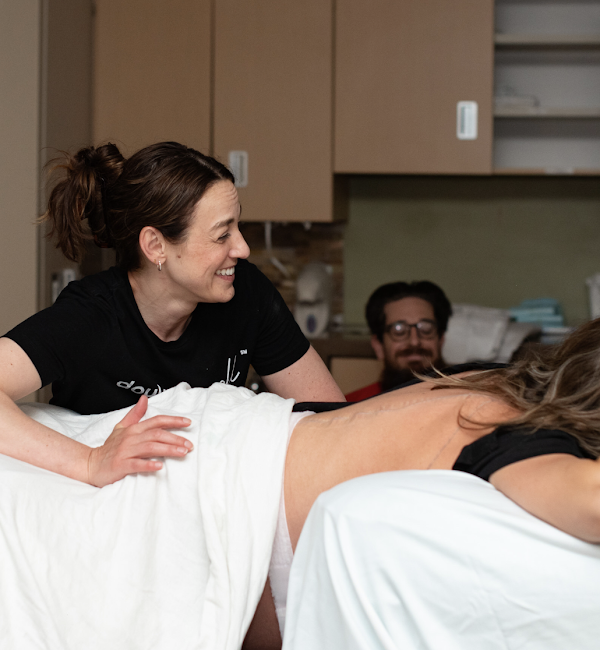
Gina Valo supports a client during labor and delivery. (Phelicia Cyrus)
Valo hoped to run her business, BirthingKind, as a “buy one, give one” model: by charging more for clients who can afford it, she planned to subsidize the cost of working with families on Medicaid.
The goal was inspired by her early work as a doula, which was often with vulnerable patients. In one case, she says she supported a 14-year-old girl at Howard University Hospital who went through a three-day induction. The girl only spoke Spanish and had no family or friends with her. Valo was her only support.
But with the Medicaid reimbursement rates, “I couldn't pay my mortgage on working on Medicaid alone,” said Valo.
According to the D.C. Department of Health Care Finance, total payments for doulas can range between $2,157.66 to $3,451.44, but it can be lower or higher depending on the number of visits and the type of visit (whether it’s a prenatal visit, delivery, or postpartum care).
But Valo says that BirthingKind averaged around $743 per Medicaid client from October 2024 to September 2025, an unsustainable amount given how time-intensive doula care can be.
And, she said, “there's a big difference between what you could earn on paper and what you actually earn.” For example, she says that clients may not call when they go into labor, and if a doula misses the birth, they also miss the largest Medicaid payment.
When Valo started the process of registering herself and her business as a Medicaid provider in 2024, her goal was to have 10 doulas able to serve Medicaid families by the end of 2025. But the difficulties of ensuring consistent payment for services have been so significant that she’s only onboarded four, and she doesn’t expect to take on more anytime soon.
“I would love to create a thriving Medicaid group practice,” said Valo. “But there have been enough challenges now where the volume of people that we can serve is still limited, despite the demand being there.”
Paperwork purgatory
Some doulas have struggled to even enroll as Medicaid providers at all, thanks to what Jackson describes as “paperwork purgatory.”
To work with Medicaid families, all providers must enroll in DC Medicaid. Once their application is accepted, they then need to get credentialed with D.C.’s Medicaid plans.
Through her work with the D.C. Doula Learning Action Collaborative, Jackson has helped facilitate multiple trainings for doulas to navigate the first step of the process. Of the roughly 40 doulas that went through those trainings earlier this year, Jackson says that around five were able to successfully get enrolled. Even for Jackson herself, it took around a year just to enroll as a provider with DC Medicaid.
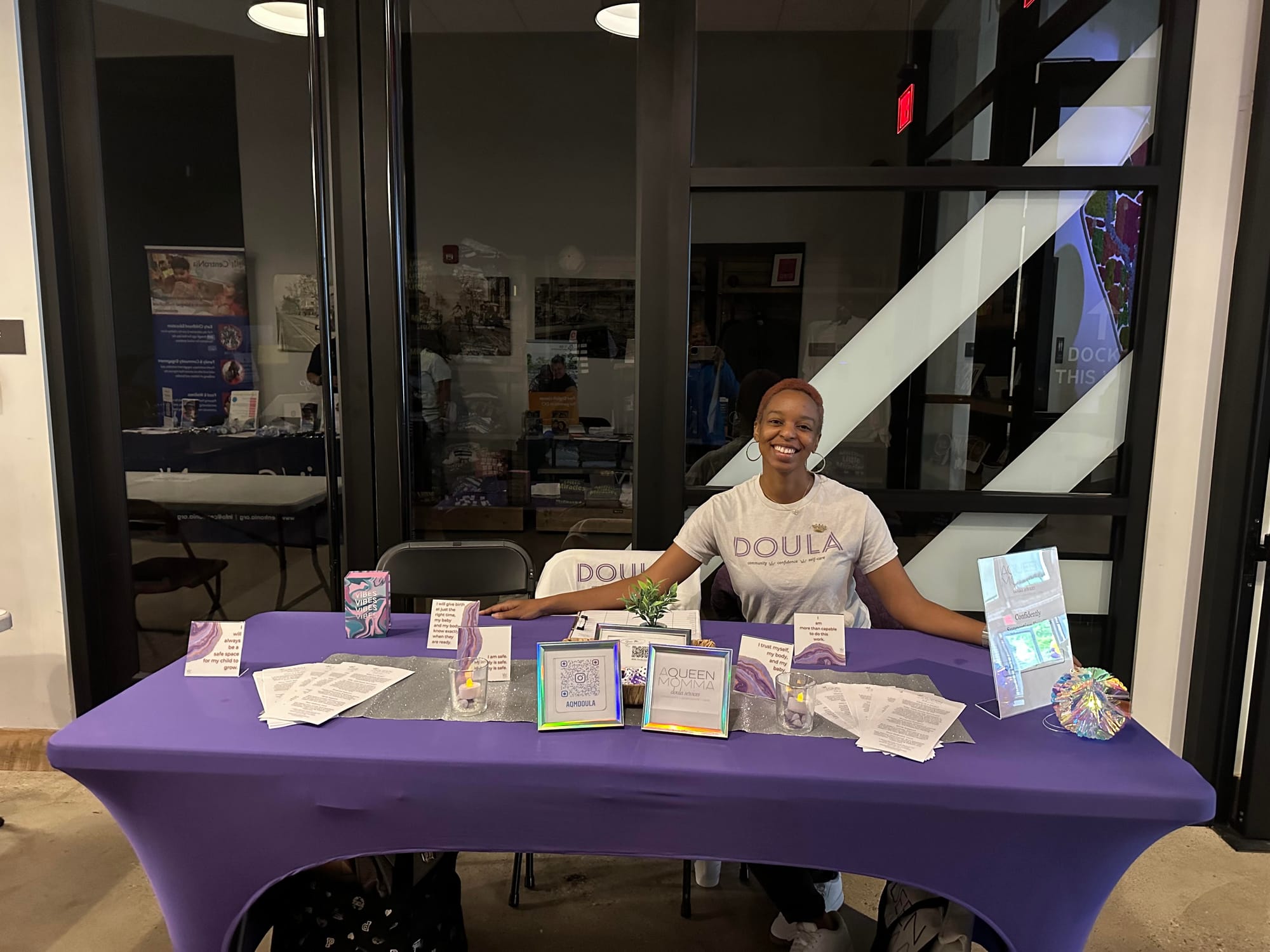
Crystal Jackson at the DC Citywide Baby Shower in 2025, which she usually attends to teach families about the benefits of doula support. (Courtesy of Crystal Jackson)
Makeba Barnes, a doula who works in D.C. and Maryland, sent in her application to DC Medicaid in November 2024 — but confusion around the process delayed her from successfully completing her paperwork. It wasn’t until March 2026, after using a checklist made by Jackson, that her application was accepted.
“Why make it so difficult for us to do what we have signed up to do, do what we desire to do, knowing what the impact is to families and their extended family?” said Barnes.
Many doulas say that the biggest pain point, however, is getting credentialed with the Medicaid managed care plans. Currently, the city has contracts with three plans: MedStar Family Choice, AmeriHealth Caritas D.C., and Health Services for Children with Special Needs. Each organization has a different credentialing process, and according to Valo, there’s little support for helping doulas get through it smoothly.
For Valo, it took almost a year and a half to become credentialed with MedStar, and seven months for AmeriHealth Caritas, with several bumps along the way. Six months after filling out the paperwork with MedStar, she learned they had no record of her application, and was forced to start the process all over again. Jackson said it took her two years of navigating the paperwork with the District’s managed care organizations. By the end of it, she was able to get credentialed with only two of them — and in July, one of those plans announced it was ending its contract with the city.
At a roundtable last year, AmeriHealth Caritas D.C. market president Karen Dale said the process with doulas requires “different thinking” since doulas are non-clinical providers who don’t have licenses like other clinicians, such as nurses or midwives. Rather, they go through doula certifications, but the licensure that most clinicians have “brings us a lot of the information,” said Dale.
“It shouldn’t be more of a barrier,” Dale added, and noted that working to get doulas credentialed was “newer for us as a jurisdiction.”
Barnes has committed to filling out paperwork with at least one of the Medicaid health insurance plans in D.C., but if it doesn’t successfully go through the first time, she won’t try again. Hearing about other doulas’ experiences has turned her off from spending too many of her resources. She’s already a Medicaid provider in Maryland, which she says wasn’t the easiest process either, but wasn’t as difficult as what she saw doulas go through in D.C.
There’s no one single group or person to blame for these errors, Valo said. She thinks D.C. Council needs to track data on the doula benefit more and apply pressure for the issues to be fixed, while DHCF should better address the technical challenges doulas are facing to become Medicaid providers. She also wants to see the managed care plans resolve their problems with their systems, “rather than doula by doula as we bring them up.”
"It is something that can be improved, and we're not doing the very basic things we need to do to make that happen, and it is a moral failing of leadership," said Valo. “That's where I get the most frustrated, because the people that are suffering are the families in this community.”
“We would do even more if we had even more.”
At a July roundtable on maternal health, DHCF’s Medicaid director Melisa Byrd said that access to doulas was “improving, but the progress is still really slow and incremental.” In a presentation, she showed that from October 2024 to September 2025, 24 beneficiaries used doula services. As of April 2026, 43 doulas were enrolled as providers, but only four had billed for Medicaid services.
Since that meeting, numbers have slightly improved, according to data shared with The 51st. By the end of September 2026, there were at least 51 doulas enrolled with D.C. Medicaid. From October 2025 to September 2026, 34 Medicaid recipients accessed doula services.
Byrd sees these increases as a positive trend. “It's small numbers, but they're growing each year so far,” she told The 51st. “If it was going the other direction or just kind of stagnated, we'd have to ask other questions of our program and what we're doing.”
In an email to The 51st, a DHCF spokesperson acknowledged the issues doulas have faced, and said the agency “should have had more tools available to better assist doulas in becoming Medicaid providers as we led up to implementation of the doula services benefit.”
“We haven't always gotten it right, but I do feel like we're on the right path,” said Byrd.
The agency has made recent efforts to clarify the process, including publishing a manual for Medicaid doula providers in August. Byrd also noted that DHCF is working on a credentialing checklist for each of these managed care programs.
She hopes that these steps can alleviate some of the administrative burden doulas are facing. “It's a lot for folks to have on their plate,” Byrd said.
Completely removing that administrative load isn’t possible, says Anais Jovan, executive director of Concentric Community Care, an organization dedicated to increasing the doula workforce. It’s what all providers have to go through in order to serve Medicaid families, and it’s unlikely to get any less complicated anytime soon. “[Centers for Medicare & Medicaid Services] has made nothing straightforward. Doulas are no exception to that rule,” Jovan added, who is a doula herself.
But there are things that D.C. could do to make it easier for doulas to get through the process, Jovan said, like holding weekly in-person registration sessions to help doulas enroll as a Medicaid provider with DHCF.
“We are consistently left out, when I feel like consistently we produce good results,” said Jovan about doulas. “I think we would do even more if we had even more.”
Jovan also noted that there’s a bill in D.C. Council that could simplify one of the biggest pain points of this process. The Streamlining Medicaid Credentialing Amendment Act, which the council is set to discuss on Oct. 14, would make it so that once a provider is enrolled with DHCF, they’re automatically credentialed with all of the contracted Medicaid managed care plans.
There are other promising signs that access to doula care in D.C. could improve, despite the challenges so far. In January 2025, the District was one of 15 states awarded up to $17 million by the Centers for Medicare & Medicaid Services over 10 years to help improve maternal health care for Medicaid recipients. One of the main goals of this grant is increasing access to doula care. D.C. is required to create a doula advisory council to help guide implementation of the Medicaid benefit, and DHCF asked the D.C. Doula Learning Action Collaborative to lead it — a role that excited Jackson.
But while this gives them a seat at the table, the difficulties they've faced over the last four years have made doulas like Jackson feel unheard.
“There's so much momentum for doula support and doulas being integrated in [these] spaces, but the actuality of that is pretty abstract,” said Jackson. “[That] causes burnout, it causes attrition, it causes just lack of excitement to do this work, which then reduces the care that families can have.”
Sam is a reporter with The 51st. She was a multimedia freelance journalist for a year before joining the team. Prior to that, she worked at Vox and More Perfect Union. Sam has covered a wide range of issues, from invasive vines to vaccines.
The recent death of a city official in a scooter collision, alongside riders landing in the ER “every week” has trauma experts questioning whether rental e-scooters should be allowed.
With your help, we pursue stories that hold leaders to account, demystify opaque city and civic processes, and celebrate the idiosyncrasies that make us proud to call D.C. home. Put simply, our mission is to make it easier — and more fun — to live in the District. Our members help keep local news free and independent for all: