

Dinner under $15? It's possible at these 7 D.C. spots
With food prices on the rise, these restaurants still provide real value.
With food prices on the rise, these restaurants still provide real value.

A punk show on the Mall, a Palestinian film festival, a Halloween-themed bike ride, and more

Birth control, poison, and calls for a more peaceful coexistence. Is the District finally winning the rat race?


Nothing could have prepared me for the phrases “sidewalk piss art” and “greasy holes with hair,” but I suppose I brought it upon myself when I signed up to attend D.C.’s rat academy.
Urban rodentologist Bobby Corrigan was describing rat urine and the burrows they dig into sidewalks, respectively, to a room full of D.C. employees, ANC commissioners, property owners, concerned residents, and one very excited journalist (me) gathered to learn how to address D.C.’s escalating rat problem. It’s a crisis that has gotten worse in recent years, and at a faster rate than a vastly larger urban area like Corrigan’s home of New York City. In fact, rat sightings have grown more in the District than anywhere else, hitting over an 800% increase since 2012, according to one study.
“We've been fighting the war on rats for years now,” said rat academy attendee Holly Gerberich, a Ward 5 resident and anthrozoologist. “And they're winning.”
But where most people see vile vermin, Corrigan sees intelligent, successful mammals. He’s spent his career chasing rats across the world (including spending weekends sleeping in a barn with them for almost a year) and designing programs for cities to reduce their rodent population.
“It's an animal that we should really admire,” Corrigan told The 51st. “Unfortunately, there's a downside. They're smart, so smart, [and] they take advantage of opportunity.”
For two days, Corrigan helped us understand why it’s been so hard for D.C. to beat these formidable foes. Rats can bite six times in a single second, he explained, and their jaws are powerful enough to shred through materials like plastic, wood, even soft metals — which is why they can make quick work of most garbage bins. Their whiskers are complex sensors that help them detect nearby dangers (such as traps) and treasures (like food). It might seem like they’ll eat just about anything, but rats look for meals that are rich with nutrients and protein (dog poop is an excellent dish in this regard). They remember where the best, freshest food is and what time it gets dropped, said Corrigan.
They also have complex communication skills: A pile of rat droppings is like a community bulletin board, Corrigan said, full of pheromones that tell each other who’s who and what’s going on. And when it comes to mating, they can reproduce in large numbers: eight to twelve babies per litter.
While DC Health’s rodent and vector control academy has gone on for years, this year's class took place as the city is gearing up for an anti-rat revolution. New legislation, a slew of campaign promises, and a surge of community efforts means some experts believe the District finally has a chance at beating this rat race.
“This is the perfect time to capitalize off of that momentum while we have everybody’s attention,” said Arian Gibson, senior deputy director of DC Health’s environmental health administration, in opening remarks at the rat academy. “I’ve been in this business for 26 years, and typically, resources are low [and] attention is low for rodent and vector control.”
But not anymore. Over the last year, three different pieces of legislation were introduced to tackle the city’s rat problem — one to help pay for rat-proof receptacles in major business districts and to launch a public education campaign, another to create a publicly accessible dashboard tracking the city’s rat abatement efforts and strengthen enforcement of trash violations, and a third to distribute vouchers for residents to purchase rodent-proof sheds for trash can storage.
In April, Mayor Bowser unveiled her plans for a multi-step rodent “blitz” pilot program using multiple strategies, like rat poison and birth control, over three weeks in three rat-heavy neighborhoods.
Rats also became a major campaign issue in the June primaries, and some of the candidates likely stepping into office next year have plans for them. Janeese Lewis George said that if elected mayor she’ll remove a key food source for the population by ratproofing the city’s trashcans. Ward 1 Democratic nominee Aparna Raj also campaigned on an extensive “ratform” that included rat-proof trash bins, expanding composting, and appointing a rat czar.
But some D.C. residents aren’t waiting for politicians or the city to figure out what works. One group of neighbors are using their alleys as urban laboratories for a pioneering community study on rat birth control.
Still, despite all this momentum, our war on rats isn’t new (there’s perhaps no more unifying issue in D.C.), so why are they beating us so badly? And will these current initiatives actually work? Since May, I went down the rabbit hole — or in this case, the rat burrow — to find out. What I learned is that while rats are very smart, we humans are also quite foolish, and it makes an easy victory for rats every time.
I don’t have many rules in life, but there is one I stick to pretty rigorously: whenever humanly possible, avoid walking through alleys. So when I got an email in mid-May directing me to a 9:30 a.m. rendezvous behind the Adams Morgan McDonalds, I wondered if I would come to regret breaking this principle.
It was week two of the city’s rodent blitz pilot program, and Andre Pitman, the program manager of D.C.’s rodent and vector control division, and his colleague Germaine Blunt were hunting for rat burrows. This week’s goal was to pump a powder into the holes, which sticks to their fur and kills them when they groom each other. The week before, they left poisonous bait around and inside the tunnel entrances to cause internal bleeding. The final week? Liquid birth control.
We started with the alley side of The Line Hotel, where in the previous week they had filled 12 underground rat tunnels with dirt after inserting the poisonous bait. Pushing their way through shrubbery, Pitman and Blunt counted the new or re-opened burrows. That week, there were just three.
I crouched to snap a picture of the tracking powder as they pumped it into one of the burrows. When I stood up, something caught Blunt’s eye. “There’s a dead one,” he said. He pointed to a flattened rat, nearly embedded into the dirt — right where I had squatted. Somehow, that didn’t deter me from following Pitman and Blunt for the rest of their outing.
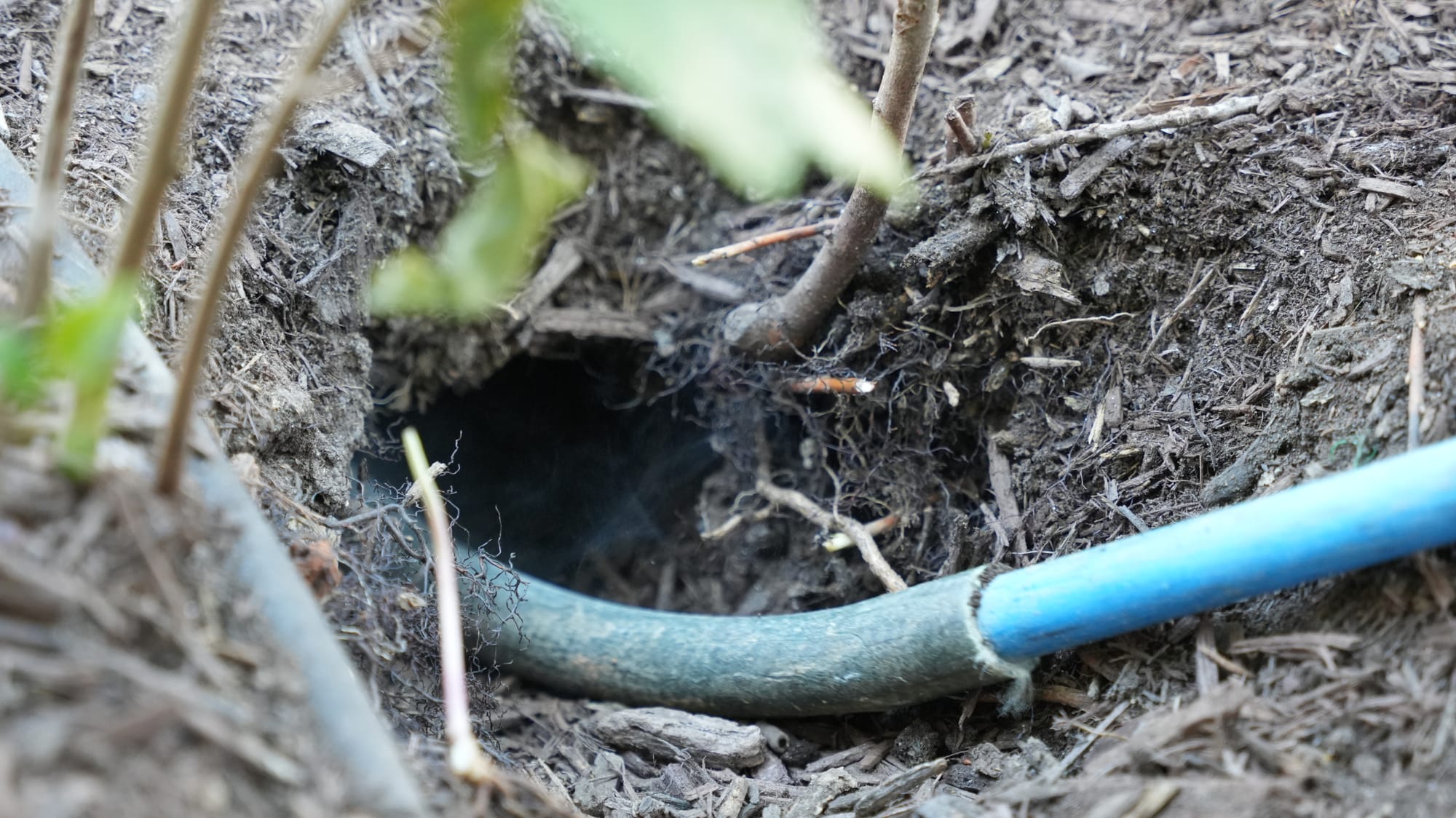
“The challenge is fixing human error,” Pitman told me. “Because human error is what causes rats.”
As we ventured deeper into the alley, Pitman pointed out all the different ways people were helping rats thrive: trash under garbage cans, dumpsters with open lids, an abandoned bar table (a perfect shelter). Pitman said the owners of the restaurants that abut the alley need to clear out the trash, remove grease from dumpsters, and powerwash the area to keep the space clean.
Much of these rules apply to residential spaces, too. “Just an empty can with a greasy film will draw the rats,” said Corrigan at the rat academy. Keeping them clean as well as clearing the area of trash will make your alley or backyard a much less desirable spot.
I know what you’re thinking: cleaning a trash can sounds pretty gross, which is probably why most people would rather put out rat bait boxes instead. But it’s a futile strategy, Corrigan said. Most rats won’t try their luck on the bait box if the trash can is still a source for food.
While individual accountability is important, experts say there also needs to be a coordinated, comprehensive trash and sanitation management plan that brings together the District government, businesses, and residents. Cities like D.C. need a “war room” of sorts, Corrigan said — though he admits he doesn’t love that term.
“But it puts together a concept,” he noted. “You do have to have ‘generals’ in the room moving things around, saying, ‘Let's [have] this agency work with this agency, let's strategize.’”
Since my May trip with Pitman and Blunt, the pilot has been completed in Adams Morgan and Eastern Market, and they’re currently wrapping up efforts in the final neighborhood of Chinatown. Success will be measured by the amount of burrows and activity observed before and after the pilot, said Pitman. He noted that outreach has also been an important part of the program, and that they’ve been communicating best practices for rat mitigation to business owners, advisory neighborhood commissioners, and business improvement districts in each neighborhood.
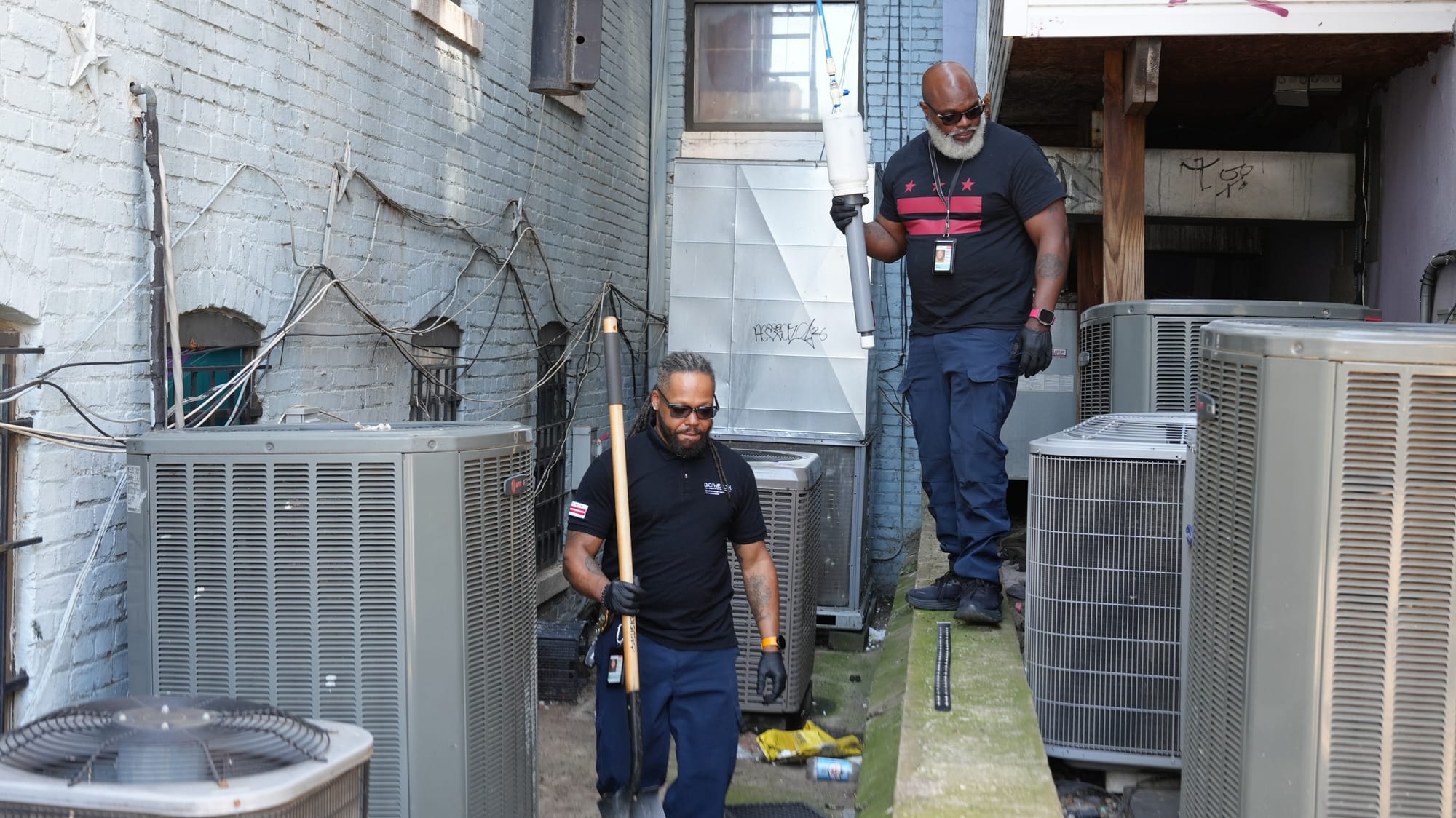

Both photos: Andre Pitman (left) and Germaine Blunt (right) on an outing for DC Health's rodent blitz pilot program. (Sam Delgado)
Once the pilot is officially complete, the rodent and vector control team will transition to analyzing the data collected, DC Health told The 51st. They unveiled a rat dashboard in July, where residents can see the amount of burrows identified and treated, and the number of 311 complaints made about rats. According to the dashboard, D.C.’s rodent control program identified and treated over 25,000 rat burrows in 2025.
Still, while the newfound government energy is critical, some are concerned that the pilot program was built on some faulty foundations.
At a July 13 D.C. Council hearing about two of the proposed rat bills, ANC commissioner Josh Jacobson noted that using multiple interventions at once — bait, tracking powder, and birth control — made for a poor study.
“If rodent activity declines, the District is not able to determine which specific intervention or combination of caused the decline,” Jacobson testified. “D.C. may invest in products that are much more expensive, without knowing that they’re effective.”
He also noted that the best evidence for the rat birth control used in the pilot was in a lab. While other cities have also implemented pilot programs, there are no scientific studies proving the efficacy of rat birth control in an urban setting.
DC Health said the pilot was intentionally designed as an initiative that used multiple abatement methods. “Because the goal was to assess the effectiveness of a comprehensive, integrated approach under real-world conditions, the pilot was not intended to isolate the impact of individual interventions,” reads an emailed statement to The 51st.
Others who testified implored the city to recognize the threats that rodenticides pose to pets and wildlife. Even after rats die from ingesting bait with anticoagulants (like the ones used in the pilot program), the toxins remain in their body — posing risks to other animals, like pets and wildlife.
“Any hawk will eat 1,000 rats a year,” said Jim Monsma, administrative director for City Wildlife. “But now we’re killing them for doing this, for providing this free service.”
The rehabilitative nonprofit for injured and orphaned wildlife in D.C. found that over the course of nine months, 85% of the animals admitted to their clinic had been exposed to rat poison. They tested multiple types of hawks, and all of them had some form of rat poison in their system.
Plus, anticoagulants have been used to treat rat populations for decades — yet we’re still dealing with them.
“After seven decades and millions of tons of rat poison applications to the District of Columbia, we have nothing to show for it, relative to sustainable suppression of the scores of rats that still plague Washington D.C.,” said Corrigan in his testimony to the council.
In his decades of experience as a rodentologist, Corrigan has found a pretty simple — and more humane — formula for bringing down the rodent population: no food equals no rats.
“We want to kill them or change their behavior, when all we have to do is stop rewarding them,” he said.
In Kingman Park, residents are taking Corrigan’s advice into their own hands.
Ebony Payne, an ANC commissioner who grew up in the Ward 7 neighborhood, didn’t remember the area having an issue with rats. But over the last five years, she and her neighbors have seen a significant uptick in rodent activity. Last year, she attended D.C.’s rat academy, and realized that her backyard was full of signs that there was a rat problem.
But she also learned that urban rats don’t live for long — a year at max — and it inspired her to think of other ways to bring their numbers down. “I realized that we didn't really have to kill them all necessarily, because they were going to die off naturally on their own in a short amount of time,” she said.
So when she heard about rat contraceptives after meeting with Max Broad of DC Voters for Animals, she wanted to see if it could help in her neighborhood. Last November, she sent out a newsletter to her constituents to gauge interest in collective action against rats.
She received more replies than anything else she’s sent out to her community.
“I knew that people were struggling with rats, but I wasn't sure if they were going to be willing to volunteer for the project,” Payne said. “I was really shocked by the level of response, because it can be very challenging to get people to volunteer at a large scale for any kind of project. But people were immediately interested and intrigued.”
A month later, Payne and Broad developed a survey for Kingman Park residents. Of the 44 neighbors who responded, 42% said they were interested in getting involved because they didn’t like seeing rats, while 21% said they were concerned about the impacts of rat poison.
Broad knew that the efficacy of rat birth control in an urban setting still hadn’t been proven. But what if Kingman Park could be the testing ground?
In May, Broad and Payne helped launch a year-long study to understand the effectiveness of two different, non-fatal rat abatement methods in Kingman Park with biologist Rebecca Gooley, the animal control nonprofit Wisdom Goodworks, the DC Responsible Rat Management coalition, and interested community members.
They set up some alleys with feeding stations that had rat contraceptives, others with trash management practices, some with both, and left the remaining alleys alone to serve as a control.
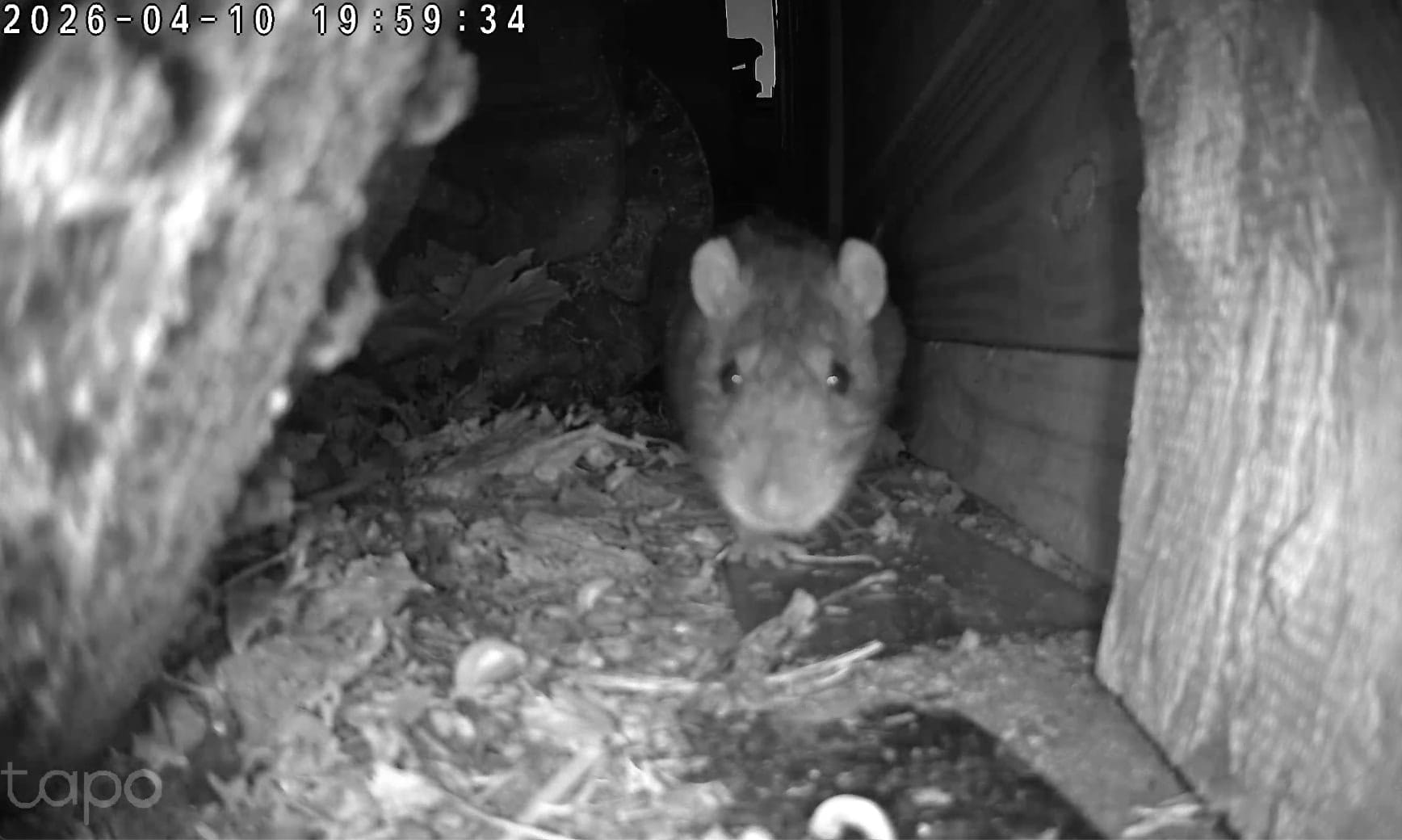
“This is a landmark study,” said Gerberich, the Ward 5 anthrozoologist, who is involved with the study. “If it does work, it will be a blueprint for other cities.”
Gerberich also started leading community rat walks with DC Responsible Rat Management, where she takes residents to alleys after dusk to see the world from a rat’s point of view. “I invite them to embody a rat and say, ‘Okay, you are a living rat … you're having your rat coffee, and you're ready for your rat meal,’” Gerberich said. “Where are you going to go, and how are you going to find this food?”
The idea behind rat walks is that increased community education is a critical part of preventing them from multiplying. “I think that's what really is lacking, is just a core knowledge,” Gerberich said.
And when attendees inevitably come across dumpsters full of rats, they have a moment of eureka, said Gerberich. A poorly managed dumpster is no longer just a dumpster — it’s a buffet for rats.
She hopes to expand these outings across all eight wards. Graduates of rat walks are deputized as D.C. “rat rangers” — experts in the mindset of urban rats. While Gerberich isn’t trying to necessarily save the rats, she doesn’t think they deserve our bloodlust.
“The only thing that gives rats their pest status is us,” said Gerberich.
Everyone wants to see less rats. But what I discovered in trying to get to the bottom of our rodent problem is that humans aren’t so different from rats: We’re both trying to survive in the city, and we’re both scared of each other. We’re certainly not friends, but perhaps we don’t need to be foes, either. If the different initiatives in D.C. can lead to better trash management practices and more humane reductions in the rat population, maybe we can coexist a bit more peacefully.
But for now, we’ll have to wait and see.
This story has been updated to reflect Kingman Park's correct ward.


Where the competitive local races are, an unusual At-Large voting situation, the fate of foie gras, and more.


Yasmin Williams is helping to book artists for the free Millennium Stage concert series.


The team plans to ask for an exemption to the city's climate law that would allow it to add a natural gas-burning plant, which is worrying environmentalists and lawmakers.
With your help, we pursue stories that hold leaders to account, demystify opaque city and civic processes, and celebrate the idiosyncrasies that make us proud to call D.C. home. Put simply, our mission is to make it easier — and more fun — to live in the District. Our members help keep local news free and independent for all:
