

D.C. evictions hit 12-year high as safety net shrinks and cost of living soars
Major policy changes leave tenants with fewer options and a higher likelihood of losing their home if they fall behind.
Major policy changes leave tenants with fewer options and a higher likelihood of losing their home if they fall behind.

The mayor-elect has made big promises about D.C.’s arts and culture scene.

Grab your favorite sweater and catch over 100 bands at PorchFest or break it down at a Diwali dance party.

The mayor-elect has made big promises about D.C.’s arts and culture scene.

Long before winning Tuesday’s election, Mayor-elect Janeese Lewis George made her plans clear on issues like transportation (dedicated bus lanes), housing (much more of it), and childcare (universal). Her arts and culture agenda is no less ambitious.
Her plans for the arts sector involve stabilizing the city’s arts commission budget; streamlining the permitting process for local festivals, venues, and cultural events; and supporting the grassroots organizations that are the lifeblood of D.C.’s arts economy. She wants to see more neighborhood-based events like the city’s porchfests — which she actively supported in Petworth as Ward 4’s councilmember — and, more broadly, make big investments in D.C.’s arts community, which she’s called the best in the country.
Her vision is sweeping and involves ideas like a “dedicated funding line” — instead of grants and partnerships — to support arts education programs in every DCPS school. She wants the RFK stadium redevelopment to include paid opportunities for local artists, and she’s pledged to revive the District’s poet laureate program, which has been dormant for nearly a decade. She’s shown interest in her hometown culture, hosting roundtable discussions with everyone from local rappers to theater directors, and has been unafraid to hop on stage during a go-go performance.
“Our city is full of creatives, entrepreneurs, and innovators,” Lewis George wrote this summer on Instagram. “We should be investing in them and creating opportunities for them to thrive.”
In some of her first moves as mayor-elect, Lewis George announced she’d brought on veterans of the arts community to serve on her transition team: Julianne Brienza, a D.C. arts commissioner and the founder of Capital Fringe; Kelsye Adams, a political organizer and executive director of Long Live GoGo; and Christopher Naoum, an event coordinator and local music festival organizer.
The picks signal that Lewis George may be interested in tapping into the knowledge base of the local grassroots arts community — Long Live GoGo, for example, was a nonprofit born out of the #DontMuteDC movement to protect Black, D.C.-native culture, and Capital Fringe survived for two decades producing a scrappy theater festival before announcing last year it will no longer produce the annual event. Naoum was instrumental in launching a D.C. music census in 2024, and Lewis George has said she wants to standardize data collection on artists and grantees.
Local cultural leaders are quietly preparing for the incoming administration and getting excited about the prospect of change.
“I've watched her since day one, and I've really been impressed with her commitment not only to small businesses but really to the arts,” says Charvis Campbell, owner of Brightwood Park’s Home Rule Records and its nonprofit, which organizes a yearly music festival promoting D.C. musicians.
“I'm really happy when I see a government forming and they've not forgotten about the arts,” says Aaron Myers, executive director of the D.C. Commission on the Arts and Humanities (CAH), the city’s main funding arm for the creative sector. “How often have we seen transfer of power and, literally, the arts are not even anywhere in the room or in the conversation? So this is an excellent sign for what is to come.”
“After years under Bowser, I’m ready for a refresh, reset, and reinvention with D.C.-born artists leading the way,” says Dee Dwyer, a Southeast D.C.-raised photographer and creator of the Chocolate City Experience (and a 51st contributor).
 Alex Koma
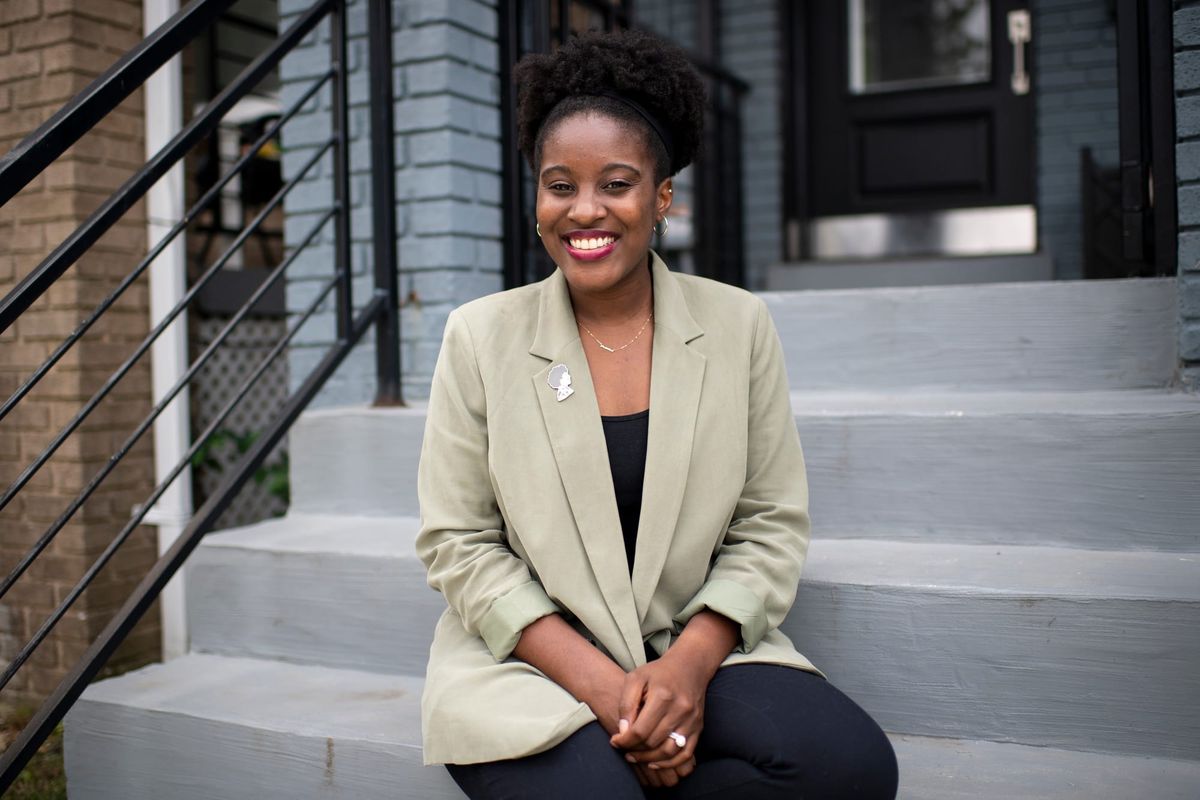
Like her predecessor, Lewis George sees arts, culture, and nightlife as intertwined with the city’s “long-term economic health,” as outlined in her plan.
Under Mayor Muriel Bowser, D.C. launched initiatives like 202Creates, which promotes local events and connects arts organizations with funding. Bowser also helped turn the annual Art All Night event into a major weekend festival across all eight wards and added a restaurant-specific promotion, Dine All Night. She ushered in the Department of Buildings’ pop-up permit program, which allows for streamlined short-term leases in vacant spaces to help with the pandemic recovery. Her efforts grew the local arts economy into a $15 billion revenue machine.
But Bowser’s relationship with the local arts community was not always smooth. She notably sparred with other local officials over control of the CAH. In 2019, after the D.C. Council transitioned the commission to an independent agency no longer under her authority, she replaced the locks on D.C.’s beloved public art collection and canceled the Mayor’s Arts Awards.
And then there’s the long-running criticism of Bowser’s tendency to sweep in and co-opt grassroots cultural movements and present them as her own — for example, the initiatives she placed under the “Mayor Muriel Bowser Presents” banner, including Art All Night and the 17th Street High Heel Race.
In some ways, Lewis George’s arts platform borrows from — or at least builds upon — progress made during Bowser’s administration. (Lewis George has said she’s met with the outgoing mayor to seek guidance on a range of topics.)
Her proposed Arts and Nightlife Activation (ANA) will run through a revamped Office of Nightlife and Culture, a Bowser creation that’s been without a director — unofficially known as the “night mayor” — since 2024. With the ANA, Lewis George says she’ll spearhead a coordinated effort between at least five agencies and more than a dozen Business Improvement Districts and Main Street programs to reduce “unnecessary barriers” that still exist within the permitting process.
That’s music to some locals’ ears.
“They've made progress, but it's still a little headache for special-event permitting,” says Campbell, the record store owner and festival organizer. “It's crazy the hoops you have to jump through, so the ability to handle that in a one shop makes the most sense.”
Leaders of roughly 140 local arts organizations share a listserv, and several of them met with Lewis George while she was campaigning. Many in the group were excited to see that Lewis George had such a clear vision for the arts, says Amy Austin, CEO and president of Theatre Washington.
“She was available and was ready to listen,” Austin says. “We’re excited not to be an amenity [or] something that people take for granted.”
Austin, however, cautions the mayor-elect to avoid proposing overbroad policies that group the arts and nightlife together, and says a cross-agency collaboration may oversimplify issues that deserve nuanced solutions: “We share a lot of concerns, but at the end of the day, we're not the same,” she says. “What the arts does is different from what nightlife promises to deliver.”
Lewis George also says she’ll “fix the funding structure so it can grow as intended” by amending a Bowser-proposed cap on the budget for the arts commission. Theater directors like Austin, along with Myers, the agency’s director, have argued that this cap — combined with other cost-saving measures Bowser and the Council enacted — has made grantmaking for the arts uncertain each budget season.
Several artists and small-business owners told The 51st they hope the incoming mayor will support a simplified grant application process that’s gotten more competitive in recent years. (Total grant applications rose from 1,657 in 2025 to 2,061 in 2026, per the agency’s director. The commission awarded over $26 million in grants in 2025.)
There are, of course, limits to what the mayor-elect can do in this arena. She’s inheriting a budget shortfall to the tune of more than $600 million, and Lewis George has said she’ll work to save where she can, and “won’t leave federal dollars on the table.” But the arts community has been concerned about public funding under the Trump administration, which cut grants and has floated axing the National Endowment for the Arts altogether. (About 2 to 3% of the CAH’s proposed operating budget comes from the NEA.)
Mary Early, a practicing artist and gallery director born and raised in D.C., says the mayor-elect could work with the Department of Small and Local Business Development to provide practical business training for artists amid unpredictable grant budgets.
“Artists are all a small business, and most artists don't form an LLC until they have to, and then it's an emergency,” Early says. “Something that could be made a little more aggressively available to artists is the opportunity to become a D.C. licensed business or a certified business enterprise.”
Keyonna Jones, founder and executive director of the Congress Heights Arts and Culture Center, says she’s excited for a mayor who sees the value in the arts.
“One of the mottos I live by is, ‘art saves lives,’ because it indeed saved mine,” Jones says. “To know that she understands that makes me excited to see how she’ll include the creative community into her transition plans.”

Major policy changes leave tenants with fewer options and a higher likelihood of losing their home if they fall behind.

In a largely suspense-free election, the District gets a democratic socialist mayor and says au revoir to foie gras.


D.C. needs artists who remain connected to the city, so we can preserve things that money, development, and time can’t recreate. Here are some tips to keep you here.


Here are three ways to make our streets and sidewalks safer, and none of them are banning electric scooters and bikes.
With your help, we pursue stories that hold leaders to account, demystify opaque city and civic processes, and celebrate the idiosyncrasies that make us proud to call D.C. home. Put simply, our mission is to make it easier — and more fun — to live in the District. Our members help keep local news free and independent for all: