

12 things to do in D.C. over Halloween weekend
Whether you’re into retro zombies, pan de muerto, or classic fall festivals, we’ve got something for you on our list.
Whether you’re into retro zombies, pan de muerto, or classic fall festivals, we’ve got something for you on our list.
Here are three ways to make our streets and sidewalks safer, and none of them are banning electric scooters and bikes.
"Once I realized that anything could be art, I think that’s when my art changed significantly. But now I need storage because I can walk anywhere and see something and think, 'Oh, I can use this.'"

Here are three ways to make our streets and sidewalks safer, and none of them are banning electric scooters and bikes.

It’s frightening when an electric scooter or an electric bike rider whizzes by you on the sidewalk — and can be even more so when you hear about recent deaths related to these new modes of transportation, including that of a D.C. official earlier this month.
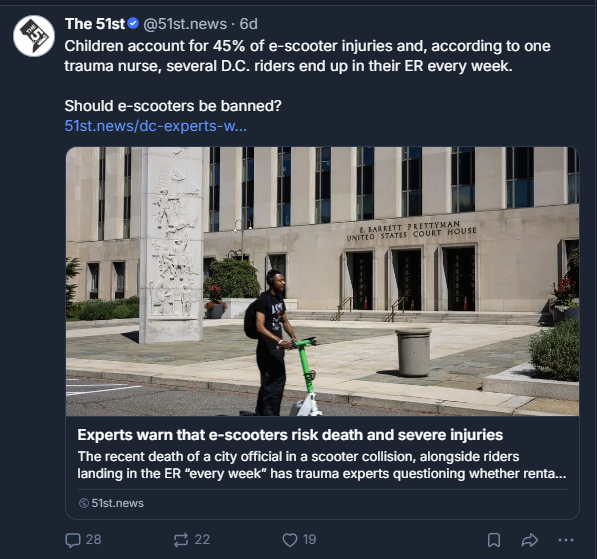
These fears have caused some residents to question whether an all-out ban might be appropriate, including in a recent social media post by The 51st.
As the founder of Hill Family Biking, a volunteer-led nonprofit that organizes community bike rides, educates on all things biking, and advocates for safer streets, I believe we need more alternatives to cars, not less. Many fears about e-scooters are precisely because they’re new — after all, we’ve had 70 years to normalize the alternative: car crashes claim almost 40,000 lives every year in the United States, while severely injuring several million more.
Micromobility usage has soared in recent years. According to the District Department of Transportation, e-bike and e-scooter trips nearly doubled from 2023 to 2025, rising from 6.4 million to 12.4 million. This year, we’ve already hit 12.3 million. Capital Bikeshare rides have also increased 50% over the same time period, with 70% of those rides being on e-bikes.
This is something to celebrate, not fear; at the end of the day, the fewer car trips we have in D.C., the safer we all are. But that doesn’t mean we shouldn’t work to make these popular new forms of transportation safer, for riders and pedestrians alike. Long term, we need a dramatic increase in the number of separated bike lanes to form a protected and connected network across all 8 wards (work that I believe the current administration has not sufficiently prioritized, causing D.C. to fall behind many cities globally). But that doesn’t mean we can’t make immediate changes too.
Here are three things we can do now — some of which are already underway — to make D.C. streets and sidewalks safe for all ages and abilities.
Along with an increase in use, the types of e-bikes and e-scooters have expanded over the past few years, and the differences in speed and safety are dramatic. Talib Shakir, the D.C. official who was killed in an e-scooter collision, was riding a hyperscooter with a top speed of 55 mph at the time of his death.
We need strong regulation of the fastest versions (Class 3 e-bikes, e-motos, and hyperscooters), including strict age requirements, licensing, registration, and insurance. And while I prefer regulation, a ban on both the sale and operation of certain vehicles should be on the table — there is no reason why anyone needs a scooter that can go 55 mph.
For example, in New York City, any e-bike that can reach speeds above 25 mph using only a throttle, or that lacks functional pedals, is classified as a moped and must be registered, licensed, and insured. They’re also banned from bike lanes, paths, and sidewalks. We should look to the Metropolitan Police Department's confiscation of illegal gas-powered mopeds in 2024, coupled with the 2025 DDOT program that helped transition delivery drivers to e-bikes by providing subsidized long-term rentals and battery-swapping stations, as a model.
DDOT’s proposed rule would require that all operators have technology to detect sidewalk riding and restrict scooter speeds to 10 mph on sidewalks and 15 mph on streets. (For what it’s worth, I actually think the sidewalk-riding speed should be 8 mph.) Why allow sidewalk riding at all? Because there are many areas of D.C. where riding in the street is a death sentence, and we want to promote e-bike and e-scooter use over car dependence.
We’ve all seen young teenagers riding e-scooters, fueling at least some of the safety concerns. But every operator in D.C. has an 18-year age limit (except Capital Bikeshare, which is 16), so how are so many kids getting a hold of them?
One contributing factor may be the programs that companies like Lime and Veo use to give unlimited, free 30-minute rides to low-income residents. These programs are a good thing, providing transportation alternatives to families who need it. But better regulation could ensure they aren’t being abused, which has often led to reckless and underage riding.
DDOT has finalized plans to shift these programs to a 300-minute monthly limit, which should curtail the surge in youth riding. We won’t know the impact until it's enacted, but this seems like a giant step in the right direction.
Since you can drive a car at 16, I hope these companies will follow Capital Bikeshare’s lead and allow 16-year-olds to ride. However, this should only happen once there’s comprehensive road safety education for K-12 students (which can be built on the excellent learn-to-ride bike curriculum for all DCPS second graders).
Fear is a natural response to fast-changing streets, but turning our backs on e-bikes and e-scooters isn't the solution to car dependence and dangerous conditions on our roads and sidewalks. With thoughtful regulation, education, and continued investment in safe infrastructure, D.C. can build a connected, multi-modal transport network where everyone can thrive.

"Once I realized that anything could be art, I think that’s when my art changed significantly. But now I need storage because I can walk anywhere and see something and think, 'Oh, I can use this.'"

Vergie “Gigi” Arandid, owner of Binge Bar on H Street, shares her recommendations ahead of No Drink November.


Hear from young writers — in their own words.


Including allegations of stolen signs, homemade attack flyers, mysterious MAGA figures, and a whole lot of name calling

With your help, we pursue stories that hold leaders to account, demystify opaque city and civic processes, and celebrate the idiosyncrasies that make us proud to call D.C. home. Put simply, our mission is to make it easier — and more fun — to live in the District. Our members help keep local news free and independent for all: