

‘Halfway to Freedom’ tells the people’s history of Black Washington
A Georgetown professor’s forthcoming book provides a major retrospective of D.C.’s Black history.
A Georgetown professor’s forthcoming book provides a major retrospective of D.C.’s Black history.

Free Thanksgiving meals, cooperative futures, and more ways to plug in.

Residents transformed these tiny public areas into something magical.
A Georgetown professor’s forthcoming book provides a major retrospective of D.C.’s Black history.

What do the largest nonviolent escape attempt in the history of slavery, anti-apartheid protests at the South African embassy in the 1980s, and the ongoing fight for D.C. statehood all have in common?
They’re all examples of how D.C. has been both a place of hope for Black people dreaming of freedom, and a place where that dream has only been halfway accomplished. That’s according to a forthcoming book by one of the city’s preeminent historians, Georgetown professor Maurice Jackson.
Jackson’s Halfway to Freedom: The History of Black Washington, DC, which arrives on Dec. 8 from Duke University Press, lays out across a whopping 776 pages (including notes and appendices) exactly what makes the nation’s capital emblematic of Black American’s broader struggle for equality.
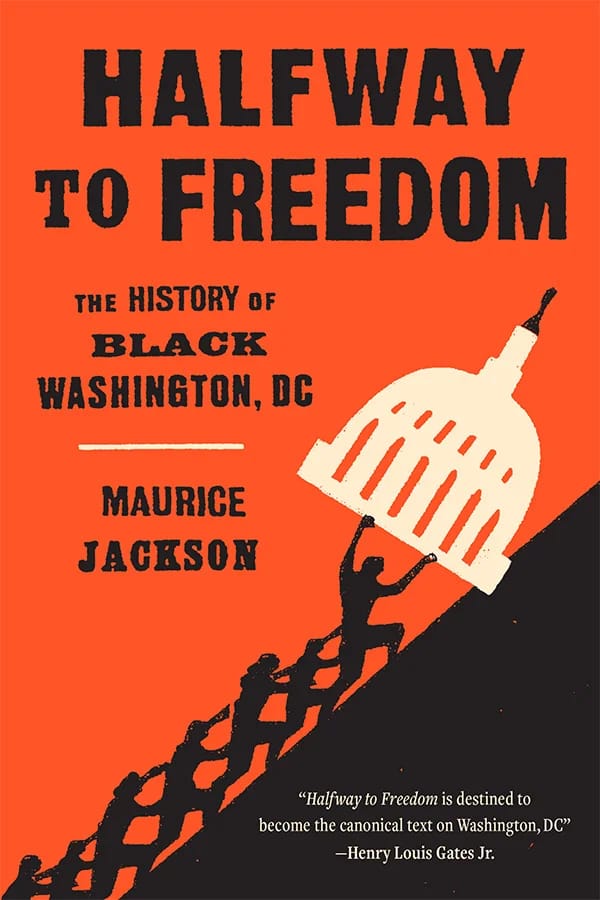
“If you look at the history of Washington, D.C., you sort of look at the history of Black people, you look at the history of a nation,” said Jackson, in a recent interview with The 51st. “It is a city made of a people who are always struggling for freedom in one way or another. And you fight all your life to free your people, to educate your people, and still you’re only halfway to freedom — by which I meant, you still don’t have full voting rights.”
Originally from Newport News, Virginia, Jackson arrived in Washington in the late 1970s to work for the Southern Christian Leadership Conference before going back to school two decades later for his master’s and doctorate at Georgetown. He now teaches in Georgetown’s history, Black studies, and performing arts departments, and in 2013 became the first chair of D.C.’s inaugural Commission on African American Affairs. The resulting 2017 report from that commission examined why Black people had left the District at such alarming rates, finding that the city had largely failed its Black residents in providing adequate education and opportunities for work as compared to their white counterparts.
On the heels of that report, Jackson wanted to continue researching the city he’d called home for decades. He ended up writing and editing an unofficial trilogy of works on D.C. history and culture. The first was 2018’s DC Jazz, which he co-edited with Blair A. Ruble, inspired by his love of D.C.’s legendary jazz scene. The second was Rhythms of Resistance and Resilience, out last year, which explored how Black Washingtonians have used sports and music as a means to equality.
Jackson’s latest effort, Halfway to Freedom, builds on these concepts and covers more than 225 years of history. He begins in 1790, when the founding fathers were selecting the location of the young nation’s capital. The decision rode heavily on appeasing Southern slaveowners by selecting a city where their interests wouldn’t be ignored. They settled on a site along the Potomac River, with Virginia and Maryland ceding land in the process.
“In the end, enslaved Black people were part of the national capital compromise, without having a say in it,” Jackson writes in the first chapter.
Jackson writes about the active slave trade in the shadow of the Capitol. He dedicates a section to individuals involved in an escape attempt in 1848, when 77 enslaved people boarded a schooner, called the Pearl, on the Southwest waterfront and fled down the Potomac. They were caught a few days later on the Chesapeake Bay, but their legacy inspired fights for freedom around the world.
Jackson then covers how the city’s Black population swelled during the Civil War, Reconstruction, and the Great Migration, becoming in 1957 the first major U.S. city with a majority-Black population. He explores the Civil Rights era and the violence and destruction that followed the 1968 assassination of Dr. Martin Luther King Jr. Jackson dives into Washingtonians’ fights for rent control at home and against racism abroad, such as when a young Eleanor Holmes Norton — then a Georgetown Law professor — joined three other Black activists in a protest at the South African embassy in 1984.
As the book moves into recent decades, Jackson examines the forces of gentrification by focusing on individual stories, like that of Bill White, who in 1997 established Bill’s Seafood Kitchen on Georgia Avenue near Howard University. Howard students nicknamed it Fish in the Hood, which White changed to Fish in the Neighborhood in 2012 as the Black population declined. “The avenue is changing, and I’m like the last of the Mohicans.… There are so many Black businesses that are dying off,” Jackson quotes White as saying at the time.
In 2024, White’s rent was six times higher than when he opened, Jackson writes: “Black businesses have always been in danger of being priced out, taxed out, run out, squeezed out.”
By the end of the book, Jackson ties these anecdotes together by pointing to D.C.’s ongoing struggle for full voting representation in Congress. In a chapter on poverty in D.C., he quotes Dr. King as saying, “You don’t have freedom in Washington because you can’t vote,” which he connects directly to the suppression of the Black voice.
Halfway to Freedom may remind local readers of other great works that lay out the city’s Black history in context of broader events across the nation and the world — namely, Harry Jaffe and Tom Sherwood’s Dream City (1994), and Chris Myers Asch and George Derek Musgrove’s Chocolate City (2017). Jackson’s book is more similar to the latter in length and scope, but while he’s read just about every book on D.C. history, he says he went out of his way to avoid copying them. Those books were wonderful explorations of political institutions’s impact on history, while his book focuses more on individual stories, he says.
“This is really sort of a people's history, and that's the way I work,” Jackson says. “I look at how people in Washington change and grow over time.”
In past lives, Jackon worked in construction, and as a longshoreman, shipyard rigger, and human rights organizer — his work as a laborer also informs his scholarship, he says, particularly as he’s watched D.C. become less affordable.
“You realize, man, this is affecting me. This is affecting my wallet. This is affecting my friends, my neighborhood,” he says. “So yes, what makes people care? Their pocket.”
Outgoing Smithsonian Secretary Lonnie Bunch, a friend of Jackson’s, wrote the foreword, in which he recounts his own story of arriving in D.C. in the 1970s to study at Howard. Bunch, who was only 17 at the time, recalls exploring a city marked by beautiful homes in neighborhoods like LeDroit Park, where he saw simultaneously the threat of blight and crime. He describes his bewilderment at the “contradictions, conundrums, and complexity” of his new hometown, “where race not only mattered, it shaped the experience of all who called the District home.”
Decades later, Halfway to Freedom has helped him understand some of what he witnessed as a freshman — how “Black Washington” differed from what the world views as the federal city.
“Jackson weaves a narrative that helps us understand the ways that slavery shaped all aspects of each Washington,” Bunch writes, “especially how Black Washingtonians and their allies creatively fought to expand freedom and fairness in a city where those basic freedoms were never meant to be shared by all.”
Jackson will host several book talks in the coming months, including at Politics & Prose on Feb. 1 with Kojo Nnamdi.

Residents transformed these tiny public areas into something magical.

Trump’s One Big Beautiful Bill has left the District scrambling to protect D.C. residents' federal food aid and medical coverage.


The GRID Act seeks to limit utility companies’ profits, regulate third-party suppliers, and update the Public Service Commission, among other changes.


Here are some of the venues you can visit to support our city's visual art, music, and poetry scenes.

With your help, we pursue stories that hold leaders to account, demystify opaque city and civic processes, and celebrate the idiosyncrasies that make us proud to call D.C. home. Put simply, our mission is to make it easier — and more fun — to live in the District. Our members help keep local news free and independent for all: