

The Commanders’ energy plans for RFK stadium are already raising alarms
The team plans to ask for an exemption to the city's climate law that would allow it to add a natural gas-burning plant, which is worrying environmentalists and lawmakers.
The team plans to ask for an exemption to the city's climate law that would allow it to add a natural gas-burning plant, which is worrying environmentalists and lawmakers.

Why we partnered with a collective of D.C. natives to produce a print edition and where you can get a copy

Get to know your neighbors, regardless of their address.

Capturing tenant organizing, statehood activism, and rapid gentrification taught her that change comes for those who keep fighting.


For the past fifty years, photographer Nancy Shia has witnessed a changing D.C. from her Columbia Road window. “I couldn’t have better television,” she said.
Shia first came to the Beverly Court apartments for a party in 1973. When she arrived at the corner of Columbia and Ontario, “the entire building was the party. You just went apartment to apartment experiencing it,” said Shia. One of the apartments had a darkroom and the communal basement was repurposed into a shared studio space for the many artists who lived there. “I remember coming out of the building and thinking: that’s where I want to live," she said.
When Shia heard about a vacant apartment, she wasted no time moving in. The Adams Morgan building was a meeting point for Washingtonians of all backgrounds, from artists and organizers to politicos, including activist filmmaker Thomas Goodwin and color school artist Gay Glading. Shia recounts wild stories from those first years in the building, including when Carl Bernstein attended their parties (conspicuously without his then-wife Nora Ephron, she says).
In 1978, Shia was a part of converting the building into a cooperative so the tenants could purchase it. In the years since, she’s raised her two children there, only moving once — from a one-bedroom to a two-bedroom when she first became pregnant. She's spent her weeks working day jobs, mostly in news, and her weekends in her apartment’s darkroom, leaning on support from neighbors who swapped childcare so they could each work on their art. Over the decades, she's come to play a central role in documenting the movements, politicians, and people who defined Adams Morgan, and the city more broadly, during several of its most tumultuous decades.
“If you had to define Nancy, she’s very interested in photographing everyday people and their lives,” said Nancy Mirabal, an associate professor of American Studies at the University of Maryland who teaches Shia’s photography in her classes to help her students understand power and gentrification. “She’s interested in movement. She’s at every protest and march. She’s committed to capturing the experiences and lives of people we take for granted. She’s also very interested in power and her photographs show her disdain for it used wrongly.”
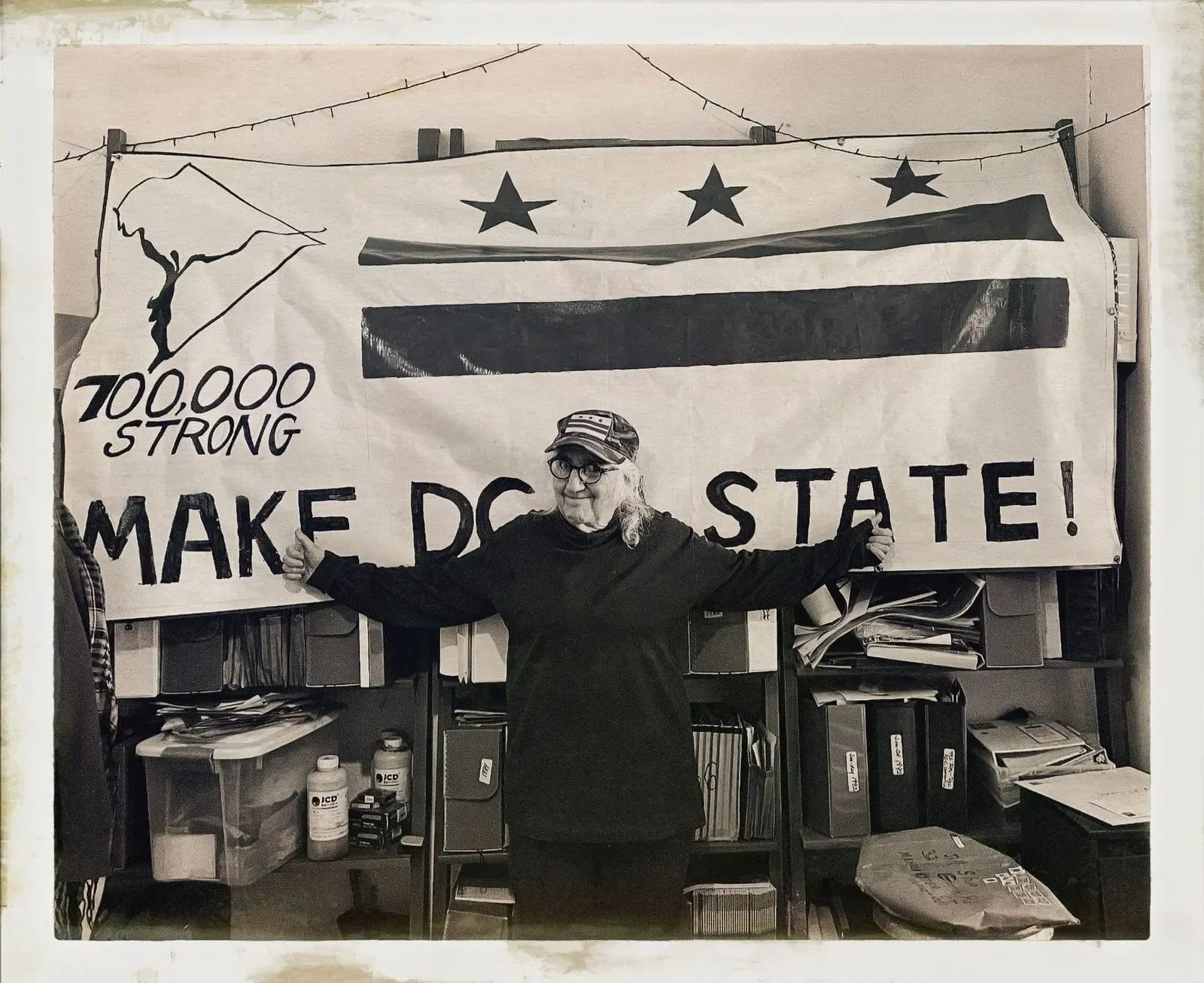
Though often focused on her block, Shia also spent decades at the Federal News Service where she photographed senators and foreign dignitaries, including Nelson Mandela, Yasser Arafat, and Hugo Chavez. She then went on to a three-year stint at The Washington Informer, where she covered tenant organizing, statehood activism, and police violence. Her work was also published in The New York Times and Vanity Fair. The educational nonprofit Teaching for Change recently received a grant from HumanitiesDC to curate her photographs into the Out My Window collection, highlighting her coverage of homelessness, gentrification, and the 1991 Mt. Pleasant uprisings.
More than the national recognition, what matters most to Shia is the connection between her photos and the people and community they depict. People who know Shia often recall meeting her in the same way: “out in the community.”
Today’s Adams Morgan is nearly unrecognizable from when she first moved there. 18th Street was mostly homes and apartments, rather than the residential storefronts that exist now. She bought her groceries at the local Field of Plenty Co-Op, which is now Mezè restaurant, and remembers when the now-closed Potter’s House was a hub for Adams Morgan residents. Most notably, Shia recalled the demographic shifts over time.
“At first it felt like all the waves of immigration to D.C. led to Adams Morgan. Then gentrification began to creep up from Dupont Circle to Adams Morgan in the ’70s,” she said.
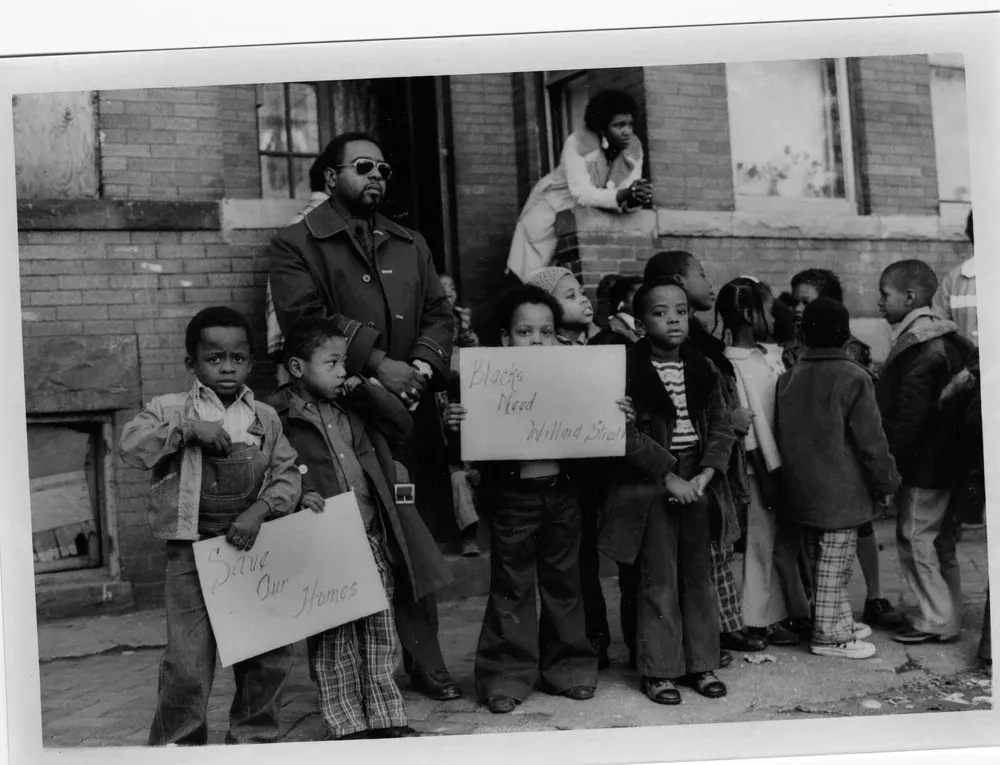
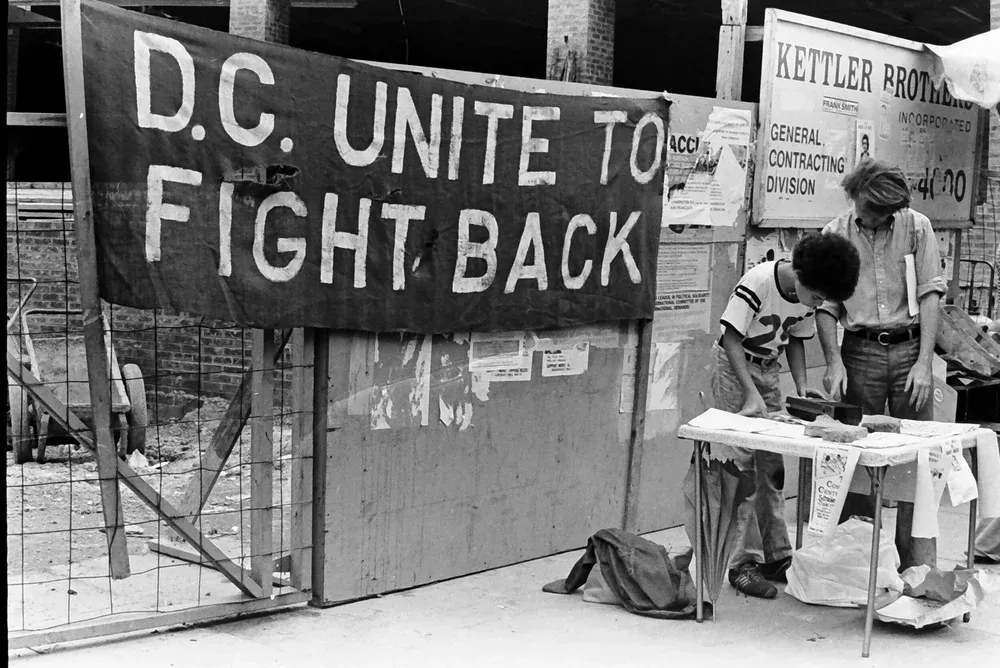
(Nancy Shia)
The gentrification that Adams Morgan and surrounding neighborhoods experienced during those years was in many ways unparalleled. Developers started scooping up property as young professionals sought cheaper rents and the dynamic culture of city life. Over just a few months of 1973, according to Chris Myers Asch and George Derek Musgrove in Chocolate City, 11 different Adams Morgan apartment buildings saw evictions. In just five years, home prices in the neighborhood doubled. The change was citywide: in 1979, a full 12% of the District’s apartments were being converted into condominiums, according to one study they cite.
As the neighborhood around her changed, Shia captured the response. “Community resistance was immediate,” she said. She photographed multiracial crowds marching on landlords’ houses, carrying signs that bore the name of tenants’ associations and messages like “We’re not moving out.” She photographed a successful fight in 1973 to stop a BP gas station from setting up shop in the public area at 18th and Columbia, and she photographed the belongings of tenants tossed onto the sidewalk following an eviction.
“Nancy wants to photograph the everyday life of the neighborhood. She wants the photo of a woman sitting with her child waiting for the bus or the lines of people coming together to protest. She elevates these folks and makes them beautiful,” said Mirabal.
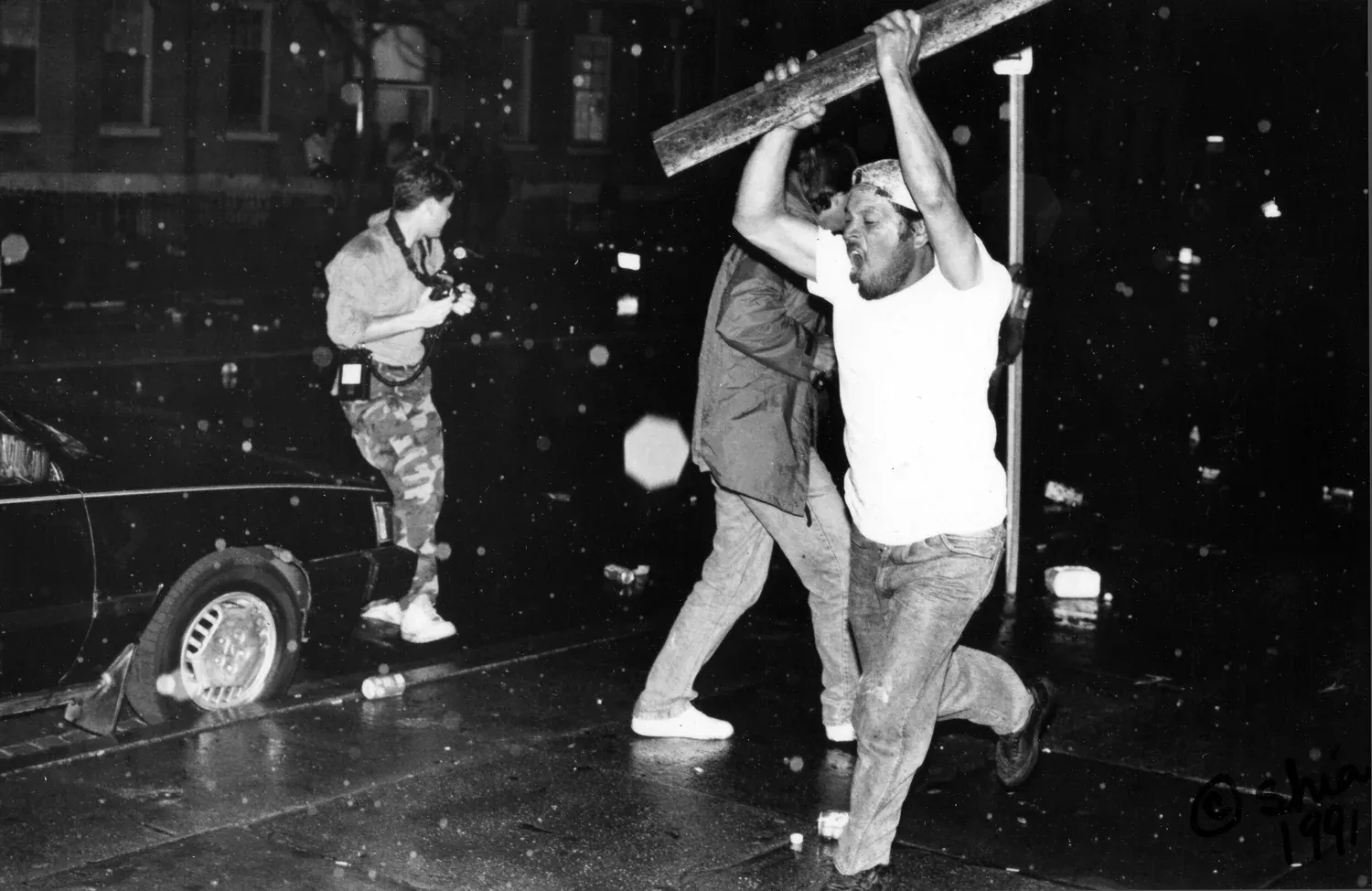
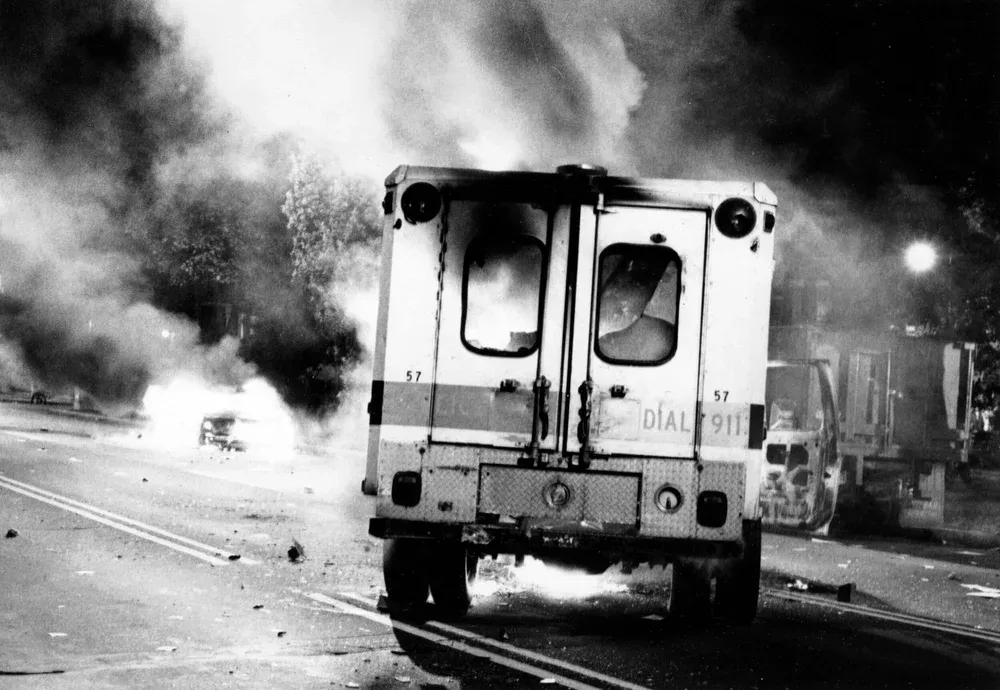
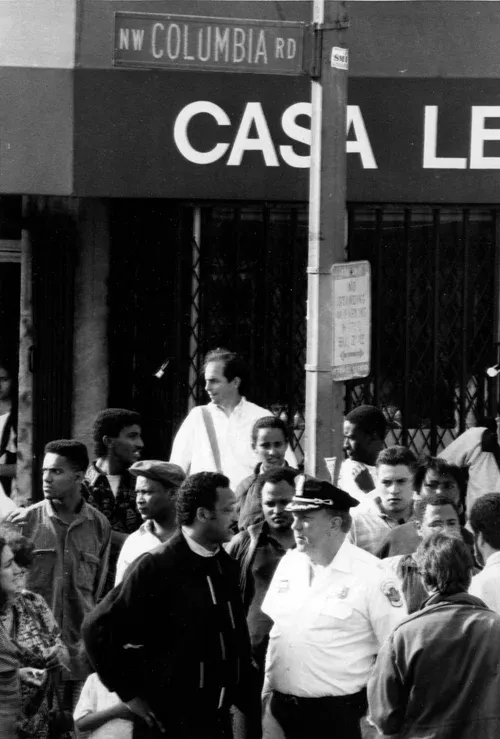
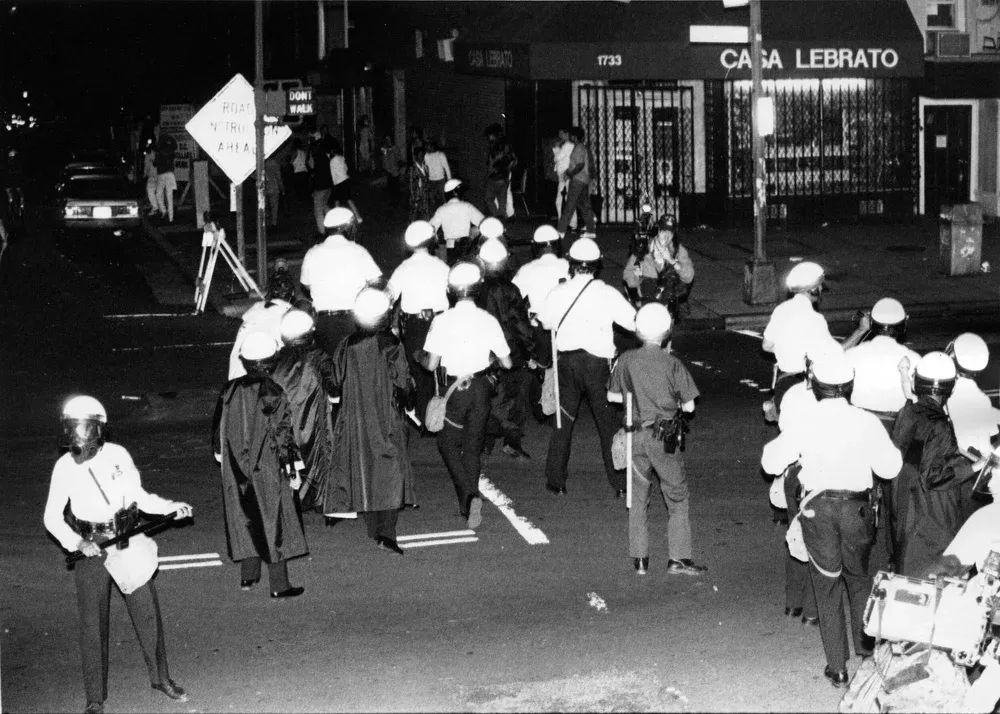
The impacts of the 1991 Mount Pleasant uprisings unfolded right in front of Shia's window. (Nancy Shia)
In 1991, Shia was there when riots broke out in Mount Pleasant after a police officer shot a Salvadoran man in the chest. For three days, protesters clashed with the police; Shia captured police vehicles ablaze. When the uprisings spread to Adams Morgan, she photographed police barricades from her front window.
Shia didn’t stop at photography — she’s also worked in service of the causes she cares about, serving as an ANC Commissioner from 1982-1984 and again from 2007-2010. One of her proudest accomplishments of her first ANC term was establishing a bilingual homeless shelter, La Casa, which remained open in the neighborhood from 1984 to 2010.
It’s part of what makes her photography different, said Mirabal.
“She knew these people. She creates a relationship with people. She gives them value. She says ‘I see your humanity,’” Mirabal said. “There's a lot of love in the work Nancy does. She loves the people she photographs. That comes through.”
Shia also aimed her lens at power. Her work at the Federal News Service — where she was mainly capturing speeches, Congressional hearings, and other political events — gave her great opportunities to photograph high-profile subjects very close-up. She began photographing government officials, beginning what she called “PIG art,” her acronym for “people in government.” Shia would often capture her subjects from unflattering angles or catch them when their eyes were closed or blinking.
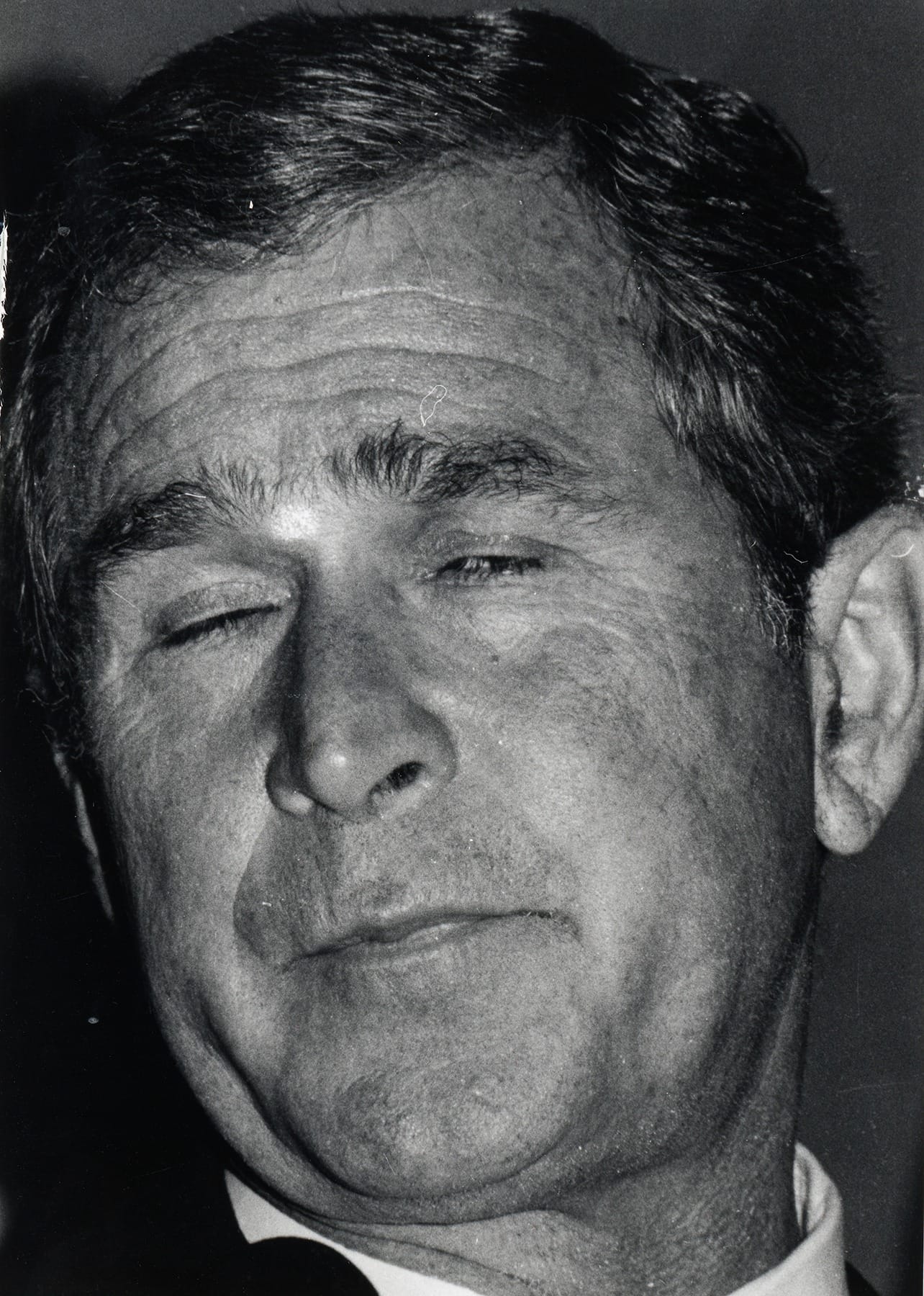
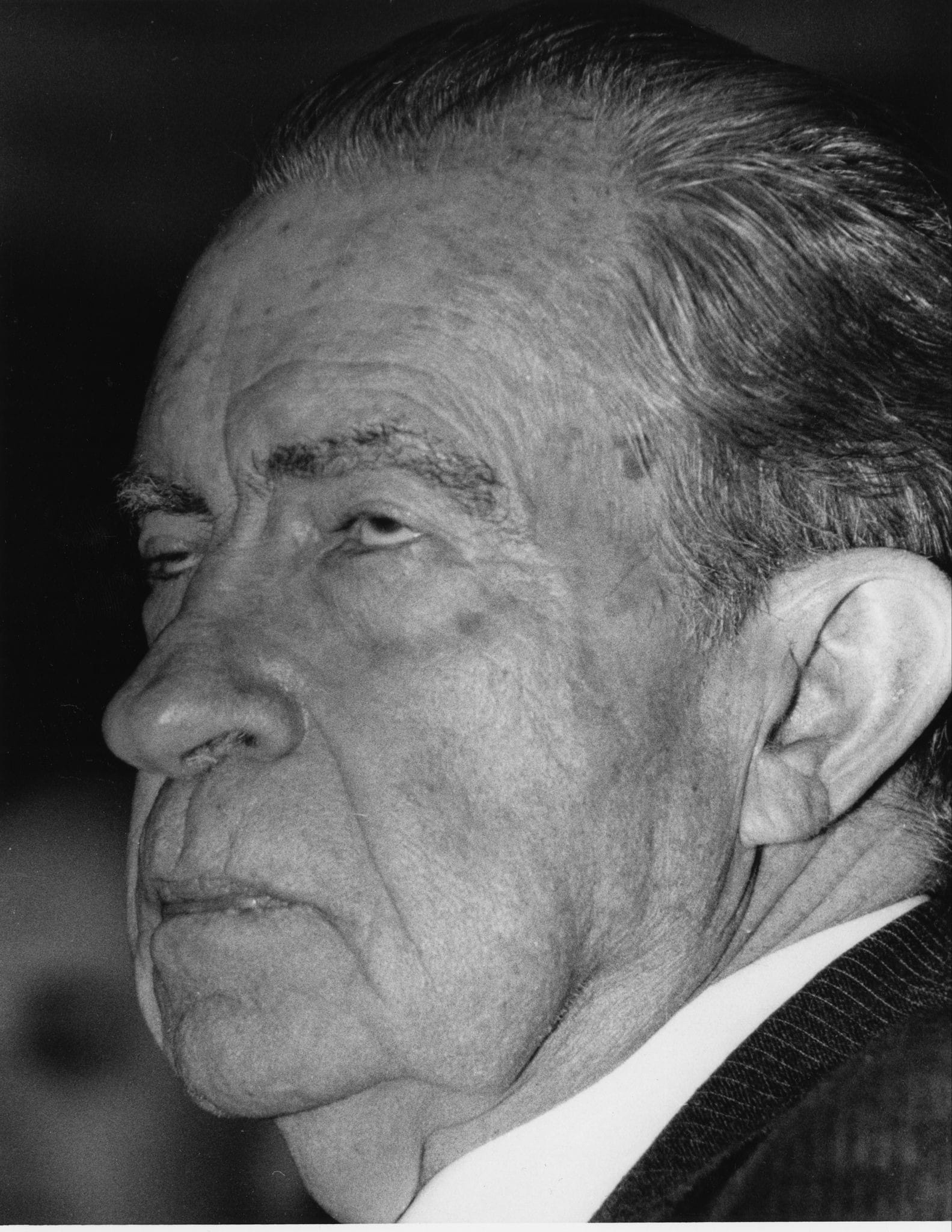
(Nancy Shia)
In recent years Shia has taken on a new role: grandmother. She’s simultaneously working on organizing her archive of photos and creating a coloring book for her two grandchildren who live in California. Always the photographer, she illustrated the coloring book’s pages with illustrated renderings of photos she’s taken of them.
But she hasn’t stopped her work as a photographer or as an organizer. In 2017, Truist Bank sold Adams Morgan Plaza — at the same intersection of 18th and Columbia where residents rallied to keep out BP decades ago — to developer PN Hoffman for luxury apartment buildings. When community organizations sued Truist over the sale, Shia was able to provide her legal and organizer insights to her neighbors.
“There were moments in the fight against Truist for the plaza where it seemed impossible,” says Shia. “I always had faith that the rights were on our side. The law was on our side. They just had all this money, but we kept the faith and we won both the legal and street fight.”
In 2023, Truist finally donated the lot to Jubilee Housing, effectively returning it to the hands of the neighborhood.
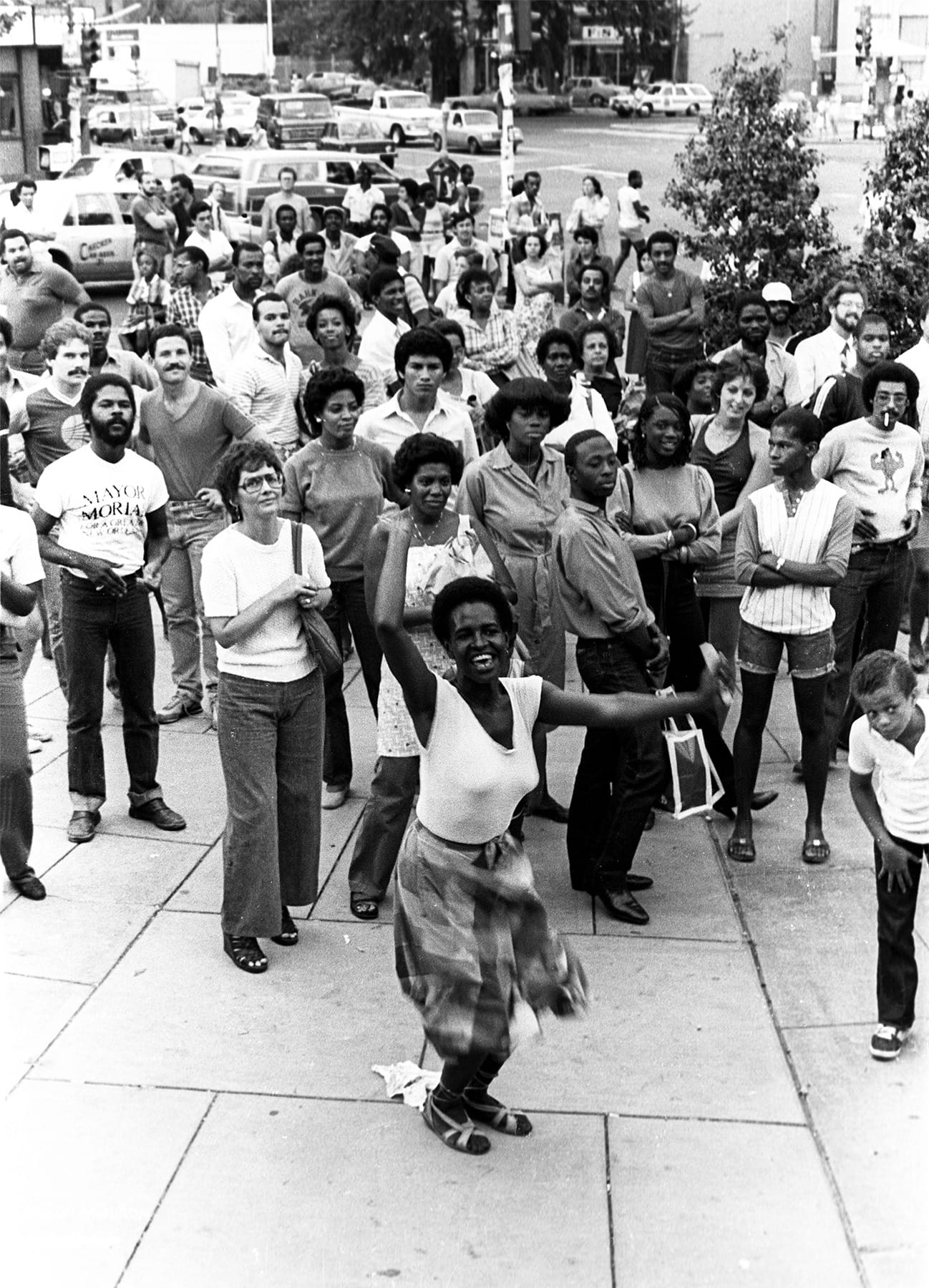
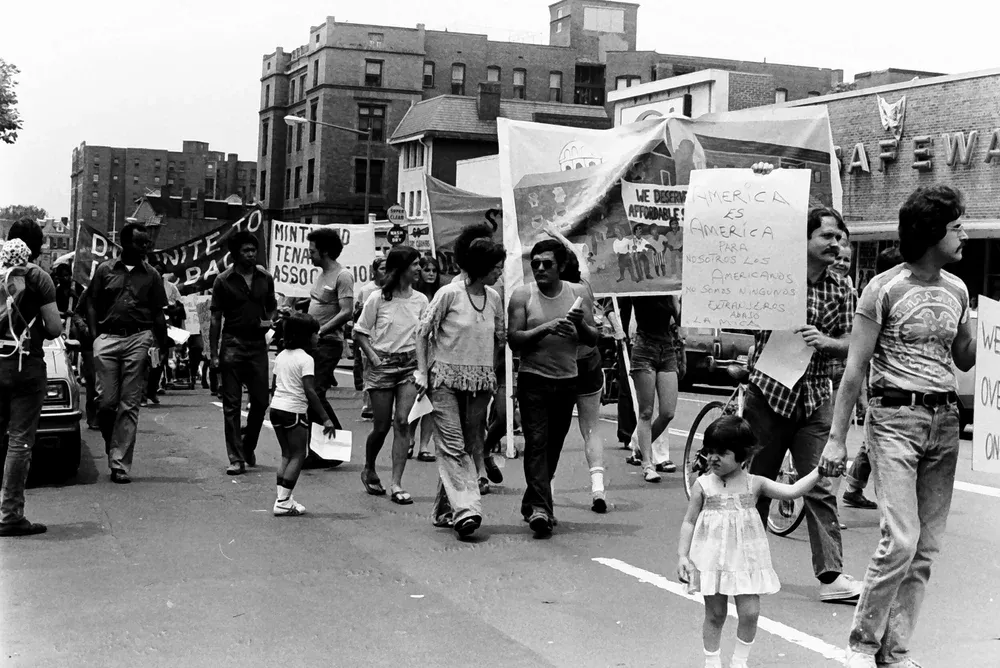
People gathered in the Adams Morgan Plaza in 1982 (left) and a 1987 march on Columbia Road to support D.C. tenants (right). (Nancy Shia)
In the fight for the plaza, Shia utilized her legal background, years of community expertise, and perhaps most importantly, her photography skills to assist organizers: “I haven’t directly changed a law, but I can say my photos were part of the fight against Truist.” Shia’s photographs were first used in the legal proceedings to show the plaza had been used by the community for over 40 years. The photos then appeared on posters around the neighborhood to get people to rally to save the plaza. Shia’s photos showed exactly how the space was supposed to be used — by the community.
Even as Adams Morgan continues to change, Shia is motivated by how many community members are resisting the Trump administration’s ongoing takeover of D.C. Shia used to have to drag friends out to wheatpaste or “wall-write” (otherwise known as spray-painting) political messages across the neighborhood. Now, street art is prevalent in the city and Free DC leads frequent wheatpasting and art-building sessions.
The fervor of organizing has increased as the conditions being organized against have worsened, Shia said: “There are a lot more comrades in the resistance now than there were before. In all my time in D.C., I’ve never felt such a critical time to get so many people resisting fascism. Imagine if we don’t resist it? How horrible would it be? Who would we become?”
The years have taught Shia that while the fights are never-ending, change does come to those who keep fighting. Even today, she remains hopeful and committed to educating new D.C. residents and welcoming them to the struggles they inherit.
Recently, Shia joined a Zoom training led by Empower DC, a local organization working to build collective power among D.C.’s lowest-income residents, where the cover image of their slides was a photo Shia herself had taken decades ago of tenant organizers protesting the gentrification of Adams Morgan. All these years later, the message still resonates. “You never know what out of your work will make an impact or when or how it’ll happen, but the more stuff you do, the more it’ll reach people,” Shia said, “That impact is what it’s all about.”

The outlet is pitching its newly robust metro section with ads and activations around town

A new Obama Center sculpture honoring Harriet Tubman has thrust one of the District's most talented artists into the national spotlight.


Domo Wells’ designs for women’s soccer merch have deep roots in D.C. culture.


Our reporter survives an overnight journey of ambient music — and the soul — at Rhizome.
With your help, we pursue stories that hold leaders to account, demystify opaque city and civic processes, and celebrate the idiosyncrasies that make us proud to call D.C. home. Put simply, our mission is to make it easier — and more fun — to live in the District. Our members help keep local news free and independent for all: