

Goodbye, Dukem, and thanks for 30 years of service
As the iconic U Street Ethiopian restaurant prepares to close, thousands on social media shared their praise and memories
As the iconic U Street Ethiopian restaurant prepares to close, thousands on social media shared their praise and memories

The outlet is pitching its newly robust metro section with ads and activations around town

The Revada Arts Center will be home to a theater company, film house, and “anti-opera” collective.

"Tomorrow the Sun Will Rise" is the result of an open call for art responding to the current political moment.

Following the results of the 2024 election, many D.C.-area artistic institutions struggled to find ways to respond to the new administration and its impact on the region. The Phillips Collection decided to put on a show.
In July 2025, the Dupont Circle museum put out an open call for work by regional artists, created after November 2024, that reflects “the museum’s values of experimentation, equity, accessibility, and social purpose.”
The Phillips Collection set a cap at 1,000 applications. But the museum was flooded with submissions and had to extend the limit to 1,500. Local artists were, it seemed, eager to share how they’d been processing the state of society since the presidential election.
A team of judges — also local artists and curators — deliberated for months before selecting 48 artists.
The resulting exhibit, "Tomorrow the Sun Will Rise," is on view at the Phillips now through Sept. 20, taking over nearly an entire floor of the museum’s eastern wing. It champions the work of local artists at all career stages, putting them on the same footing as globally recognized names – a rarity at D.C.’s major artistic institutions. For more than a dozen of the artists, this is their first time having their work showcased in any museum.
“It's massive to be able to say that you've shown at an institution like the Phillips because of its global reach, and also its really rich collection,” says Tsedaye Makonnen, a D.C.-based visual and performance artist who co-curated the show with Tie Jojima, the Phillips’ curator of global contemporary art.
A placement in an exhibit like this could change an artist’s career trajectory. For example, a piece by local artist Marta Pérez García was featured in the Phillips’ last juried invitational in 2021, and the next year, the museum hosted her solo exhibition.
Artists who sell their work featured in the exhibit keep all proceeds, and the Phillips already has plans to acquire some pieces for its permanent collection, per a museum spokesperson. (Details will be announced next month.)
The show’s title was inspired by a Brazilian protest song, Chico Buarque’s 1970 samba “Apesar de você” (In spite of you). The song plays in the background as guests enter the central gallery, its lyrics suggesting resilience during the height of Brazil’s dictatorship (1964–85): "In spite of you / Tomorrow will be another day / I ask you, where will you hide / From the great euphoria?"
In this spirit of enduring creativity in the face of oppression, the judges selected artists who represent the diversity, creativity, and resilience of the D.C. region. Many immigrated from other parts of the world. Makonnen says the artists blend globally relevant themes with hyperlocal stories to create “a beautiful representation of what America is.”
For example, Filipino artist Joey Mánlapaz’s oil painting, "No Mask, No Service," depicts the familiar pandemic-era scene of a D.C. hot-dog cart with a mask slung on a sign a few feet away. Mánlapaz immigrated to D.C. in the 1990s, and her work often captures the city’s street vendors and disappearing icons.
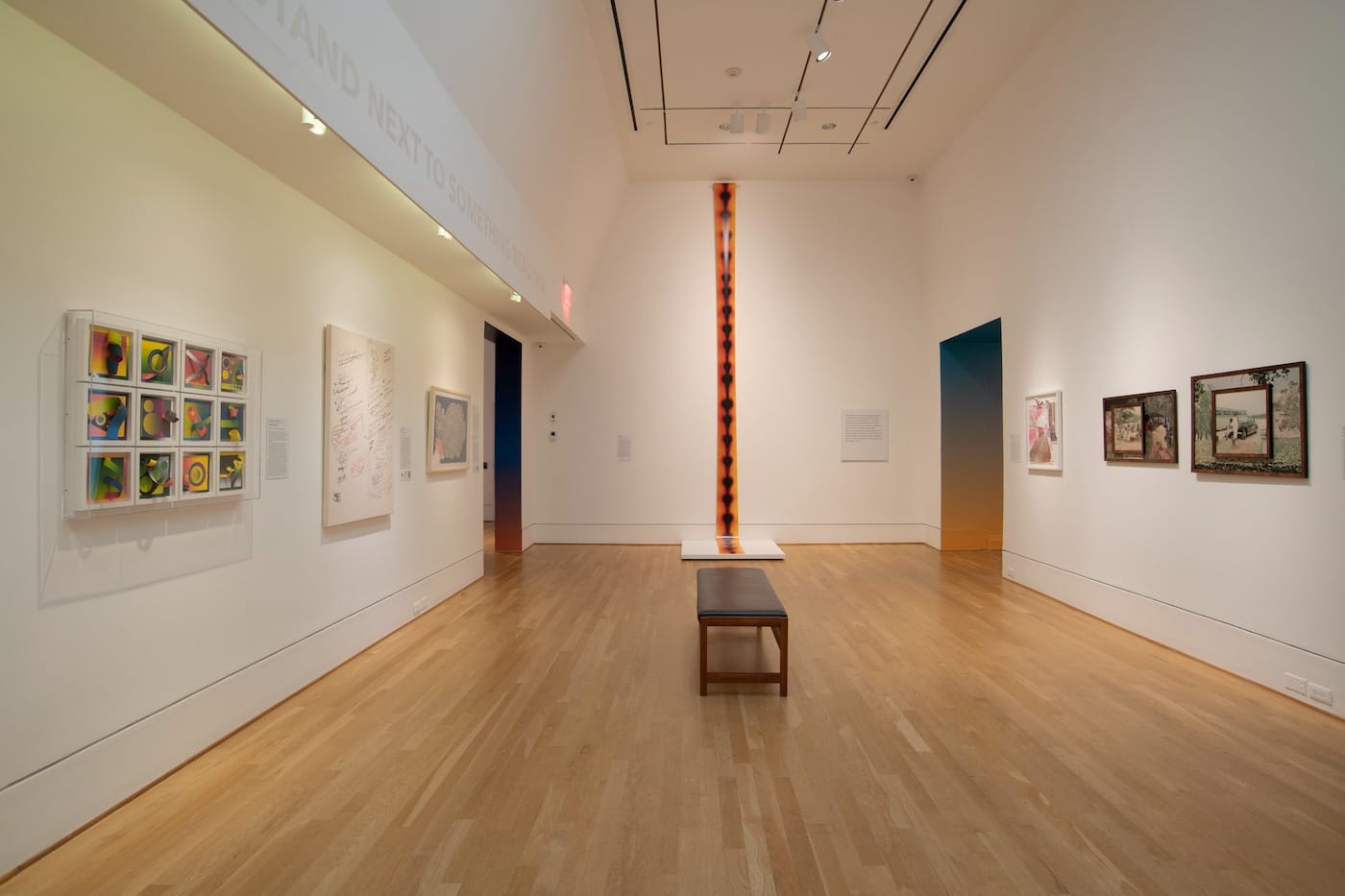
There’s no set order in which visitors are expected to peruse the exhibit’s six rooms, but the show’s curators say they organized it based on five main themes, introduced in a summary at the entrance: Gazing within and as Diaspora; Archiving the Personal and the Historical; Challenging Hegemonic Ways of Seeing and Knowing; Processing the Self; and Experimenting with Matter and Form. (Mánlapaz’s painting fits the “gazing” theme, for instance.)
In a video installation, "Studio Practice," that’s part of the “challenging” theme, South Arlington native Danyela June Brown emphasizes the struggle of finding affordable studio space in D.C. In the looped, six-minute adaptation of a much longer video, Brown rows across a lake holding onto a handmade plywood sign that reads, “STUDIO,” reading a copy of bell hooks’ Black Looks: Race and Representation.
Brown says she filmed the piece in Upstate New York, where she negotiated for a residency after failing to find a space in D.C. to create a sculpture for a show at the Hirshhorn Sculpture Garden. The Phillips exhibit is one of just a handful of shows the 30-year-old artist has been a part of in D.C. — she’s found more success in New York, where she splits her time while working toward an MFA at Bard College.
Brown isn’t convinced this exhibit is a sign of major D.C. institutions endorsing local artists more broadly — but she says a Phillips placement will make it easier to negotiate with local gallerists.
“In D.C., it’s so hard to create a market for your work,” Brown says. “But [the Phillips exhibit] definitely is a cool talking point with some of the local arts presenters.”
Baltimore-based artist Kei Ito’s piece, "Sungazing Scroll," won the $2,500 first-place prize with a stunning, floor-to-ceiling scroll that explores memory and ritual. Ito, a descendent of a Hiroshima survivor, created the scroll by exposing light-sensitive photographic paper directly to sunlight and his own breathing. The result is a piece that reflects his grandfather’s description of the atomic bomb’s devastation as “hundreds of suns lighting up the sky.”
“The artists who are in the show are … not only archiving personal stories from their communities, the ethnic groups they come from, their families,” says Makonnen, “but they're also speaking to colonization, imperialism, racism, white supremacy.”
Another unspoken theme, not included in the list provided by the curators, is hope. As guests enter each room, they pass through archways painted in a red-to-yellow gradient, as if walking through a sunrise.
It’s fitting, then, that one of the exhibit’s largest pieces is an experimental sculpture that resembles sunbeams hanging from the ceiling. Mary Early, director of D.C. gallery Hemphill Artworks, crafted the work, "Línea XV," out of beeswax and cotton.
The piece smells like a homey candle and illuminates the room. In the background, Buarque’s lyrics are still audible, asking, "How will you prohibit, when the rooster insists on crowing, new water flowing, and our people loving one another, without stopping?"
It’s as if, through this exhibit, the museum is trying to tell local artists they’re welcome to stay.
"Tomorrow the Sun Will Rise" is on view through Sept. 20. Museum hours are 10 a.m.- 5 p.m., Tuesday - Saturday (11 a.m. opening on Sundays). Tickets for adults are $20.

As the iconic U Street Ethiopian restaurant prepares to close, thousands on social media shared their praise and memories

The outlet is pitching its newly robust metro section with ads and activations around town

The Revada Arts Center will be home to a theater company, film house, and “anti-opera” collective.

As a new parent, I needed activities that were child-friendly but not child-centric. These spots did the trick.
With your help, we pursue stories that hold leaders to account, demystify opaque city and civic processes, and celebrate the idiosyncrasies that make us proud to call D.C. home. Put simply, our mission is to make it easier — and more fun — to live in the District. Our members help keep local news free and independent for all: