

In these hyperlocal ANC races, there's no shortage of drama
Including allegations of stolen signs, homemade attack flyers, mysterious MAGA figures, and a whole lot of name calling
Including allegations of stolen signs, homemade attack flyers, mysterious MAGA figures, and a whole lot of name calling

Renters at Faria Management properties say they're battling mold, rats, sewage leaks, and intimidation. They believe a reckoning for unaccountable landlords is finally here.
With food prices on the rise, these restaurants still provide real value.

This invasive species is spreading through the District. Some residents are taking matters into their own hands.


A few years ago, a Mount Pleasant parent named Joanna was out walking with her child when she noticed a familiar foe cropping up in the cracks of sidewalks and in her neighbors’ yards: the beautifully named but troublesome tree of heaven.
Joanna (who asked to go by her first name in the story for privacy reasons) not only recognized the young trees but understood the threat: her previous apartment building had been at risk of foundational damage due to the aggressive root system of a tree of heaven. She also knew that her neighbors had previously mobilized around other environmental projects, like Mount Pleasant Village's initiative to plant and care for native plants in the neighborhood.
“I thought, ‘Wow — we could actually do something,’” she said.
The tree of heaven, a deciduous tree identifiable by its smooth oval leaves with pointy ends and a distinctive burnt peanut butter scent, was originally brought to the United States from China back in the late 1700s and originally valued for its ability to grow nearly anywhere — even in urban areas that were hostile to other greenery. In the classic coming-of-age novel A Tree Grows in Brooklyn by Betty Smith, the tree of heaven mirrors the resilience of the story’s young female protagonist. “It would be considered beautiful,” reads the book, “except that there are too many of it.”
That is certainly the case in D.C. The city’s tree of heaven problem is “pretty bad,” says Jeff Stottlemyer, ecological landscaping lead at Swamp Rose Co-op, a local native plant nursery and landscaping company. While it was once prized as a tree that could provide shade in urban settings, the tree is now mostly known as a hindrance.
“It establishes itself and puts on a lot of vegetative growth very quickly,” said Stottlemeyer. “The biggest long-term threat that they pose is actually just making it harder for the native plants that are so critical for our local ecosystems and, in particular, our local food webs ... to grow and thrive.”
The tree is a prolific reproducer — a single female tree of heaven can drop over 300,000 seeds in a single year. Because of this, “the population [of trees of heaven in D.C.] is widespread and increasing,” a representative of the D.C. Department of Energy and Environment (DOEE) said in an email to the 51st.
Trees of heaven are also the preferred host of the pesky spotted lanternfly, an invasive insect that can lay many more eggs if it’s feeding on a tree of heaven, as compared to other tree species.
After spotting the trees of heaven in Mount Pleasant, Joanna, along with her husband, began researching the basics of controlling this invasive species from Penn State Extension's website. The most effective time of year to take trees of heaven down, they learned, was in late summer and early fall, because that’s when the trees move nutrients down into their roots — a perfect time to soak up herbicides.
In summer 2024, Joanna reached out to her neighbors to see if anyone would be interested in using a herbicide mix on the trees in their yards. A dozen responded yes, including 31-year resident of Mount Pleasant Sheila Krumholz, who learned from Joanna that her yard had a mature tree of heaven. “I feel terrible, because it was spreading for a long time before I realized what it was,” she said.
Krumholz and other neighbors had concerns about the use of herbicides — understandably so, as these chemicals can pose serious hazards to human health and harm surrounding wildlife. But in the case of trees of heaven, they may be the only option for gardeners looking to slow the spread. “There are a relatively small set of invasive species where responsible targeted application of herbicide is our suggested method,” said Stottlemyer. “Tree of heaven is one of those.”
Trees of heaven send out deep roots that can sprout up from the earth as far as 50 feet away. Pulling out a smaller root is virtually impossible, said Stottlemeyer. Even trying to cut it down will trigger a tree of heaven to produce upwards of a dozen more root sprouts — making the problem even worse.
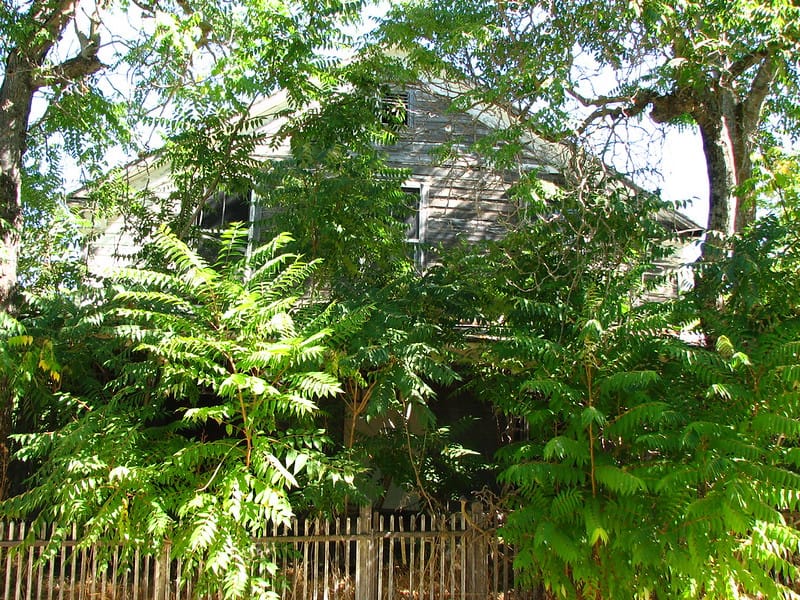
DOEE also pointed out that the research-based approach for removing tree of heaven is by using a systemic herbicide, although the representative explained that “any herbicide must be used in strict accordance with its EPA-approved label.” D.C. residents are allowed to apply a general-use pesticide to their own property without a license. “For larger trees, residents are best served by hiring a licensed pesticide applicator or a certified arborist,” the representative noted.
Stottlemyer recommends adding tracking dye to herbicides, which gives the solution a dark blue hue so that it’s easy to tell where it’s been applied. He also strongly recommends that people use personal protective equipment, like nitrile gloves and protective eye equipment, to prevent any contact with chemicals.
Ultimately, thoughtful application of an herbicide seemed like a fair trade-off to Joanna and her neighbors, if it meant the opportunity to tackle both trees of heaven and spotted lanternflies. Working in their backyard, Joanna’s husband made an herbicide solution using triclopyr, one of the chemicals recommended by Penn State as posing “little risk” to surrounding plants from root uptake. He also added a bit of diesel to help the mixture absorb into the stems. The group of neighbors then applied the solution in small doses, using a paintbrush or a small spray bottle, to the bases of the young trees of heaven on their property.
“It took five minutes to do one spritz on the half a dozen very small plants in my yard,” said Joanna.
Joanna and her neighbors have seen some success in their efforts. In the trees she targeted last year, none returned back in the same spots — though because of their ability to reproduce an overwhelming amount of seeds, and because of their wide-spreading root system, she acknowledges taking them down in large numbers is a bit of a Sisyphean task.
Krumholz was able to successfully remove the mature tree of heaven in her yard by using the “hack and squirt” method: a more intensive strategy where cuts are made into the tree and then filled with an herbicide. The next year, she hired an arborist to confirm it was dead and finally remove it from her property. She was hopeful that would take care of the root suckers on her property — but to her disappointment, they still cover her yard.
“I had hoped that by killing the tree, I was killing the roots running from the tree,” said Krumholz. But she knows that the root suckers in her yard may come from another source. “They're all over the neighborhood.”
Luckily, Joanna and her squad are back at it this season. She says there’s been significantly more interest: 30 people are now in the neighborhood group chat dedicated to talking about the trees and where they’re spotting them. “Everybody's sharing these strategies, and it's a really great way to both tackle issues that you can't tackle on your own,” Krumholz said. “And it's a great way to meet your neighbors as well.”

Including allegations of stolen signs, homemade attack flyers, mysterious MAGA figures, and a whole lot of name calling

Renters at Faria Management properties say they're battling mold, rats, sewage leaks, and intimidation. They believe a reckoning for unaccountable landlords is finally here.


Where the competitive local races are, an unusual At-Large voting situation, the fate of foie gras, and more.
With your help, we pursue stories that hold leaders to account, demystify opaque city and civic processes, and celebrate the idiosyncrasies that make us proud to call D.C. home. Put simply, our mission is to make it easier — and more fun — to live in the District. Our members help keep local news free and independent for all:
