

12 things to do in D.C. this weekend
Grab your favorite sweater to catch over 100 bands or break it down at a Diwali dance party.
Grab your favorite sweater to catch over 100 bands or break it down at a Diwali dance party.

Filling the at-large seat vacated early by Robert White just got even more complicated.

In a largely suspense-free election, the District gets a democratic socialist mayor and says au revoir to foie gras.

Filling the at-large seat vacated early by Robert White just got even more complicated.

Election Day was expected to be a low-drama affair for D.C. Democrats. Instead, a last-minute resignation and surprise party switch has ratcheted up intraparty agita to heights not seen since the primary.
There was still plenty of celebrating, of course, as Mayor-elect Janeese Lewis George and her fellow Democratic nominees cruised to easy victories. But an impending fight over the at-large seat vacated by Delegate-elect Robert White has proved to be a turd in the punch bowl, pitting competing factions of the party against each other after they’d only just reached an uneasy peace in the wake of June’s contentious primary contest.
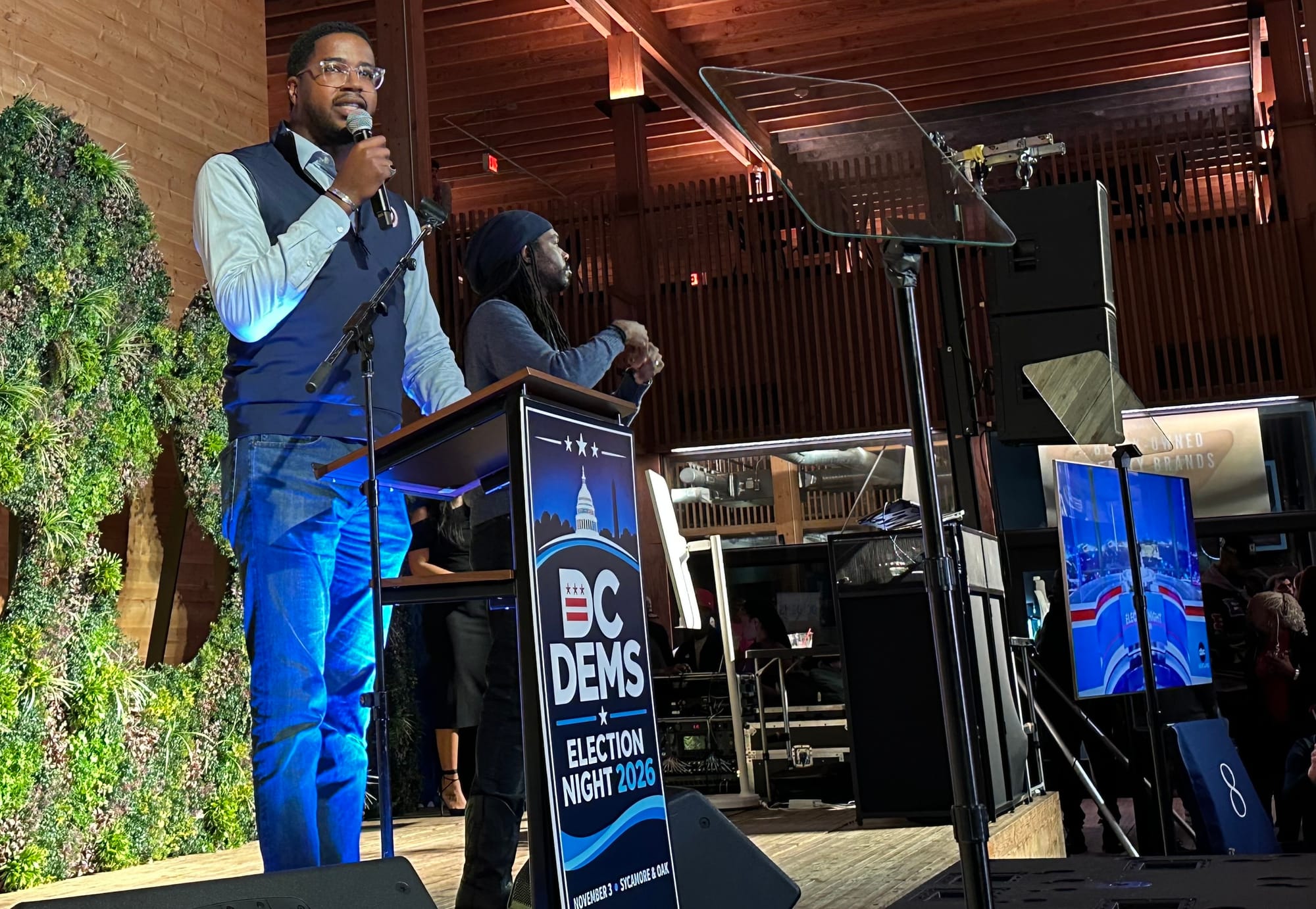
Speaker after speaker at the D.C. Democrats’ big election party, from ward party chairs to embattled Ward 8 Councilmember Trayon White, took time to address the controversy, even on a night that was supposed to be nothing but dancing and good vibes.
“Fewer people have been asking about my race and Initiative 86, and more about the Robert White situation,” Oye Owolewa, who just won a different at-large seat on the Council, told The 51st.
White originally planned to resign his at-large seat once he was sworn in as Congressional delegate in January, and a newly elected batch of party leaders to the Democratic State Committee sketched out ambitious plans to pick his interim replacement, taking steps to hold a 1,000-member party convention.
But those plans began to melt down once White realized the D.C. code bars anyone from winning the delegate seat if they currently hold public office. He scrambled to find a way to change the law (and said he believed the city’s lawyers were actually misinterpreting it), but these questions ultimately proved too thorny to resolve at the last minute. White chose instead to resign Monday to eliminate any doubt about his eligibility for his new role.
That change was disruptive enough on its own — party officials figured they’d need to scrap drawn-out plans for a convention and massively accelerate their timeline to appoint someone. But then At-Large Councilmember Christina Henderson threw another wrench in the works by announcing Tuesday that she’s switching her party registration to become a Democrat.
This creates a situation without precedent in D.C.’s history. When Congress granted D.C. limited self-governance 50 years ago, it required that at least two seats on the Council be set aside for anyone who isn’t part of the majority party (in practice, non-Democrats). Henderson, like so many others before her, ran as an independent despite a long history working in Democratic politics. Once White resigned, that opened the door for her to re-register without upsetting the Council’s partisan balance. She called it a chance to “freely associate and rejoin the party I once called home.”
It’s a politically advantageous move for Henderson. She won’t have to resign her seat should she run in a Democratic primary for higher office someday, as Kenyan McDuffie was required to earlier this year. (In fact, McDuffie himself considered attempting a similar move to try and stay in office during his mayoral bid.) But it has caused a major stir among Democrats. Not only might it rob the party of a chance to pick White’s replacement, but it means precisely no one is sure how to proceed.
“She wants to have her cake and eat it too,” said one Democratic party leader who requested anonymity to speak candidly. “And she's willing to trample on the D.C. Democratic Party to do it.”
Lewis George said on election night that she fully supports the D.C. Democrats filling the seat, no small thing given her long-standing close relationship with Henderson. White himself has been more critical, arguing Henderson’s move “undermines the Home Rule Act” and “does not put the city in a good light as we are fighting Capitol Hill to respect us and our laws.”
Former Board of Elections Chair Gary Thompson believes Henderson can’t even legally make this move, writing in a social media post it would violate the city’s charter. The board has yet to weigh in one way or the other, which will tee up what comes next.
“This was clearly never anticipated, and it’s a poorly designed system,” says Brian Strege, who has spent years immersed in the arcana of rules around at-large races in his role advocating for the adoption of ranked choice voting and open primaries. “There are so many edge-case scenarios that completely jack this up, and this is one of them.”
The D.C. Dems seem to be spoiling for a fight. The group’s leadership voted on Tuesday to appoint Jamal Holtz, the head of the D.C. Young Democrats, to White’s old seat, according to three people close to the process. However, the Dems view Holtz merely as a placeholder to preserve the party’s appointment power, and he intends to resign once the state committee can hold a full vote to pick someone else, one source familiar with the matter says.
The committee believes Henderson ran afoul of a section of D.C. law barring people from changing their party affiliation less than 21 days before an election. They feel her party switch hasn’t taken effect yet, giving them an opening to make their appointment for White’s seat. If the elections board disagrees, that could lead to a legal challenge. Former attorney general Karl Racine has already begun advising the party on its options.
“[Henderson] might find herself out of a job,” says one source, who requested anonymity to discuss internal party deliberations.
But several election observers who spoke with The 51st doubt this approach will work. And the longer a legal case drags on, the more it eats into the already brief term of any interim councilmember.
Instead, experts believe a compromise of sorts is more likely. If the board doesn’t accept Holtz’s appointment, D.C. Democrats can still pick a new councilmember, but that person can’t actually be a Democrat. (Council Chair Phil Mendelson has told reporters he believes this is what the law requires; otherwise, the power to pick a new councilmember reverts to the full Council.)
That’s because, confusingly, election regulations require the party to pick a member from within its ranks to fill the seat, but the city’s charter doesn’t have any such requirements. Attorneys think the charter’s language would win out in any conflict, but a workaround may be that any appointee could immediately re-register as an independent so they’d be eligible to serve on the Council. This is far from an ideal scenario for the Dems, but it’s probably better than nothing.
“A lot of people ran for the state committee or mobilized to back the Free DC slate specifically for that opportunity to pick the next Democratic councilmember, and now it may not happen,” Owelewa observes.
But whoever the party picks would face the same problem that previously bedeviled Henderson: They could only serve as an independent and would be barred from future Democratic primaries. The upcoming special election for the seat would similarly require anyone hoping to run to do so without registering as a Democrat. That doesn’t make the seat wholly unattractive to the people eyeing it, but it certainly complicates things for ambitious young politicians. (Strege jokes that Henderson’s seat is “the one nobody wants” for precisely this reason.)
Things get even more interesting (and convoluted) when you consider the ambitions of Henderson’s colleagues. Several current ward-level councilmembers have considered running for White’s seat, including Ward 5 Councilmember Zachary Parker and Ward 6 Councilmember Charles Allen, according to sources around the Wilson Building and within the state committee. If Henderson’s party affiliation switch holds, they’d then need to change parties to do so.
That’s particularly meaningful for Allen, who has long been rumored as a candidate for Council chair. (Most D.C. Dems assume Mendelson, a septuagenarian who’s served on the Council nearly three decades, won’t run again in 2030 after winning a new term Tuesday.) White’s at-large seat would give Allen a citywide profile as he contemplates such a bid, and move him into a different election cycle. Assuming Allen won reelection in 2028, he could safely run for chair without giving up his seat, a guiding light for just about any politician.
It happens to be that Henderson has also been discussed as a candidate for chair; some activists tried to push her to run against Mendelson this year, and she told reporters this week any future run she’d make would be for Council, not mayor. That attitude could change, of course, should Lewis George falter heading into 2030, but all this maneuvering seems like it would simultaneously benefit Henderson and rob a potential rival of some key advantages.
But it’s a real question whether this backfires on Henderson. Most voters won’t care about these gymnastics, but many of the party activists she’d rely on to build such a campaign are hopping mad.
“You asked D.C. voters to elect you as an independent. They deserve a better explanation,” Michael Campbell, a prominent Ward 7 activist, wrote in a statement Tuesday. “Party affiliation should reflect conviction, not career convenience!”
For more moderate types, who increasingly see Henderson as their best champion on a Council that has drifted leftward, this probably won’t register as an issue. Jason Fink, an alum of Mayor Muriel Bowser’s administration who helped run McDuffie’s mayoral campaign, called her decision “a boss move.”
“Maybe she made the calculation that people won’t remember this years from now,” Strege says. “It was clearly her best chance to get out of this seat.”
But all of that intrigue is a long way off. More immediately, elections officials have to decide how to interpret this strange set of circumstances, and then schedule a special election.
If they hope to have it coincide with a similar contest in Ward 4 prompted by Lewis George’s elevation, their options are limited — the deadlines for each one are a bit different, with only a few dates in March and April overlapping as possibilities. (Lewis George said Wednesday she hopes the elections board picks “the earliest possible date” for the special elections, which would be March 16.)
That makes it a real crunch for anyone hoping to gather the 3,000 signatures necessary to get on the ballot, particularly with this uncertainty surrounding the process.
“It really moves everything up by two months,” says former Ward 2 Councilmember Jack Evans, who resigned amid an ethics scandal in 2020 but has been angling for a path back to elected office ever since. “For someone like myself hoping to run, I may have to file by next week.”

In a largely suspense-free election, the District gets a democratic socialist mayor and says au revoir to foie gras.

Including allegations of stolen signs, homemade attack flyers, mysterious MAGA figures, and a whole lot of name calling

Where the competitive local races are, an unusual At-Large voting situation, the fate of foie gras, and more.

The recent death of a city official in a scooter collision, alongside riders landing in the ER “every week” has trauma experts questioning whether rental e-scooters should be allowed.
With your help, we pursue stories that hold leaders to account, demystify opaque city and civic processes, and celebrate the idiosyncrasies that make us proud to call D.C. home. Put simply, our mission is to make it easier — and more fun — to live in the District. Our members help keep local news free and independent for all: