

D.C.’s 2026 general election results are in. Here’s what they mean.
In a largely suspense-free election, the District gets a democratic socialist mayor and says au revoir to foie gras.
In a largely suspense-free election, the District gets a democratic socialist mayor and says au revoir to foie gras.

Make a voting plan, advocate for the arts, pack the Wilson Building, and more opportunities to plug in to local volunteering and political organizing.

D.C. needs artists who remain connected to the city, so we can preserve things that money, development, and time can’t recreate. Here are some tips to keep you here.

In a largely suspense-free election, the District gets a democratic socialist mayor and says au revoir to foie gras.

The initial votes are in, and D.C. has elected Ward 4 Councilmember Janeese Lewis George as mayor and (overwhelmingly) voted to ban the sale of foie gras. Elissa Silverman has won a full term on the D.C. Council, and as expected, the Democratic nominees cruised to easy victories following the June primaries.
The District’s general election, while mostly uneventful, marks the beginning of a new era in D.C. politics: Lewis George is the city’s first-ever democratic socialist mayor-elect, Robert White will be the city’s first new congressional delegate in 35 years, and the council will take a progressive turn with Aparna Raj in the Ward 1 seat and Oye Owolewa in the At-Large seat.
Chairman Phil Mendelson, Ward 3 Councilmember Matt Frumin, Ward 5 Councilmember Zachary Parker, and Ward 6 Councilmember Charles Allen also won their re-election bids handily.
Here’s a closer look at the preliminary results of D.C.’s 2026 election, and what it all means.
While Lewis George’s decisive primary victory in June made her the presumptive winner, it’s now official.
“It’s a new day for D.C.,” said Lewis George to a crowd of supporters at her election night party. “Tonight, we are living proof that you don't have to choose between loving your city and fighting to make it better.”
Lewis George’s campaign zeroed in on D.C.’s affordability crisis, pitching residents on ambitious solutions — like universal affordable childcare and adding over 70,000 new units of housing — to tackle it.
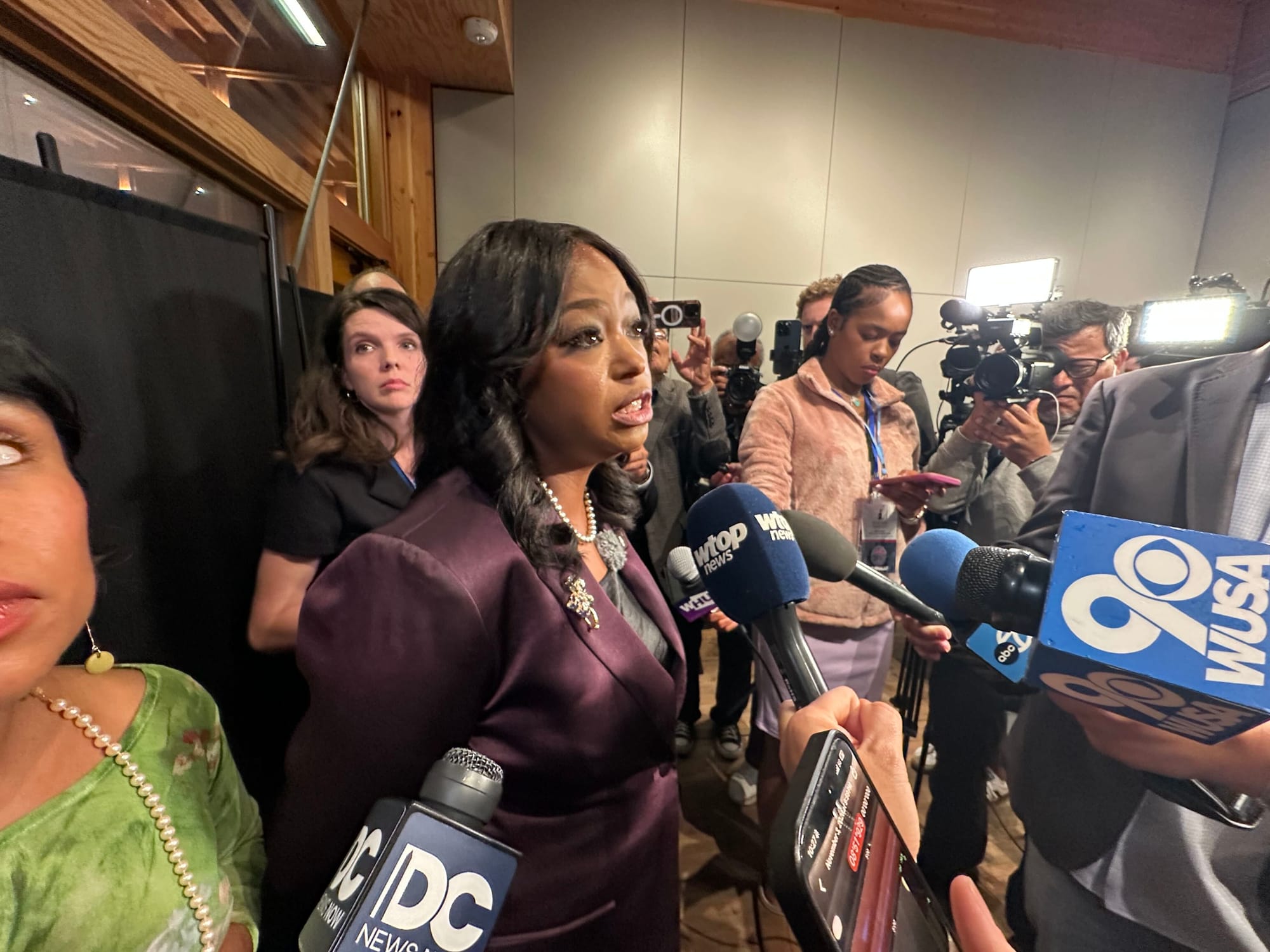
Leading up to the general election, Lewis George embarked on a listening tour across all eight wards to hear directly from residents, giving her a taste of the whiplash that often comes with mayoral life. She also attended a maternal health community forum hosted by National Nurses United in September and hosted a tenant town hall the week before the election, an indicator of other issues she’ll focus on in her first term.
While Lewis George’s win was historic, she’s inheriting a difficult set of economic and political circumstances. The District has a budget gap that could stretch upwards of $800 million dollars, the Washington region has recently seen greater job losses than any other major metropolitan area in the country, and intense scrutiny on D.C. affairs by the Trump administration could trigger federal interference at any moment.
But Lewis George is well aware of the challenges ahead. “Our vision will face doubters. Our legislation will face roadblocks. Our city will face threats to its autonomy,” she said at her election party. “But together, no one can bully us. Together, no one can intimidate us.”
Robert White won the congressional delegate race, but unlike some of the other winners of the night, he’ll have some free time on his hands before he’s sworn into Congress in January. After an eligibility provision was raised less than a week before the election, he chose to resign from his At-Large seat on Monday.
White sought legal remedies to keep his seat on the council for at least a few more weeks, but his campaign ultimately announced last week that he would step down the day before the election. “I want to make sure that there is nothing that stands between … this day and the next mission, which is on Capitol Hill,” said White at a press conference after his resignation. (There’s much more maneuvering yet to come over who will replace him, after At-Large Councilmember Christina Henderson announced on Election Day that she submitted the paperwork to change her party affiliation from independent to Democrat.)
After a decade on the council, White will be stepping into the shoes of his former boss, Delegate Eleanor Holmes Norton. Her fierce advocacy for statehood over 30 years as the District’s delegate earned her the nickname “the warrior on the Hill,” though a notable decline in energy led to public and private pressure for her retirement. In a show of support for her successor, the delegate made a special appearance at White’s election night party.
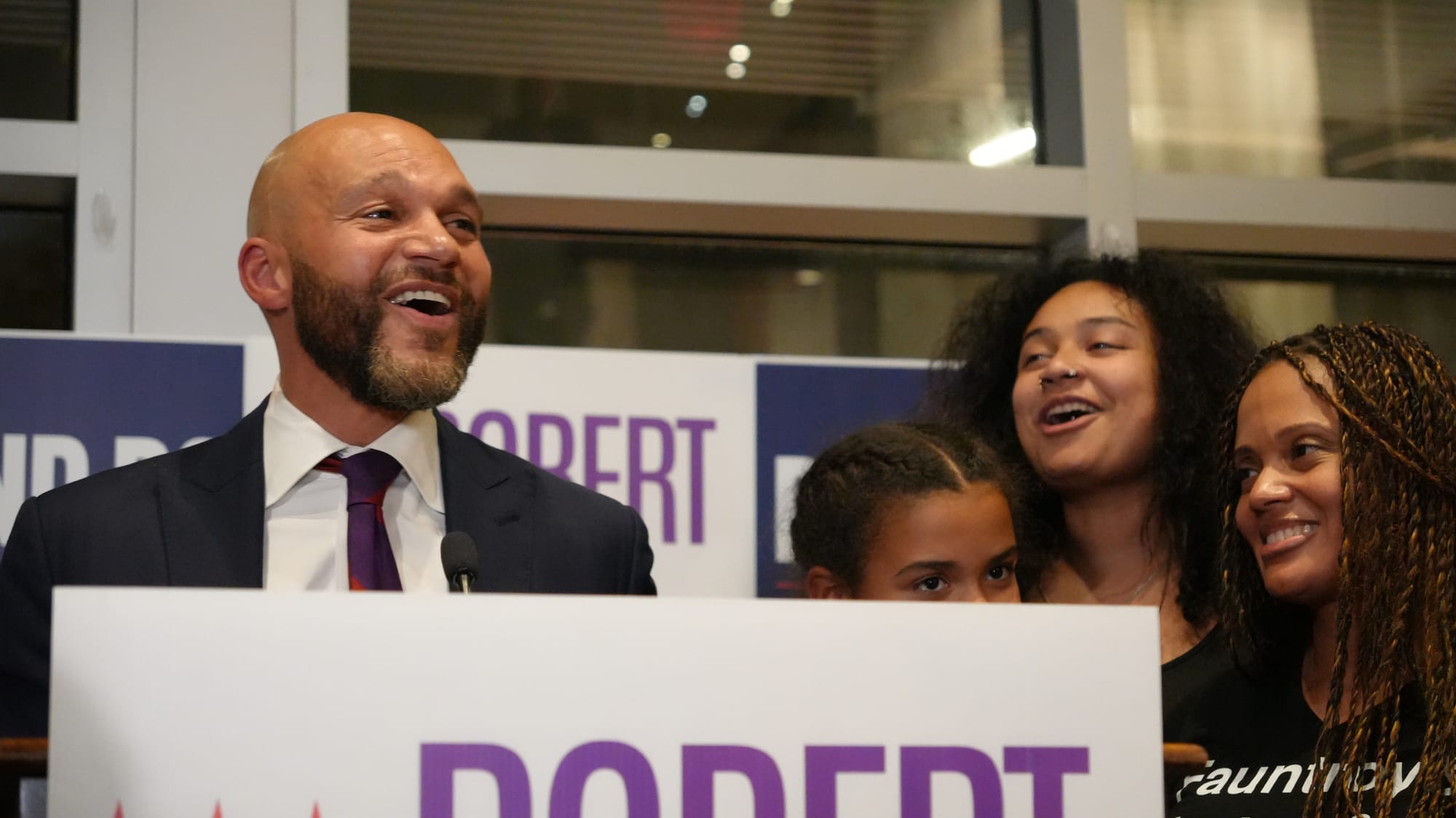
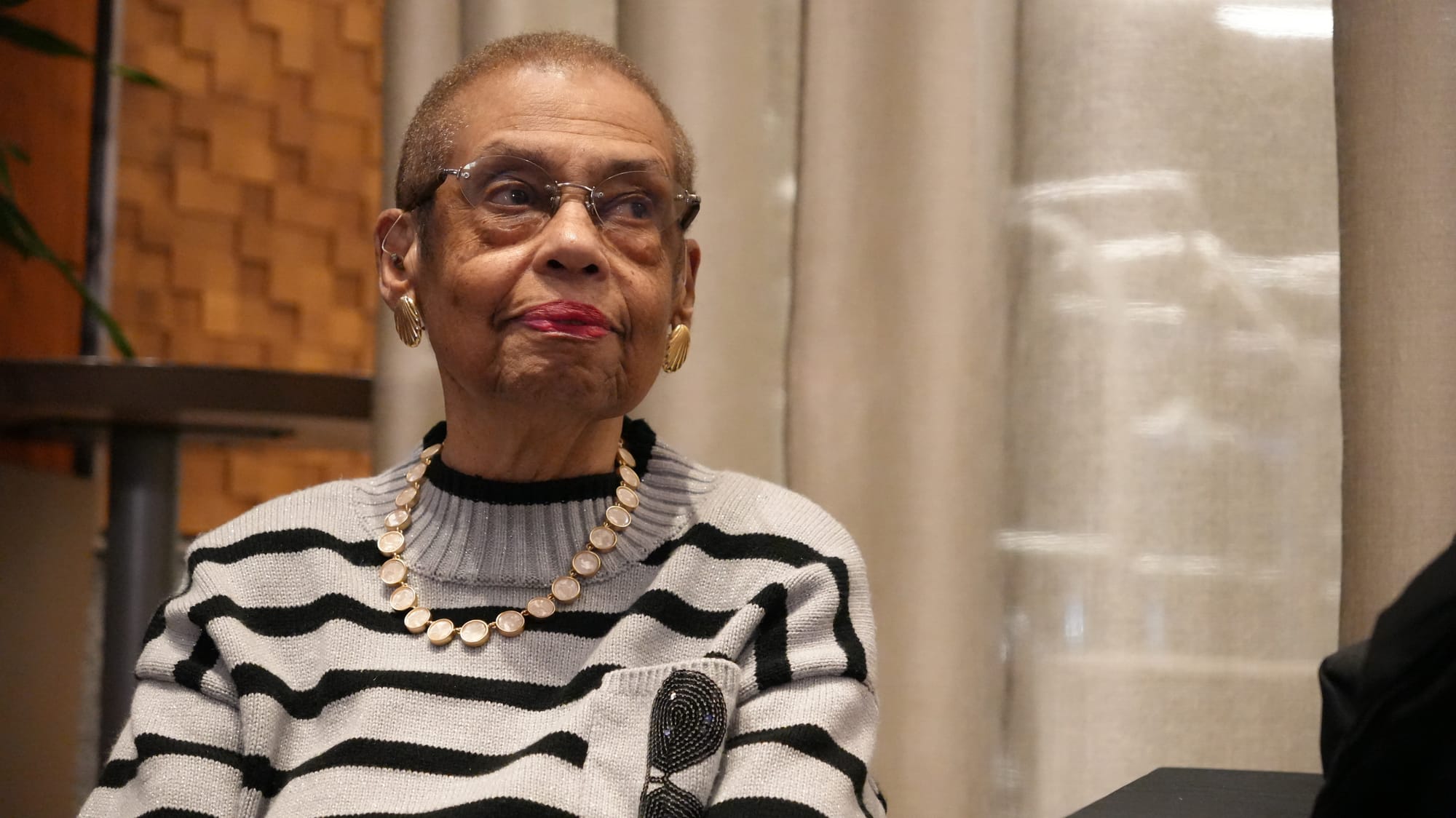
Robert White celebrates his victory with family and supporters at The Delegate (left). Delegate Eleanor Holmes Norton attends White's election night party (right). (Sam Delgado)
White will be D.C.’s third non-voting representative in the role’s history. Throughout his campaign, he laid out his ambitions, such as pursuing a seat on the House Appropriations Committee to direct more federal funds to the city and elevating the fight for statehood nationally.
White has the opportunity to approach the role differently than his predecessors, and with Democrats enjoying a blue wave on election night that could well clinch them not only the House but the Senate, he’ll have more allies to work with on the Hill. (Ahead of the midterms, White launched Defend DC, a political project that rallied D.C. residents to knock on doors for Democrats in key House districts.)
But even if Democrats have a blowout, he says he won’t let his guard down.
“We can't be fooled by the results coming in tonight. They are still going to come for us,” said White, in reference to the Trump administration and Republicans who have scrutinized D.C.'s autonomy. “And they got to know that we are going to come back for them.”
With 73% voting yes on Initiative 86, a clear majority of Washingtonians have chosen to say au revoir to foie gras — a.k.a., fattened duck and goose liver.
The ballot initiative was one of the few contentious fights of the general election. Animal rights activists gathered signatures and campaigned for months, but in the weeks leading up to Tuesday, heated debates over the ban burst out on X and Reddit.
Critics of the foie gras ban saw it as a waste of government resources, given other financial and political issues the District is currently facing, and local restaurateurs blasted it as another restriction on an already struggling industry. Some also worried the text of the ban was overly broad, and could potentially be applied to other bird-based food products.
Proponents of the ban said the process to make foie gras, which involves force-feeding to enlarge a duck or goose’s liver, is inhumane. A few other places in the U.S. have banned foie gras, including California, but not without legal challenges by producers — which could also happen in D.C.
Barring any lawsuits that delay the ban, it’s up to District leaders to fund the initiative and enforce it, which isn’t guaranteed. Aside from Owolewa, the council has shown little interest in the ban.
The implementation of ranked-choice voting this year threw a minor wrench in the works for the At-Large candidates’ campaigns. In years past, voters could pick two candidates for the At-Large seat, but now that their vote is ranked, things are more complicated.
That could have spelled trouble for independent Silverman, since the assumption was that most Democratic voters would rank Owolewa first. Indeed, Owolewa, D.C.’s shadow representative, won with 69% of the vote compared to Silverman’s 21%. But given Silverman’s wide name recognition and a less crowded race, pundits were right not to worry about her losing.
Silverman has had a few months to readjust to the job, after winning the June special election following Kenyan McDuffie’s resignation. She campaigned on issues she’s worked on before, like affordable housing, but also signaled interest in education and addressing truancy, which would be newer policy areas for her.
In a July interview on WAMU’s Politics Hour, Owolewa said one of his top priorities out of the gate would be helping residents navigate new Medicaid work requirements, which are set to start in January as part of President Trump’s One Big Beautiful Bill Act. Among his more ambitious aims is making the University of District Columbia tuition-free (it currently charges over $7,000 per year for a bachelor’s degree) to help younger residents avoid debt while pursuing higher education.
Four seats on D.C.’s State Board of Education were up for election this year, though the Ward 1 SBOE seat only had the incumbent, Ben Williams, on the ballot.
The tightest race was for the Ward 3 seat, where incumbent Eric Goulet appears to have narrowly held onto his seat with 51% of the vote after being challenged by health care policy worker and active public school parent Aaron Wesolowski. Wesolowski outraised Goulet in campaign funds and had the endorsement of the Washington Teachers’ Union, but ultimately failed to clinch a majority.
In Ward 5, Lynn Jennings bested former high school teacher Jon Alfuth with 77%. And in the Ward 6 seat, Amber Williams won with 58% of the vote, followed by Joshua Wiley at 28%.
There were more than 300 ANC races to elect the hyperlocal representatives who do the often-thankless (and always unpaid) work of connecting residents with the D.C. government. But don’t let lower stakes make you think nothing interesting happens in the world of ANC campaigning — there was plenty of drama ahead of the general election.
So who’s your next ANC? Josh Jacobson, an ANC himself, set up a website where voters can easily see the results for their district. You can see it here.
Alex Koma contributed reporting to this story.

D.C. needs artists who remain connected to the city, so we can preserve things that money, development, and time can’t recreate. Here are some tips to keep you here.

Here are three ways to make our streets and sidewalks safer, and none of them are banning electric scooters and bikes.

"Once I realized that anything could be art, I think that’s when my art changed significantly. But now I need storage because I can walk anywhere and see something and think, 'Oh, I can use this.'"


Vergie “Gigi” Arandid, owner of Binge Bar on H Street, shares her recommendations ahead of No Drink November.

With your help, we pursue stories that hold leaders to account, demystify opaque city and civic processes, and celebrate the idiosyncrasies that make us proud to call D.C. home. Put simply, our mission is to make it easier — and more fun — to live in the District. Our members help keep local news free and independent for all: