

The Commanders’ energy plans for RFK stadium are already raising alarms
The team plans to ask for an exemption to the city's climate law that would allow it to add a natural gas-burning plant, which is worrying environmentalists and lawmakers.
The team plans to ask for an exemption to the city's climate law that would allow it to add a natural gas-burning plant, which is worrying environmentalists and lawmakers.

Why we partnered with a collective of D.C. natives to produce a print edition and where you can get a copy

Get to know your neighbors, regardless of their address.

As the city faces a Black maternal health crisis, health advocates are concerned about cuts at MedStar Washington Hospital Center.


Ward 4 resident Sofya Leonova’s pregnancy was uneventful — until the very end. The 39-year-old federal government employee was receiving prenatal care through MedStar Washington Hospital Center’s midwifery team, and planned to give birth with them. If necessary, she also had the option of giving birth with the well-respected labor and delivery team in the Women’s and Infants’ Services wing.
In the final week of her pregnancy in April 2025, Leonova began experiencing contractions and took a rideshare to the hospital. Her contractions remained slow, however, and after two exhausting nights, she transferred to Women’s and Infants’ Services for a Cesarean section. During the procedure, Leonova began hemorrhaging.
By the time her son was born, she had lost a dangerous amount of blood and was unconscious. “I could have died,” she told The 51st. Leonova’s kidney had also been damaged, and later, she was diagnosed with postpartum hypertension, a serious condition that can cause seizures.
Following her delivery, she received postpartum care for three days: A team of nurses tended to her around the clock, making sure she was well enough to go home and preparing her for her new life with an infant.
The high level of care that Leonova received at MedStar Washington Hospital Center was not an outlier for the maternity services there. Located in Ward 5, the center delivers more babies than any other hospital in the District: In 2024, nearly 30% of D.C. babies were born there. The hospital serves pregnant patients across a spectrum of needs, including some of the highest-risk and sickest patients. And as a safety net hospital, the facility serves many Medicaid beneficiaries and patients from low-income households.
So local health advocates were deeply concerned when MedStar announced that it would close one of their two postpartum units on July 26 — cutting 11 beds for a new total of 18, eliminating eight nursing positions, and potentially, advocates say, disrupting the flow of the labor and delivery unit in ways that could affect high-risk patients like Leonova. “The idea that there might not be that level of care available to people is … really shocking,” she said.
The announcement comes at a moment when D.C. is already facing a crisis in Black maternal health. Birth complications disproportionately affect communities of color, especially Black families: 84% of maternal deaths in the District were Black women, despite Black adults making up 41% of D.C.’s population. While there has been a national and local decline in the infant mortality rate, it’s still four times higher for Black mothers compared to white mothers in D.C, according to data from DC Health.
And all of this data was collected before the recent Trump administration cuts to safety-net programs like Medicaid and SNAP, which are likely to seriously affect health care access and health outcomes for low-income families.
Tambra Raye Stevenson, CEO and founder of Women Advancing Nutrition, Dietetics and Agriculture (WANDA), said that MedStar’s decision to close the unit doesn’t take into consideration the broader picture of maternal health in the District. “[Given] the context of all that is happening with social protection programs being cut nationally and locally, it just helps inflame an already dire situation,” she told The 51st. The issue is personal for her: she had emergency Cesarean sections during both of her births at MedStar Washington Hospital Center.
In an emailed statement to The 51st, the hospital cited increasing financial pressures, which includes “significant changes to Medicaid” (43% of all births in D.C. are paid by Medicaid, according to the D.C Department of Health Finance), along with declining birth rates in the District as their reasoning for closing down the unit.
“The unit was not reaching capacity. We were having decreased volumes,” said Dr. Tamika Auguste, chairwoman of Women’s and Infants’ Services at MedStar Washington Hospital Center, at a July 8 D.C. Council roundtable on maternal health. Auguste added that they analyzed internal data about when the unit was full, when it was empty, and the availability of beds in the other unit, and concluded that they could shutter one of the units without changes to their services.
While MedStar Washington Hospital Center spokesperson So Young Pak told The 51st that the hospital cannot share internal data, she referred to the District of Columbia Hospital Association’s April 2026 utilization report. DCHA’s data showed that comparing April 2026 to April 2025, there’s been a 15% reduction in births across all D.C. hospitals. At MedStar Washington Hospital Center, 49 fewer babies were born in that same time frame, a 19% reduction.
“After the consolidation, we will have 18 post-partum beds, which are more than sufficient to safely and fully meet the needs of the patients we serve today and into the foreseeable future,” said Pak.
MedStar has also taken significant steps to tackle the reality of the maternal health crisis in the District. In 2020, after receiving $30 million in grants, they launched an initiative called Safe Babies Safe Moms that provided integrated clinical and supportive care for families from before pregnancy to after, improving health outcomes for the Black families who entered the program.
But for one of the community organizations that partnered with MedStar on Safe Babies Safe Moms, the decision to eliminate one of the postpartum units feels like the hospital is turning their back on their own work.
“How do you put your name on that promise and ... close the very beds where it was supposed to be kept?” asked Dr. Aza Nedhari, CEO and president of Black maternal health nonprofit Mamatoto Village, at a June rally against the unit closure.
Averie Foster, a postpartum nurse at MedStar Washington Hospital Center, spends her 12-hour shifts walking her patients through recovery: monitoring their vitals for signs of health complications, helping them manage pain, and teaching new parents how to take care of a newborn. Patients come to her unit directly from the labor and delivery unit, usually two hours after giving birth if they’re in stable condition; they typically stay for 1-4 days. “The postpartum period, especially that transition period right after birth, is very important,” Foster said.
52% of pregnancy-related deaths happen after giving birth, the majority of which happen anywhere between one day to six weeks postpartum — often from infections, severe bleeding, and heart conditions. However, despite this being the period where the majority of maternal deaths occur, many families experience the “postpartum cliff”: a sudden drop in health care and support right after giving birth.
So the care that patients receive in the first few days after giving birth is crucially important, says Dr. Lauren Messinger, the women's health clinic lead at Mary's Center, a community health center that primarily serves uninsured and underinsured patients in D.C. and Maryland. “We're talking about an incredibly vulnerable time — not just for mental health, but to physical health, to parent and infant bonding,” said Messinger.
Though she understands MedStar Washington Hospital Center has a financial justification to shrink postpartum bed capacity, Messinger is still concerned about reducing resources for maternal health: “If we have less staff and we have less space for that, and we're trying to get patients out faster, we may be missing things: early signs of postpartum complications, [and] early intervention opportunities for lack of social support they may have when they go home.”
While the birth rate in the District may be declining, nurses at the Washington Hospital Center say that the postpartum unit is often full — which can form a bottleneck in labor and delivery beds.
That was the case during a recent shift for Cambria Coughlin, a labor and delivery nurse. “Both units were completely full, and we had one [postpartum] patient who was boarding on labor and delivery,” she said. “So if that's our situation when both units are open, what's going to happen when one is closed?”
If both the labor and delivery unit and postpartum units are full, Coughlin says that leaves no space for patients in active labor, who sometimes have acute medical conditions in urgent need of treatment. That worries postpartum nurses like Foster, who is concerned that her colleagues will feel pressure to shorten their patients’ stays — and potentially not get the full care they need — so that they can free up beds for those waiting to move from labor and delivery.
MedStar spokesperson Pak said if there’s no room, the hospital will go on what’s called diversion, “allowing ambulances to direct patients to other hospitals with available resources and the ability to provide care. Existing patients are not discharged prematurely or denied care.”
But being diverted to another hospital, Messinger said, can potentially compromise the quality of care a patient receives. “That somewhere else may not have access to their medical records,” she told The 51st. “That somewhere else may not have social work services and resources like [Washington] Hospital Center has, and like the patient needs.”
Since the beginning of 2026, MedStar Washington Hospital Center’s labor and delivery unit has already gone on diversion 17 times, according to a statement from At-Large Councilmember Christina Henderson.
Some patients may also come in on their own, not realizing that the hospital’s labor and delivery beds are full. “It's especially concerning considering the population that we work with,” said Coughlin. “To see [Washington] Hospital Center specifically divesting in maternal health right now is just really unfathomable.”
Pak said that MedStar Washington Hospital Center will continue to “monitor demand and will add beds if needed to serve our community,” and later clarified that the beds themselves will remain in place in the unit, though they won’t be staffed. (After following union contract requirements, six of the nurses whose positions were eliminated will move to another unit on Women’s and Infants’ Services; two other nurses volunteered to leave the hospital.)
Two members of D.C. Council are pushing back against the unit closure. On Wednesday, from her mayoral campaign X account, Ward 4 Councilmember Janeese Lewis George called on the MedStar Washington Hospital Center to reverse the decision. “At a time when DC faces a maternal health crisis, particularly for Black women and families experiencing the greatest health disparities, we should be expanding, not reducing, maternal health capacity," wrote Lewis George.
On Monday, Councilmember Henderson, who chairs the council’s committee on health and led the recent maternal health roundtable, issued a statement with her own concerns. “I worry what a reduction in maternity beds will mean for women who need this level of critical care before and immediately after their child is born,” Henderson wrote.
Henderson (who, as she noted in the press release, has personally experienced the effects of diversion at a D.C. hospital) added that MedStar Washington Hospital Center has given “light responses” to the Committee on Health’s requests for more information on the closure decision.
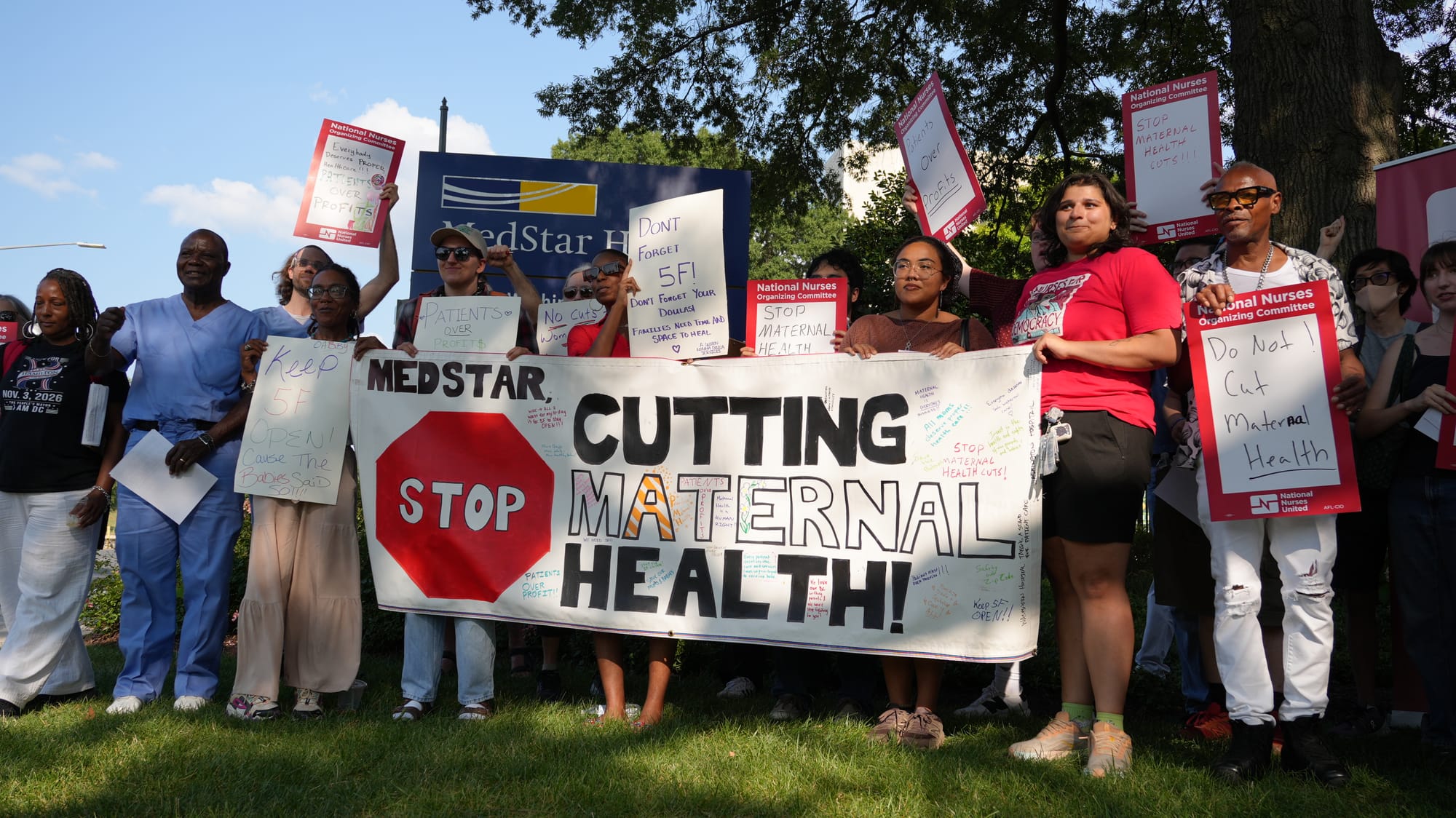
But advocates continue to fight. On Wednesday evening, dozens of MedStar Washington Hospital Center workers and their supporters gathered outside the hospital along Irving Street and First Street Northwest. Some stood along the busy road with signs that read, “Mothers and babies matter,” and “Patients over profit.” Passing cars honked their horns in support. Towards the end of the rally, nurses and their supporters unveiled a banner: “MedStar, stop cutting maternal health!”
The support that Women’s and Infants’ Services nurses have received gives some of them hope that the hospital will eventually reverse the decision, which is set to take place on Sunday. “I hope that MedStar sees the community support, the support from our coworkers, and does the right thing,” said Gianna Chacon, a labor and delivery nurse.

The recent death of a city official in a scooter collision, alongside riders landing in the ER “every week” has trauma experts questioning whether rental e-scooters should be allowed.

Facing high maternal mortality rates, the District made doula care free for Medicaid patients. But experts say the benefit isn't working out in practice.

As the iconic U Street Ethiopian restaurant prepares to close, thousands on social media shared their praise and memories

The outlet is pitching its newly robust metro section with ads and activations around town
With your help, we pursue stories that hold leaders to account, demystify opaque city and civic processes, and celebrate the idiosyncrasies that make us proud to call D.C. home. Put simply, our mission is to make it easier — and more fun — to live in the District. Our members help keep local news free and independent for all: