

Goodbye, Dukem, and thanks for 30 years of service
As the iconic U Street Ethiopian restaurant prepares to close, thousands on social media shared their praise and memories
As the iconic U Street Ethiopian restaurant prepares to close, thousands on social media shared their praise and memories

The outlet is pitching its newly robust metro section with ads and activations around town

The Revada Arts Center will be home to a theater company, film house, and “anti-opera” collective.

Ten years ago, WMATA was in dismal shape. Now, people are lining up to rep the transit system with pride.


Eager shoppers formed a line last week that spanned an entire block as they waited for the Washington Metropolitan Area Transit Authority’s newest pop-up store to open its doors for the first time.
“We have some internal joke bets going on about when we’re going to sell out of merch,” Randy Clarke, Metro’s general manager and CEO, told The 51st the afternoon before. Last year, he says, Metro sold about a million and a half dollars worth of merchandise, which even he describes as “mind boggling.”
For the staffers who get to experience customers’ enthusiasm first hand, “what that does to morale can’t really be quantified,” Clarke says. “It gives you a whole perspective, I think, of how important we are to this region and when we are doing our job well, how much we make people’s lives truly better.”
And the excitement about retro-style merch for Metro’s 50th anniversary is only the latest manifestation of a serious vibe shift regarding WMATA, which has gone from regional punching bag to communal point of pride.
Train frequency is up. Crime is down. A staggering 91 percent of rail customers were satisfied with their experience in the first quarter of this year, according to internal WMATA data. Metro even won the American Public Transportation Association’s “outstanding public transit agency of the year” award this past fall, its first time netting the industry’s biggest accolade in nearly 30 years.
That’s a sea change from the dire way Metro spent the past few decades, when there were such constant reliability issues that someone built a website for commuters to check “Is the Red Line on fire today?”
Amid years of deferred maintenance, there were two major tragedies. A collision of two Red Line trains between Takoma and Fort Totten killed nine people in 2009 (it remains the deadliest incident in the agency’s history). Six years later, a smoke incident in L’Enfant Plaza led to the death of one woman and the hospitalization of dozens more.
By 2016, Metrorail ridership had dropped so precipitously that the Washington Post called its quarterly report “unrelentingly dismal.” Meanwhile, social media users gained tens of thousands of followers by disparaging the transit system (sample Twitter handles included “UnsuckDCMetro” and “FixWMATA”). The idea of people lining up in droves to earnestly buy brown baseball caps that say “ask me about the Metro” would have been inconceivable.
There are still issues, no doubt. Frequency of buses and fare evasion, as well as concerns about employee safety come to mind. And of course, you might still face a delay when trying to get to the office. But daily ridership numbers are back up to more than 80 percent of pre-pandemic numbers during commuting hours and it seems like now, people are willing to grant the system — and the people who run it — grace.
Clarke is the face of this shift. Since becoming general manager in 2022, he has remained in the spotlight in a way that differs from his predecessors. “He’s become almost a celebrity,” says Robert McCartney, a retired columnist who covered WMATA for many years at The Washington Post.
Clarke travels the system daily and happily snaps selfies with riders. He responds to questions, complaints, and comments on social media with detailed zeal. In a can’t-make-this-up biographical detail, he met his wife on mass transportation, a story he uses to illustrate the kinds of interactions that he says simply can’t happen in a car. He’s out there making the affirmative case for public transit.
The GM doesn’t talk about “riders.” He uses “customers,” instead. “It’s not about a financial term,” he says. “It’s about that we want to earn people’s trust and earn people’s decision to use the system. And that’s what customer service is oriented around.”
Clarke has even been bandied about as a mayoral candidate, a job he says he doesn’t want.
The agency has notched significant wins under his tenure. The overhaul of the bus system. The restoration of automatic train operation after 15 years. The redesigned fare gates and tap to pay.
But some longtime Metro observers say the beginning of the system’s turnaround actually began several years earlier. Namely, they point all the way back to March 2016, when then-new WMATA General Manager Paul Wiedefeld made the unprecedented decision to shut down the entire rail system for a day so crews could inspect the same kind of jumper cables that led to the deadly smoke incident at L’Enfant.
Wiedefeld remembers that choice well. There was smoke in an eerily similar place as the fatal incident at L’Enfant. He went down there before service began. “I’m not a track engineer but I have some common sense and I’m like, ‘This is not right. I’m not getting comfortable with the answers I’m getting,’” he says. When he wasn’t satisfied with the information he received, “I said, ‘Well, in that case, we’re not moving trains.’”
He immediately got pushback from internal staff and consultants. “They said, ‘No, you can’t, because if we don’t move, the federal government shuts down,’” Wiedefeld recalls. Such are the stakes of running a transit agency in Washington. But he didn’t relent. “I think it showed that there was a new focus on safety, which was my number one and still is.”
The 29-hour shutdown had “a huge impact on traffic congestion,” recalls Rebecca Higgins, vice president of policy at the non-profit Eno Center for Transportation. “I think it made people realize how much Metro matters for commuters who take Metro – and those who don’t.” (Wiedefeld is currently serving as the interim president of Eno, so Higgins declined to comment on him directly.)
As McCartney sees it, Wiedefeld’s time in charge of WMATA was spent “playing defense.” He was trying to “stabilize the operation and get over the bad period. And I think he succeeded in making a lot of progress.”
Wiedefeld, who grew up in Baltimore, remembers when Metro first opened. “You would take out of town visitors to use this system, right? It was part of the experience of Washington,” he says, recalling that he used to take dates to see the Metro.
“My view coming into the job was like, we have let this treasure literally almost crumble at our feet,” he says. “The operators of this system literally used to wear the uniforms to church because they were so proud of the institution. That had all deteriorated.”
He instituted SafeTrack, a program focused on expediting preventative maintenance and capital work. To get all that work done in a shorter time period, trains stopped operating earlier and segments of lines were shut down for weeks at a time.
“It was extremely tough at the beginning,” Wiedefeld says. For years, Metro had erred on the side of providing service, even if it meant deferring maintenance. Wiedefeld switched that calculation. He fielded complaints from politicians, businesses, riders, and employees, whose lives and livelihoods were disrupted by the closures.
But over time, he says, it got better. Once the work was done, “it was night and day. They’re like, ‘Oh, I get it. This is the medicine I’ve got to take, but this is what we get at the other end.’”
The culture of safety extended to employees, too. He decided to hold all-hands meetings with more than a thousand of WMATA’s managers for the first time in decades to emphasize the new focus, a practice he continued regularly. And he fired inspectors who falsified records and announced it publicly. “The culture had slipped so much, so I was setting the standard internally and externally,” he says.
The system also had a far more contentious board of directors at the time. As McCartney recalls, “there was a lot of drama and a lot of infighting.” Plus, he notes that then-Board Chair Jack Evans “was prone to making controversial statements that got a lot of attention but rubbed people the wrong way.”
Trying to make the board less histrionic was part of the culture change, as Wiedefeld sees it. “When I started, the dynamic between the three member jurisdictions was pretty intense,” he says. “I basically tried to steer clear of that as much as I could.”
When the pandemic hit, Higgins says, there was a public recognition of the “essential service that [WMATA was] providing to people who needed to get to work.” She sees that appreciation reflected in Congress’ COVID relief funding, which included money for public transportation systems. WMATA invested that money back into the system, and took advantage of lower ridership to keep working on maintenance.
And then, when Clarke took over in 2022, he started “playing offense,” says McCartney. “He’s really pushed through a lot of projects that have gotten people’s attention and improved the system’s reputation.”
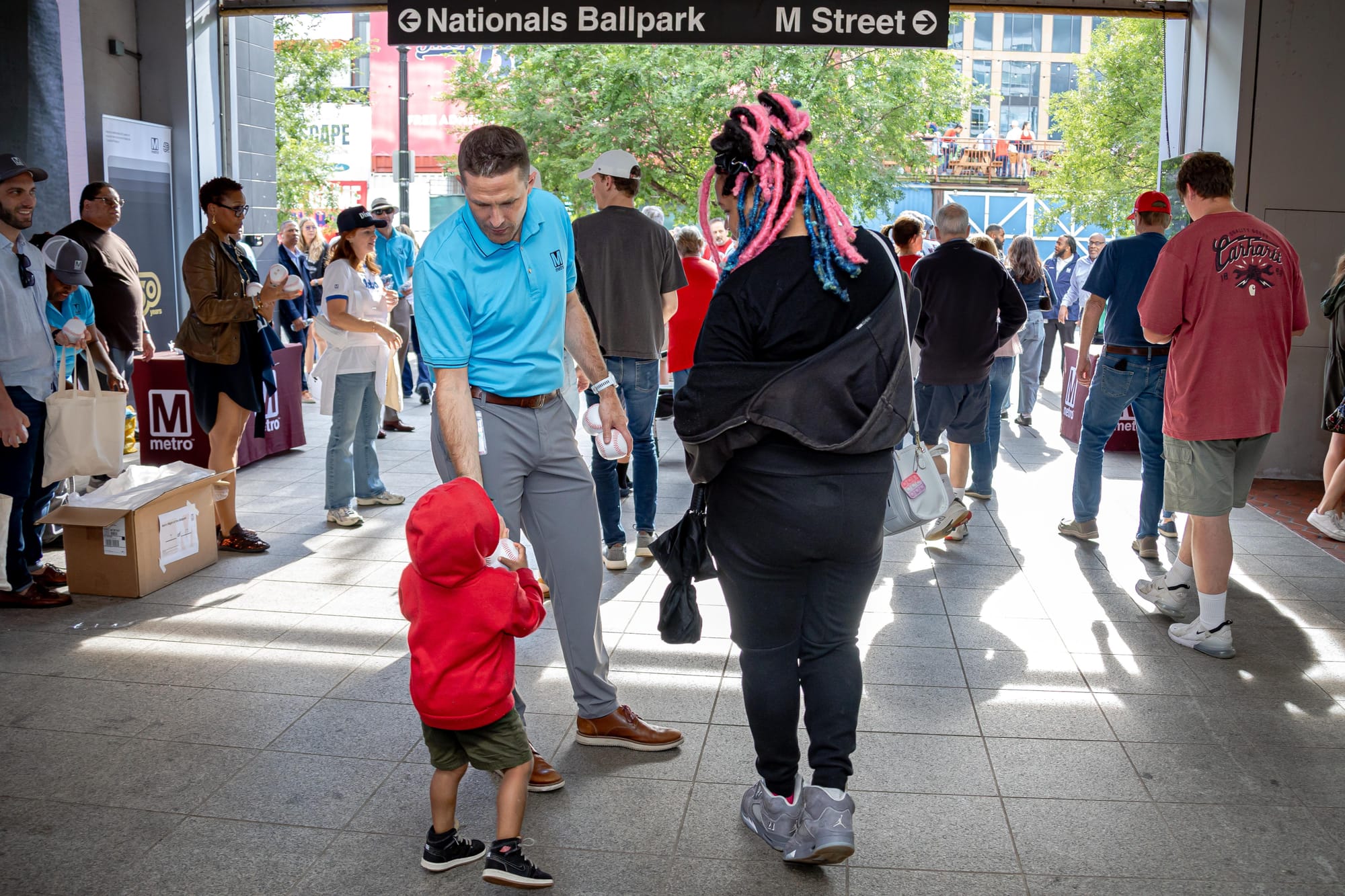
The overall strategy remains concentrating first and foremost on safety, though Clarke also has a keen interest in the details. For instance, he improved the quality of real-time bus information. “We ping a bus every few seconds on our algorithm,” he says. “When I got here, it was every 30 seconds. Now it's every three to five. … It's almost always accurate now.”
It might sound trivial, but that could be the difference between a bus waiting at a traffic light three stops back or it appearing on your block. In other words, the difference between catching the bus and watching it drive away as you sprint towards the stop.
To Clarke, part of being in the public eye is a way to focus on the system’s progress. “We are working our butts off and we’re not shy about showing that and we’re not scared of taking some ownership,” he says. “Not many institutions take that ownership … We do want the responsibility. And with responsibility comes the potential for accountability and criticism, but it also gives you the ability to really impact people’s lives.”
Kai Hall, policy manager at Greater Greater Washington and the coordinator of the D.C. Transportation Equity Network, has also noticed how Metro’s marketing and social media accounts make more of an effort to “demonstrate the human connection that transit enables.”
But he points out that bus service remains a “mixed bag.” Indeed, 76 percent of customers were satisfied with their last bus trip, 15 points lower than rail customers.
Clarke acknowledges that much of the criticism he hears these days revolves around the buses. But he says most of the problem is road traffic, a frustration that he and others at WMATA share. “The number one complaint that people have in the bus system is slowness and the reliability of bunching and gapping, which happens because of traffic,” he says. ”It doesn’t happen because we don’t know how to run buses.”
There are limitations to what Metro can do about it, because the agency doesn’t control the roads. Instead, they constantly advocate for new bus lanes.
Take Georgia Avenue as an example, where “we move 20-some thousand people a day,” Clarke says. Half of all people travelling that road each day are on a bus, but there’s only a short stretch of dedicated roadway. The District Department of Transportation has been working on a bus priority lane that spans the entire 4.5 miles for the past three years, “but, you know, we’re trying to really push that even faster.” (Simply adding more buses wouldn’t help, he says, because it would just further jam up the roadways.)
Still, Clarke can point to some recent bus improvements, including hundreds of millions of dollars of investment in bus fleets and garages. “You don't get good service on the street if you don't have a good fleet and the fleet's not maintained in a good garage,” he notes.
As for the massive effort to overhaul the bus network (otherwise known as Better Bus) last year, it was the first time in Metro history that the system saw such a major change. Despite cutting routes and stops, the changes to the network means that 27 percent more customers have access to highly frequent Metrobus service, according to data released by the agency.
But Clarke is frank about the shortcomings, too: “The network redesign overall was good, but it doesn’t mean it was great,” he says. One major reason for that? Funding. “We proposed to run more service this year, and we were not able to get that funding.”
And that brings us to what has long been Metro’s stickiest wicket. WMATA doesn’t have a truly dedicated source of funding that is indexed, so the agency has to ask for money from D.C., Maryland, and Virginia every budget season (and wait to see how much is allocated).
A plan initiated by WMATA and the Metropolitan Washington Council of Governments, the DMVMoves initiative, would instead have the three jurisdictions agree to contribute a total of $460 million annually, and grow 3% each year. Virginia included its share in its budget and Maryland pledged to do so next legislative cycle; the agency is waiting for D.C. to do the same.
That funding is ultimately tied up with WMATA’s reputation. “If you increase service and show riders what is possible and what kind of service they should expect from their transit agency, then it becomes easier to make the case to the jurisdictions that fund the agency that it is worth investing in,” Hall says.
So where does the vibe go from here? “I don’t want to sound weird about this, but I’m not sure we go higher,” Clarke says. He and other members of senior staff have worked in transit for a long time and “I don’t know if I’ve ever seen anything like this. When it’s bad in transit, it feels real bad.”
These days, though, it’s feeling pretty good. “People feel that they can count on us,” Clarke says. “And maybe once a month they have a crappy day or twice a month. But guess what? If you’re in traffic, you’d have nine a month.”
As for Metro’s anniversary pop-up, it closed 10 days early. Pretty much everything had already sold out.
But in this new congenial public era, the transit agency is giving the people what they want: the shop will open back up with restocked items on Monday.

The outlet is pitching its newly robust metro section with ads and activations around town

A new Obama Center sculpture honoring Harriet Tubman has thrust one of the District's most talented artists into the national spotlight.

Domo Wells’ designs for women’s soccer merch have deep roots in D.C. culture.

Our reporter survives an overnight journey of ambient music — and the soul — at Rhizome.
With your help, we pursue stories that hold leaders to account, demystify opaque city and civic processes, and celebrate the idiosyncrasies that make us proud to call D.C. home. Put simply, our mission is to make it easier — and more fun — to live in the District. Our members help keep local news free and independent for all: