

The Commanders’ energy plans for RFK stadium are already raising alarms
The team plans to ask for an exemption to the city's climate law that would allow it to add a natural gas-burning plant, which is worrying environmentalists and lawmakers.
The team plans to ask for an exemption to the city's climate law that would allow it to add a natural gas-burning plant, which is worrying environmentalists and lawmakers.

Why we partnered with a collective of D.C. natives to produce a print edition and where you can get a copy

Get to know your neighbors, regardless of their address.

Meet the “Swiss Army knife of trail maintenance crews.”


This article was produced as part of HumanitiesDC’s Community Journalism Program.
Natty McAlpine crouches down to point out an invasive garlic mustard plant on the edge of the Marvin Gaye Trail in Ward 7, showing a small group of volunteers how the plant’s leaf shape reveals its age. He plucks it out by its roots before instructing the group how to tackle their main target for the day: the invasive English ivy crawling up trees beside the trail.
McAlpine, who was leading a monthly “Bicyclists Against Invasive Vines” event that Saturday morning, is one of six year-round trail rangers who serve as stewards of more than 25 miles of D.C.’s paved trails, keeping them in good condition and helping people make use of these outdoor resources. He describes the trail rangers as the “Swiss Army knife of trail maintenance crews.”
They bike along the trails in electric cargo bikes, picking up litter and debris, cutting back overgrown vegetation, managing invasive plants, helping out trail users, and relaying repair needs and other issues to the appropriate government agencies. They also lead volunteer and outreach events on the trails, including trash cleanups and a monthly morning coffee hour. Over the years, they’ve logged thousands of instances of maintenance and service work.
“We’re on bikes, we’re doing this work from a human level, so we’re experiencing what pedestrians and cyclists are experiencing in real time,” he explains.
The program, which is run by the Washington Area Bicyclists Association with funding from the D.C. government, was created in 2013. Rangers work on the Anacostia Riverwalk, Metropolitan Branch, Oxon Run, Marvin Gaye, 295/Malcolm X Interchange, Suitland Parkway, and Klingle Valley trails, all of which D.C. agencies are responsible for maintaining. (Disclosure: this author is a member of WABA).
Most of these multi-use trails are separated from roadways, making them safer and more accessible for a variety of trail users, from a kid on a bike to someone roller skating. (Other paved trails on federal land in D.C., like the Capital Crescent Trail and Rock Creek Trail, are maintained by the National Park Service instead.)
Trail rangers’ weekday work shifts start at 6:30 a.m. Depending on the day, pairs of rangers either bike along the trail and respond to what they find or head to a specific trail section to tackle issues they scouted out previously. Their work bikes are packed with an eclectic grab bag of anything that they or other trail users might need — a bike tire pump, trail maps, trash bags and grabbers, saws and pruning tools, gardening gloves, a leaf blower, a dust pan and brush for broken glass, among other items.
The Trail Ranger grant, issued by the District Department of Transportation, initially only covered summer work but expanded to year-round service in 2022 with $680,000 in annual funding. It allows WABA to employ a full-time crew, including the six year-round rangers (four field staff and two program managers), a director, and a couple of summer rangers.
While the grant agreement outlines baseline requirements (such as how often to visit specific trails), they often do much more than what’s required, according to McAlpine. This year, for example, the rangers hacked away at snowcrete on the trails.
“This job is tough,” said McAlpine, who has worked the trails for three and a half years. He remembers a day when fellow crew member Agyei Williams carried out 92 tires that were illegally dumped by Oxon Run.
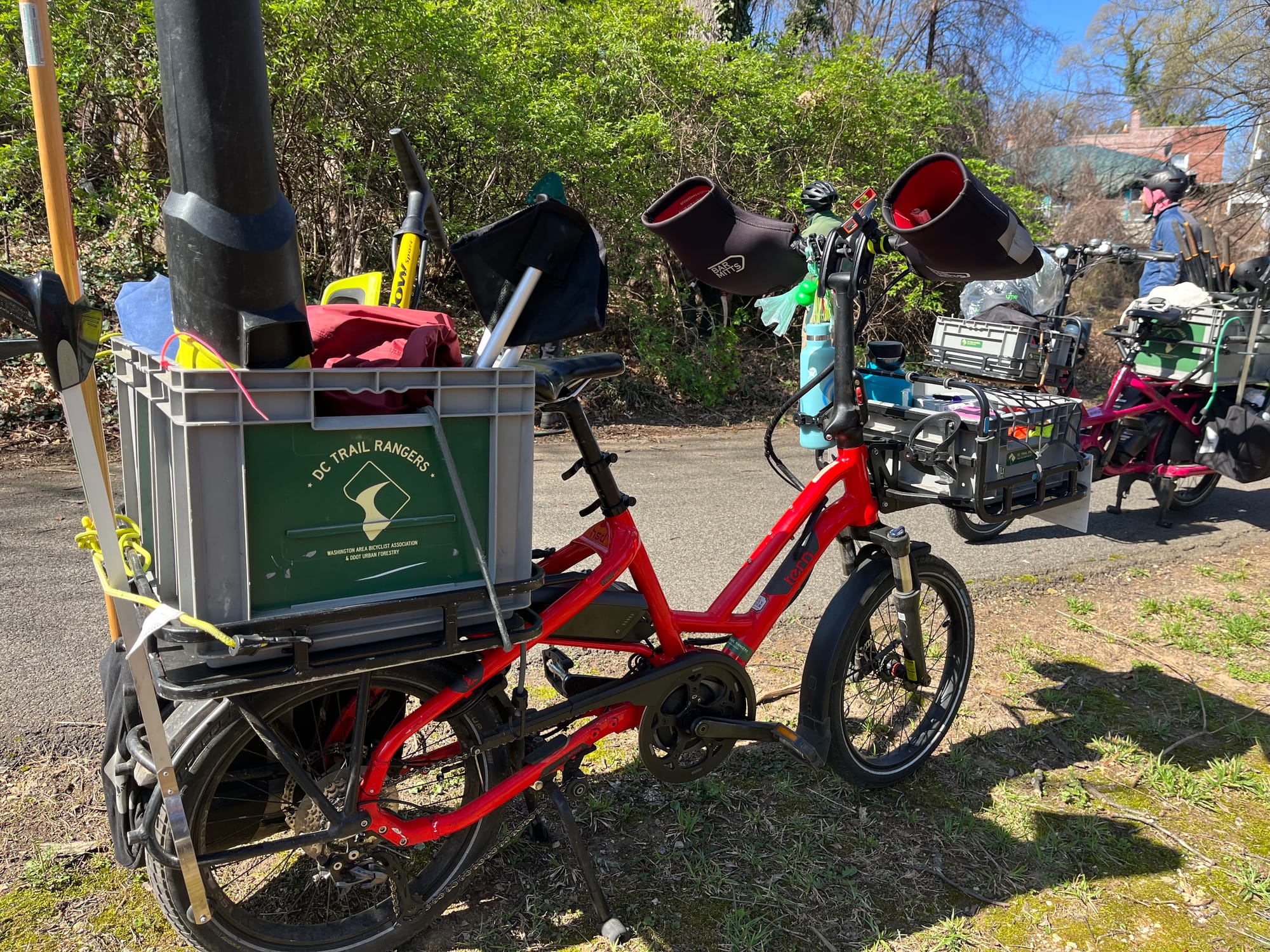
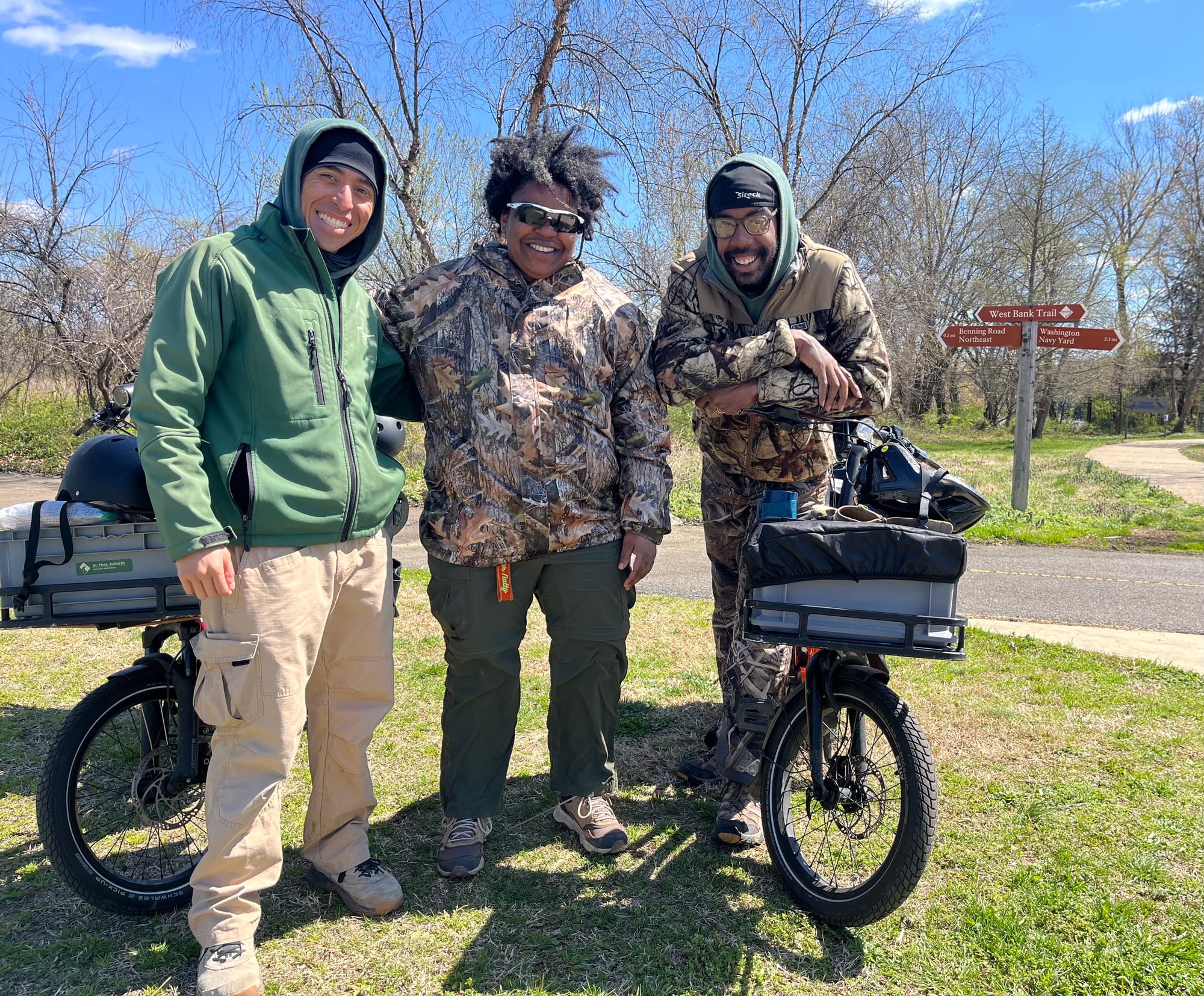
Trail Rangers Alvin Zepeda, Natty McAlpine and Agyei Williams (left to right) take pride in maintaining over 25 miles of D.C.'s bike trails; their cargo bikes are packed with anything and everything they might need. (Sarah Loftus)
Williams, who’s been a trail ranger for a little over four years, lives within a mile of the Oxon Run Trail. “I show up on all the trails, but there’s a little extra in the tank when we’re in Ward 8 and Ward 7,” he said. Through his bike commute and spending time with his kids, he said he gets to see the result of the rangers’ work and takes a lot of pride in seeing those areas taken care of.
People passing on the trail sometimes recognize the rangers and thank them for what they do. “It’s those kind of moments where I feel like a superhero and why for me I get a lot of fulfillment in just being of service and doing what I’m doing with the team,” said Alvin Zepeda, who has been doing the work for a little over a year.
Events like Bicyclists Against Invasive Vines have also earned some regular volunteers, such as longtime cyclist Abby DeRoberts. “When I saw a cycling organization taking on the invasive plants, which have a huge impact on the landscape of our bike trails, I was very excited to step in and do something where I could actually make a difference,” she said.
Over the past two years of that series, ranger-led volunteers have released over 400 trees from the grip of invasive vines that can smother native plants and destroy habitats.
John O’Neill, an arborist and lawyer with DDOT’s Urban Forestry Division who administers the Trail Ranger grant, said the rangers are a high-performing, autonomous group.
He recalled how the group initiated trail work days on the Suitland Parkway Trail. While they regularly inspect the trail, the rangers aren’t able to perform regular maintenance due to its unsafe proximity to a busy road. So they partnered with DDOT staff who could divert traffic around the trail work and offer tree expertise.
“It almost feels like we’re assisting them, and we’re very grateful for it, because our attention is often pulled in a lot of different directions because we’re managing trees all over the city,” said O’Neill. “The end result is that the trail is maintained to a much higher standard than it would be otherwise.”
That standard of care was evident as rangers guided the vine-wrangling cyclists along winding sections of the Anacostia Riverwalk and Marvin Gaye trails, pointing out invasive Bradford pear trees blooming with white flowers, offering assistance to those stopped on the trail, and removing trail obstructions – like an abandoned scooter.

The outlet is pitching its newly robust metro section with ads and activations around town

A new Obama Center sculpture honoring Harriet Tubman has thrust one of the District's most talented artists into the national spotlight.


Domo Wells’ designs for women’s soccer merch have deep roots in D.C. culture.


Our reporter survives an overnight journey of ambient music — and the soul — at Rhizome.
With your help, we pursue stories that hold leaders to account, demystify opaque city and civic processes, and celebrate the idiosyncrasies that make us proud to call D.C. home. Put simply, our mission is to make it easier — and more fun — to live in the District. Our members help keep local news free and independent for all: