

The 51st in print!
Why we partnered with a collective of D.C. natives to produce a print edition and where you can get a copy
Why we partnered with a collective of D.C. natives to produce a print edition and where you can get a copy

Get to know your neighbors, regardless of their address.

The recent death of a city official in a scooter collision, alongside riders landing in the ER “every week” has trauma experts questioning whether rental e-scooters should be allowed.
The delicious fruit is abundant throughout the D.C. region. Here's how to get your paws on “nature’s best kept secret.”


A month ago, if you’d asked me what a pawpaw was, I would have said it’s a Southern nickname for grandfathers. Or that it had something to do with an animated children’s series about heroic puppies.
I certainly wouldn’t have guessed that it’s the largest edible fruit native to North America — or that it’s gained a cultish fanbase in recent years, including a nearly 26,000-member Facebook group that calls it “nature’s best kept secret” and a booming subreddit where thousands of people show off their hauls. In September, which is peak pawpaw season in the mid-Atlantic (the fruit grows on trees near bodies of water throughout D.C., Maryland, and Virginia), pawpaws are everywhere once you start looking. They also grow throughout the Midwest and most eastern states, as far west as Texas and all the way north to Canada.
Pawpaws are a fruit that resemble smaller, yellowish-green mangos — and taste like them, too, with a hint of pineapple and banana. They were a favorite of George Washington and have long been part of the diet of several Native American tribes. They belong to the Annonaceae (or “custard apple”) family, along with more than 2,400 species found most commonly in tropical regions. Their large, green leaves require lots of moisture, so they do well in the D.C. region’s high humidity: Michelle Obama even planted a pawpaw tree in the White House kitchen garden.
“We're part of what's called the Pawpaw Belt, where they're just naturalized and really thrive,” says Michael Judd, a self-described edible landscaping educator who published the book, For the Love of Paw Paws. Judd hosts an annual PawPaw Fest at his homestead in Frederick, Maryland, where he’s grown more than 100 pawpaw trees, including around 30 cultivars — trees grown through deliberate breeding and cross-pollination — which he says produce the tastiest fruit.
Under ideal conditions, the trees can produce up to 50 pounds of fruit each, Judd says, but their thin skin means they bruise easily and don’t transport well, which is why you won’t find them on grocery store shelves. He recommends eating pawpaws in small quantities since they’re rich in nutrients and will “clean you out,” gastrointestinally speaking. There are other reasons to enjoy in moderation: the large, black seeds are considered toxic, so you’ll want to scoop those out before eating the custardy middle, and the pulp is known to contain a neurotoxin called annonacin. (In general, there’s an ongoing debate about the fruit’s toxicity, as well as its potential as a cancer treatment.)
Judd’s festival isn’t the only one dedicated to the cultivated varieties: there’s another in Paw Paw, West Virginia. The majority of pawpaw eaters, however, are probably casual foragers, as wild-grown pawpaws are abundant throughout the region. If you’re looking for pawpaws in the wild, just don’t ask Bluesky user Eggbutt Snafflebit, who wrote, “No way am I sharing my secret pawpaw location,” when I asked our readers for recommendations.
But while Eggbutt won’t share, others suggested searching “pawpaw” or its scientific name, “Asimina,” on tree databases here and here. Hint: If you see a zebra swallowtail, you’re getting closer — the beautiful butterflies rely on pawpaw tree leaves as caterpillars.
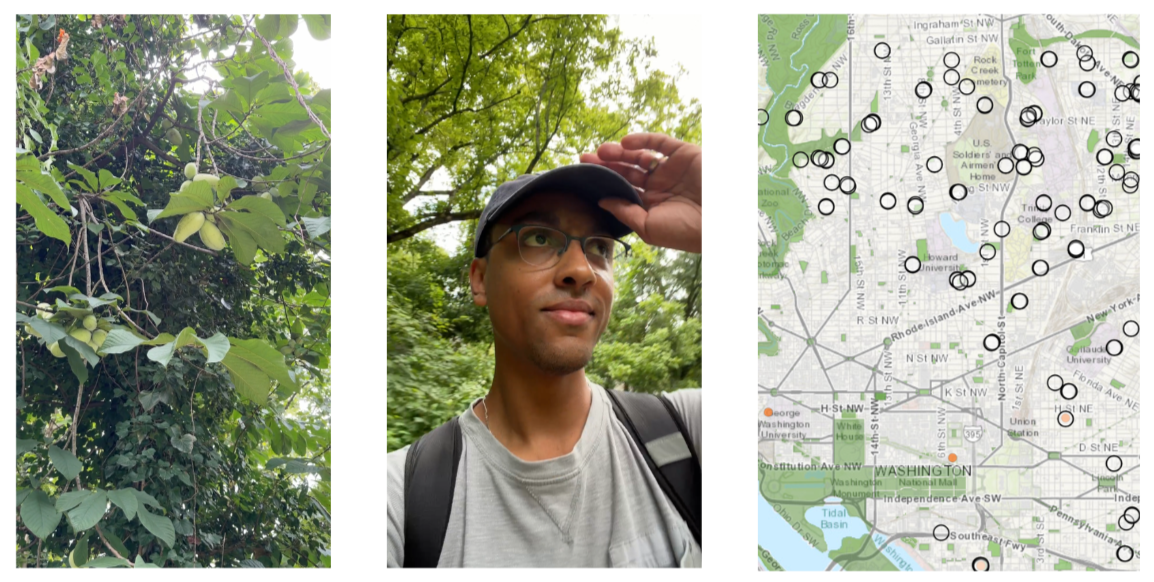
My own curiosity led me on a two-hour solo foraging expedition near Cabin John, a wooded area in Montgomery County and, more specifically, along the C&O Canal towpath, which runs parallel to the Potomac River. I gently shook enough trees to harvest over a dozen of the fruit and found the most success near canal Lock 7, which has a convenient parking area right off the Clara Barton Parkway.
I went foraging alone, but I’d recommend pawpaw gathering with an experienced friend. It took me, a first-timer, quite a while to spot the trees, which were further off the trail and taller than I expected. I’d suggest bringing a grabber tool to collect fallen pawpaws, but don't use it to grab fruit directly from the tree; they don't ripen very well once harvested, and you may damage unripened clusters. (Apologies to the hiker I scared when I emerged from the bushes with a handful of mysterious fruit.)
While on the trail, visitors are permitted to harvest up to half a gallon each day. The National Park Service, however, bans people from collecting fruit in most other federal parks, including Rock Creek Park and Roosevelt Island. In general, it’s smart to look up rules wherever you plan to pick.
To skip the foraging, you can find delicious pawpaws throughout September at several local farmers markets, including Fresfharm's Dupont Circle and Downtown Silver Spring markets — though in lower quantities due to weather patterns this year, including a late-spring freeze.
Local collectors are even known to sell pawpaws by the pound on Facebook marketplace. Plus, the occasional local chef will offer a pawpaw-flavored dessert during the season.
Alex Bilaro, a Silver Spring-based chef and forager, discovered pawpaws a few years ago and calls their flavor “sublime.” For his hand-crafted dessert business, Umai, he crafts a sorbet that blends pawpaws with a hint of passionfruit and Tahitian vanilla, which he dubbed The Passion of Paw.
“Out of all the sorbets I've made, that [flavor] is said to be on the pantheon of everything … the best,” Bilaro says.
Similarly, Poplar, the locally sourced restaurant on Kennedy Street NW in Brightwood, offers at least one pawpaw-infused dish each summer. Executive Chef Iulian Fortu, a local forager, says the late-spring frost killed off many fruit trees this year. Still, he’s hopeful there will be enough pawpaw fruit to add them to the menu this season.
“Pawpaws kind of grow everywhere around here,” he says, “if you know where to look.”
This story has been updated to clarify that you shouldn't pick pawpaws directly from the tree; and to reflect that, due to low supply from a late-spring freeze, several farmers markets around D.C. will have fewer pawpaws this season.

Get to know your neighbors, regardless of their address.

Facing high maternal mortality rates, the District made doula care free for Medicaid patients. But experts say the benefit isn't working out in practice.


As the iconic U Street Ethiopian restaurant prepares to close, thousands on social media shared their praise and memories

The outlet is pitching its newly robust metro section with ads and activations around town

With your help, we pursue stories that hold leaders to account, demystify opaque city and civic processes, and celebrate the idiosyncrasies that make us proud to call D.C. home. Put simply, our mission is to make it easier — and more fun — to live in the District. Our members help keep local news free and independent for all: